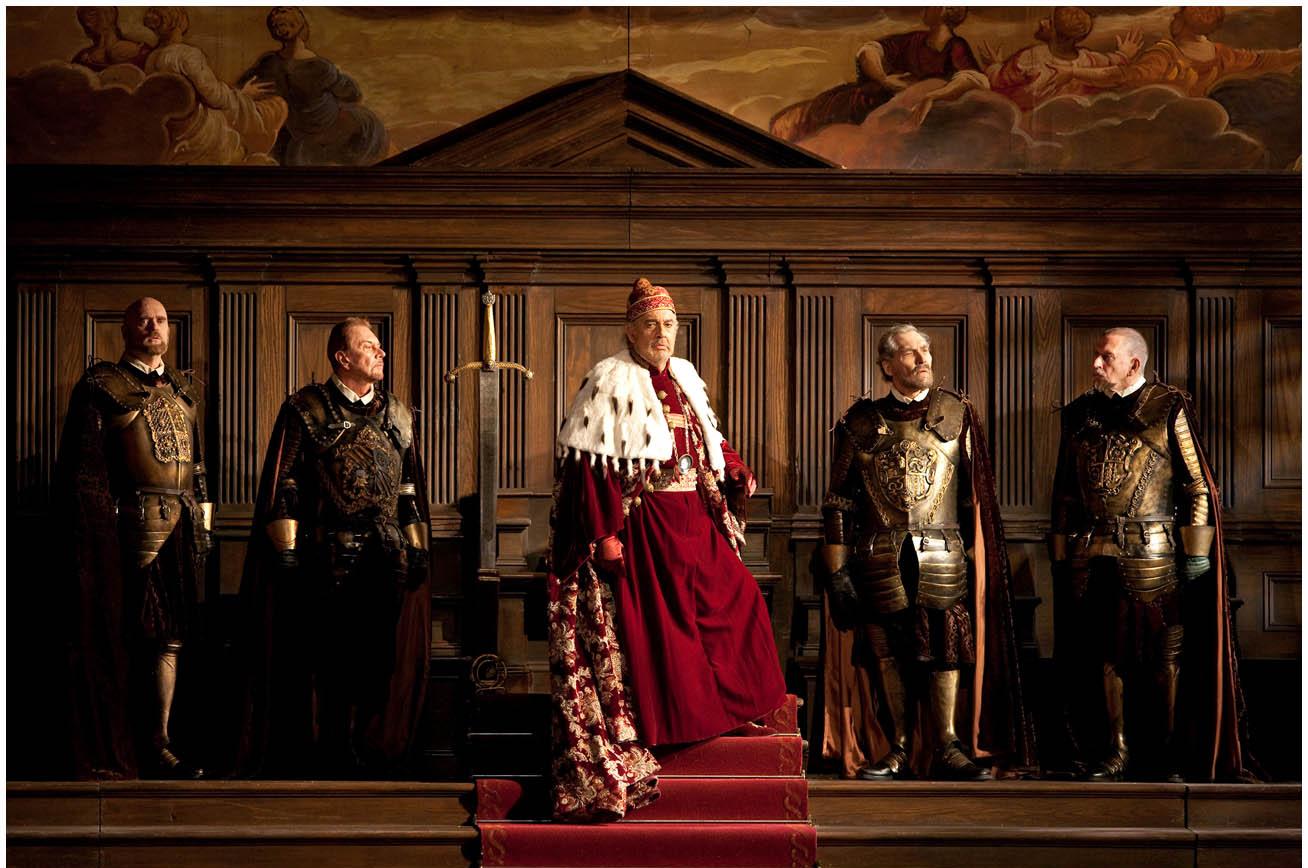
Monday January 25, 2010 – Above, Placido Domingo as Simon Boccanegra in the Council Chamber scene of the Metropolitan Opera production of the Verdi opera. Photo by Mary Sohl from the Met website. Click on the image to enlarge.
Placido, who has been singing professionally since 1957 and who I first heard at the New York City Opera in 1966, recently made the decision to take on the great Verdi baritone role of the Doge of Genoa and it has turned out to be not only a career-extending role for him but also one of the most truly satisfying and impressive vocal and dramatic performances of the past quarter century.
Domingo is in fact the last man standing who was part of the ‘last’ golden age of opera which began fading out in the early 1980s. He sang with Tebaldi, Nilsson, Price and Sutherland in a period when the singing was what made opera vibrant. Blessed with the greatest asset a singer can possess – a unique and immediately identifiable timbre – Domingo, like the ladies he sang with, made a personal mark on many of the great operatic roles.
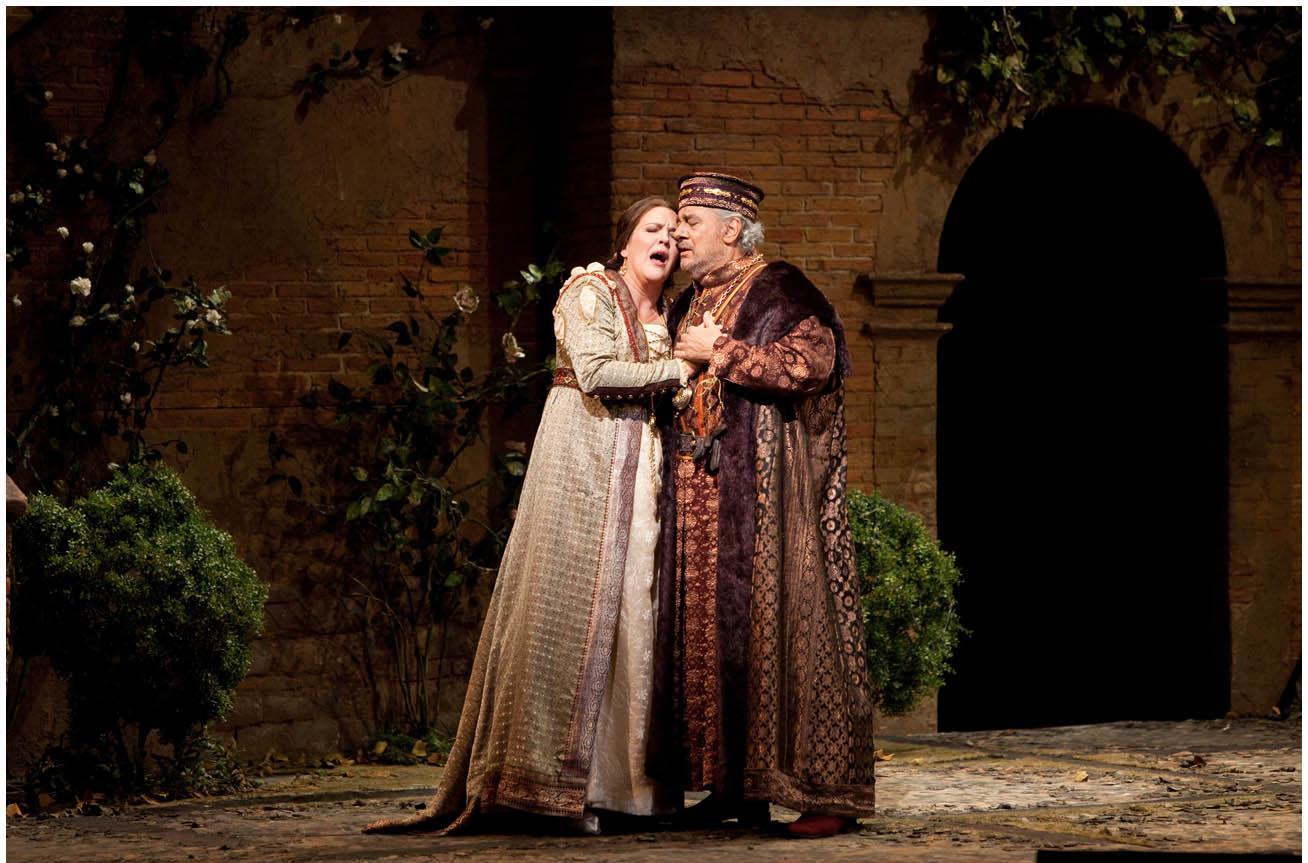
And now he has done so again, with Boccanegra. Firstly, there is the sheer presence of the voice – a truly Met-sized sound that fills the big space effortlessly and projects clearly at any dynamic. Then there is the instinctual Verdi style, the legato and portamento so expressively used, the words always so clearly declaimed and the vocal coloration so emotionally apt. His physical portrayal – including a couple of very risky falls – is uncomplicated and devoid of melodrama: he doesn’t act, he just is. And finally there is the simple generosity of spirit which has been an essential component of his career. Photo above: Adrianne Pieczonka & Placido Domingo in the great father-daughter duet. Photo/Mary Sohl from the Met’s website.
Yes, of course: this is a tenor sound singing in the baritone range. But after only a phrase or two, the ear is tuned-in and Domingo just lets it roll. From the anguish of finding his beloved ‘s corpse thru the elation of meeting his long-lost daughter to the authoritative declamation of the Council Chamber scene and on to the poetic expressions of tenderness as he dies in Amelia’s arms, Domingo was magnificent. Well-supported by Levine, Placido phrased so generously with many sustained notes in the upper reaches of the role, and a spine-tingling prolonged piano on the word ‘Figlia!’ at the end of the recognition scene.
The rest of the cast gave of their respective best: Adrianne Pieczonka, best known for her excellent Sieglinde, seemed miscast to a degree. But despite some edginess here and there, she was successful in modulating her voice which has the power and warmth needed if not always the delicacy of expression. Marcello Giordani gave another maddeningly uneven performance – he could be sublime one moment and sloppy the next – but his singing had a strong emotional undercurrent and in his best phrases he was impressive, and his singing had the right Italianate throb. James Morris has kept his voice ‘up’ for so many years singing Wotan, Hans Sachs and the Dutchman and now suddenly he wants to go back ‘down’ to plumb the depths of the music of Jacopo Fiesco. Unfortunately it didn’t work: his lower range has little resonance now and so for all his good intentions the role lost its profundity. Patrick Carfizzi had an excellent opportunity as Paolo Albani and seized it with a strong vocal and dramatic portrayal of this creepy, duplicitous character. Richard Bernstein’s Pietro was also powerfully sung.
The orchestra played grandly under Maestro Levine’s baton; I always feel he rushes the tempo of Amelia’s opening aria but perhaps he does it to accommodate the breath-control of his soprano. A couple of times the brass playing covered the singers but the overall sweep of the music with its leitmotif characteristics was beautifully served.
Domingo won a big volley of cheers when he stepped out for his solo bow, and then in the next group bow Levine held Placi onstage after the other singers had walked off. It was a nice salute to the great tenor but of course as soon as the houselights came up everyone dispersed. In the old days there would have been a fifteen-minute ovation…confetti…the asbestos curtain stopped in its tracks.
 Oberon's Glade
Leave a comment