Tuesday March 20, 2012 – I have no one to blame but myself, really. When the Met calendar for the current season came out, I skipped easily over MACBETH even though it is an opera I love: “Not with that cast!” But then a few weeks ago I was listening to the Leinsdorf recording and decided it would be good to experience MACBETH in the opera house. Despite the currrent Met trend for unmemorable productions and often brainless casting, I decided to give it a try.
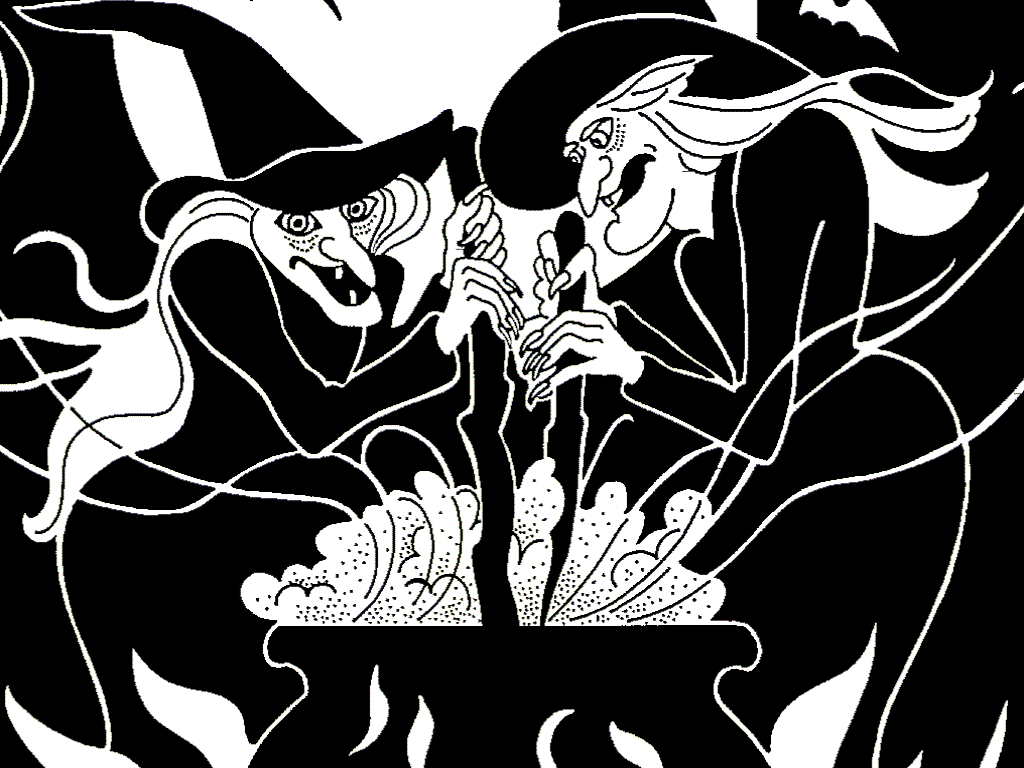
I’d seen this production before; I love the huge moon with the black, scudding clouds that fills the proscenium as we wait for curtain-rise. But then the opera starts with the trivialized witches in 30s housedresses, coats and purses (each purse contains lightbulbs, how clever!). They are not sinister or even mildly interesting dramatically. And thus the production is off to a ho-hum start, and proceeds on its dreary way with injections of blood and vomit meant to shock us. It doesn’t work.
Gianandrea Noseda is often a fine helmsman at the opera, but tonight his MACBETH was workaday, and the chorus seemed uninspired. I very much liked the firm and dark-hued basso of Gunther Groissbock as Banquo; to hear his aria would have been the only reason to stay longer than we did. But not reason enough.
Over the years I have greatly enjoyed Thomas Hampson’s performances at The Met, but although he’s been fine in the more lyrical Verdi roles of Posa and Germont he simply doesn’t have what it takes for the big-guns parts like Boccanegra or Macbeth. It’s a bit like the borderline between a Merrill and a Warren: the former never trespassed into the Nabucco/Boccanegra/Macbeth region which suited (or would have) the latter so well. It’s a matter of amplitude. The sound of the Hampson voice is still fine, steady and more resonant than I expected. But it’s not Italianate in the least, it doesn’t billow and bloom with the turns of phrase or sail grandly on the words. Verbal over-emphasis, a common gimmick for over-parted singers, was a distration in a few places, as was a tendency to be ever-so-slightly sharp pitchwise. Yet still there was a lot to admire in his vocalism.
I’d heard Nadja Michael about ten years ago singing the mezzo part in the Verdi REQUIEM at Avery Fisher Hall. She sounded awful. Of late her name has cropped up as Salome in a European production that has made it to DVD (so many productions do these days, god knoweth why). I was expecting nothing from her vocally as Lady Macbeth, and that’s what I got. I’ve heard lots of bad, unattractive or hopeless singing in my day but usually it either has to do with a ‘beloved’ singer being past his/her prime, or a perfectly respectable singer attempting a role beyond his/her capabilities, or being indisposed but giving it a go to ‘save’ the evening. In these instances, you can usually still perceive that there is a real instrument at work but just not suited – for whatever reason – to the task at hand. There’s no such excuse to be made for Ms. Michael: this is how she sounds.
Obviously no one at The Met these days knows or cares enough about singing to have sorted this out in advance. Would this woman have passed an audition for the East Buttfcuk, Idaho community choir? I dunno, but somehow she’s entrusted with a great Verdi role at The Met. Her first aria was a mess and wtf is up with giving her a repeat of the cabaletta? Once was more than enough: the voice is shallow, desperate, breathy, wobbly, harsh and grossly unpleasant. Some people have said: “At least she has the high notes!” Yeah, if ill-pitched, desperate screeching counts. Following “Vieni, t’affretta” there was one prominent ‘brava’ (husband? manager? paid goon?) and one boo from a neighboring box, plus tepid applause for an aria that should bring down the house. There was also an oddly rustling sound to be heard which I soon determined to be the joint spinning in their graves of Callas, Rysanek, Nilsson, Dimitrova and Verrett.
The booer got up and left; I eyed my friend Alan to see if he was ready to leave but the opera was going forward and I didn’t want to cause even a slight disruption for those around us, so we stayed on thru the end of the great ensemble that marks King Duncan’s murder. Luckily no one attempted the traditional top note to crown the choral finale. I would like to have heard Mr. Groissbock’s aria but that meant listening to “La luce langue” first. No way.
Despite the mess she made, Michael won’t be bought out. The Met can’t afford to do that anymore. So if she shows up, ready to sing, she sings and gets paid leaving the audience with the stick end of the lollipop. One might wish for her to vanish from the scene, but apparently they have her down for BLUEBEARD’S CASTLE two seasons hence. I won’t go to that, regardless of who sings the Duke.
Alan and I staggered down to the Plaza in disbelief at what we’d just heard. There’s no excuse for it, really. A sad commentary on the state of things at The Met. And then there were all those empty seats…
 Oberon's Glade
Leave a comment