
More Wagnerian treats have come my way, thanks to Opera Depot and to Dmitry’s generosity in making me copies. I have a ‘new’ (to me) TANNHAUSER, and an Act I of WALKURE, and a complete GOTTERDAMMERUNG to enjoy on these long Winter afternoons.
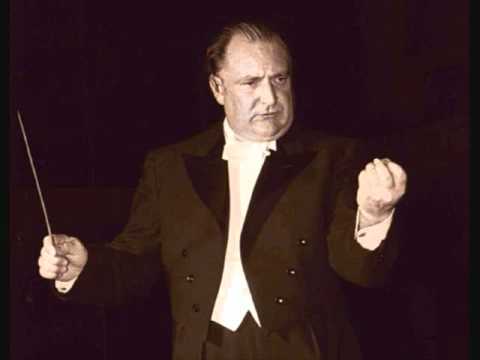
I played the WALKURE Act I first; it comes (as does the GOTTERDAMMERUNG) from a 1959 Covent Garden RING Cycle conducted by Franz Konwitschny (above). This Cycle does not seem to be readily available in the USA, but it was on special offer at Opera Depot so Dmitry snatched it up since one can never have too many RING Cycles.
Konwitschny opens with a superbly-paced prelude; it’s slightly on the fast side but gives an uncanny feeling of relentless pursuit: Siegmund is the prey and little does he know that he’ll find shelter in the very home of his pursuer. Ramon Vinay, who sang Siegmund in the 1953 Keilberth RING from Bayreuth, sounds more baritonal here – six years later – and tends he to be a bit more declamatory in his approach. Amy Shuard, who was to be Brunnhilde for Solti at Covent Garden in 1965 seems to me better suited to Sieglinde. She has a nice feeling of womanly lyricism in her voice and is especially moving in the passage where she asks Siegmud to stay with her and await Hunding’s return. Later, Shuard scores again with a wonderfully pensive quality at “O still, lass mich der Stimme lauschen!”. She has a few passing moments of flatness in the middle register, and Vinay is taxed by his final “…Walsungen Blut!” But overall they are quite exciting, and Kurt Boehme is a strong. dark-hued Hunding. Some random off-notes from the orchestra; the sound quality is quite good overall.
~~~~~~~~~~~~~~~~~~~~~~~~~~~~~~~~~~~~~~~~~~~~~~~~~~~~~~~~~~~~~~~~~~~~~~~~~~~~~~~~~~~~~~~~~~~~
Taking a break from the RING, I moved to the 1965 Bayreuth TANNHAUSER. Andre Cluytens gives a well-paced reading of the score, and the sound quality of the recording is more than acceptable. Wolfgang Windgassen, then 50-years-old, takes on the arduous title-role; as he begins to sing there is a sense of strain, but he somehow manages to get the voice in gear and though there are moments when he seems tested, his knowledge of the role and of his instrument manage to sustain him through the first two acts. The strenuous demands of the Rome Narrative sometimes cause the tenor to sound as if he’s at the outer edge of his vocal possibilities, and although he steers thru the music without disaster it’s not pleasant to listen to. The fact that Tannhauser is exhausted and on the brink of madness can serve to cover some of the moments of vocal peril, but in the end it’s not something to listen to more than once.
Leonie Rysanek sings with her usual intensity and command of the upper range, and she uses a broad dynamic palette quite impressively. There are moments when she sounds unstable, notably in the Act III prayer which is taken quite slowly. In 1964, the soprano had had something of a vocal crisis which affected her performances in OTELLO and DON CARLO at The Met. At the end of the 1964-65 season she was gone from the Met for nearly a year (including the very Summer of this Bayreuth TANNHAUSER) and when she returned to New York City she seems to have given up nearly all of her Italian roles (aside from Tosca – though she later took on Medea, Gioconda and Santuzza, but not at The Met). She continued to sing Elisabeth in TANNHAUSER for twenty more years, including a stunning performance in San Francisco in 1973, and an impressive Met broadcast in 1982. This Bayreuth ’65 Elisabeth is perhaps not her finest rendering of the role, but it’s pretty exciting nonetheless.
Ludmila Dvorakova’s huge, over-ripe sound amply fills the role of Venus though her singing will not be to all tastes, and basso Gerd Neinstedt makes a strong impression as Biterolf in the scene of the song contest.
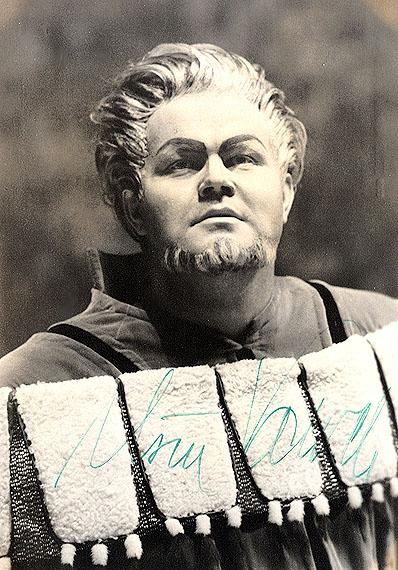
What makes the performance worthwhile are the performances of Martti Talvela (above) as the Landgraf Hermann and Hermann Prey as Wolfram. Talvela is on spectacular form, his commanding voice – marked by just a trace of the vocal ‘whine’ that was something of trademark – is thrilling to hear he welcomes the guests to the Watrburg and sets forth the framework of the contest. It was such a pleasure to hear this voice again.

Hermann Prey (above) as the steadfast Wolfram, who gallantly sets aside his own feelings for Elisabeth in view of her clear preference for Tannhauser, sings with lovely lyricism and expressiveness; a couple of the lowest notes of the Evening Star are a bit of a downward stretch for him, but for tenderness and poetic resonance his is a peerless incarnation of the role. Both Talvela and Prey have voices instantly recognizable, and their contributions to this performance are superb.
~~~~~~~~~~~~~~~~~~~~~~~~~~~~~~~~~~~~~~~~~~~~~~~~~~~~~~~~~~~~~~~~~~~~~~~~~~~~~~~~~~~~~~~~~~~~
![Thomas-Marjorie-03[771]](https://oberonsglade.blog/wp-content/uploads/2025/09/643c2c976afb07bb34d87c24c4b2df2d.jpg "Thomas-Marjorie-03[771]")
Back to the ’59 Konwitschny Covent Garden RING Cycle for GOTTERDAMMERUNG in which the first voice we hear is that of Marjorie Thomas (above) as the First Norn. I had not been aware of this singer previously, despite her substantial career, and she makes a wonderful impression in thei opening scene of the RING‘s final opera – a scene I greatly enjoy both for its atmosphere and the vocal opportunities afforded the three singers. Her sister-Norns are Monica Sinclair – a mezzo who later joined Joan Sutherland’s touring Company and whose prodigious breath control makes her an unusually interesting Bradamante on the Sutherland recording of ALCINA – and soprano Amy Shaurd, who doubles as Gutrune here and later went on to sing the Brunnhildes.
Wagner legends Astrid Varnay and Wokfgand Windgassen pour their hearts out in the prologue duet. Varnay is a soprano I sometimes find oddly matronly and overblown but here she is in very fine voice, moving from strength to strength as the opera progresses. I hear some similarities between her voice and that of Regina Resnik; does anyone else? Windgassen is unfortunately not at his best in this performance. His voice is unsettled, his phrasing wayward. In this repertoire one has to allow for off-days; it”s just too bad this was a performance being preserved for posterity. Hermann Uhde (Gunter) and Gottlob Frick (Hagen) are simply magnificent, and Shuard is an ample-toned Gutrune, sometimes a shade off pitch.

Ursula Boese (above, with composer Igor Stravinsky) is a rich-toned Waltraute, sometimes putting me in mind of Rita Gorr. Ms. Boese’s voice sometimes takes a moment to tonalize on a given note, giving a slight feeling of pitchiness, but overall she is impressive in her long scene with Varnay.
![Kraus-Otakar-01[Alberich-099]](https://oberonsglade.blog/wp-content/uploads/2025/09/526fad9a51d3b7b0d66d1176bf715ebb.jpg "Kraus-Otakar-01[Alberich-099]")
As Act II begins, the Czech-born baritone Otakar Kraus (above, great photo as Alberich) sings the role of the dwarf who appears to his son Hagen in a dream, singing with mysterious, haunted tone. This sets the stage for one of the most thrilling readings of the cataclysmic events of this singular Wagnerian act that I have heard. If only Mr. Windgassen had been on peak form on this day, we’d have been left with a veritable masterpiece. The tenor does sing powefully and doesn’t shrink for the demands, but moments of strain and rhythmical variances detract a bit from the overall sweep of the act.
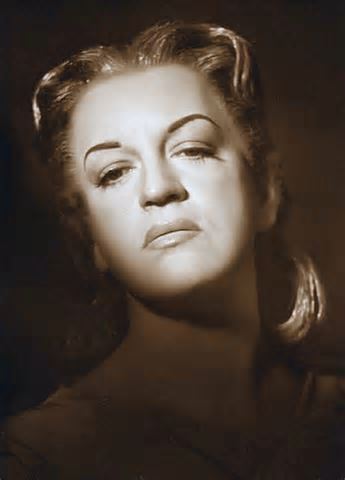
Astrid Varnay (above) is simply thrilling in this demanding music; her voice – not so much the timbre but the way she sings – continues to remind me a bit of Resnik. The top is earth-shattering and her expressively dramatic vocal thunderbolts are astounding in their bright, steady power. Along with her 1953 ELEKTRA this is my favorite Varnay recording I’ve heard to date. Gottob Frick is imperterbably sinister and grand as Hagen, and if the notion that Gunther’s undoing could be described as heartbreaking, you hear it magnificently here in Hermann Uhde’s uncanny vocal portrayal.
I’ll confess to skipping over some of the final act, since Windgassen is so out-of-sorts. The Rhinemaidens – led by the girlish-sounding Joan Carlyle singing along with star-in-the-making Josephine Veasey and Marjorie Thomas, who fills out her evening by adding the third Rhinemaiden to her First Norn.
Varnay’s Immolation Scene begins triumphantly. The diva is in huge and secure voice, and her characteristic tendency to sometimes approach a high note from below doesn’t bother me, since she always gets where she’s going eventually. In her deeply felt and lyrical singing of “Wie Sonne lauter strahlt mir sein Licht…” Varnay wins my heart entirely. A bit later though there is a jarring parting of ways between singer and orchestra: Varnay seems absolutely in the right to my ears (not having a score to hand), but a few measures of musical mayhem ensue before things are set to rights. Thereafter traces of fatigue creep into the soprano’s vocalism, but by this time she’s delivered so much marvelous singing that we can’t help but be swept away in admration for her overall performance.
 Oberon's Glade
Leave a comment