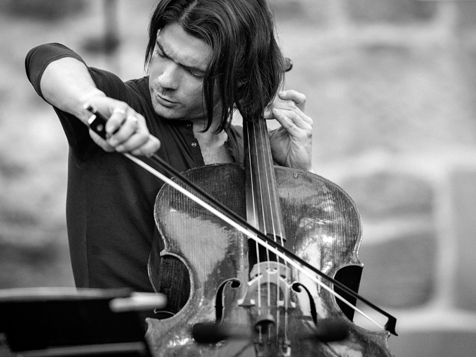
Friday January 24th, 2014 matinee – Cellist Gautier Capuçon (above) gave an inspired rendering of the Shostakovich cello concerto #1 at this afternoon’s New York Philharmonic concert. Conducted by Andrey Boreyko, the programme was book-ended by works of two Russian composers with close ties to the world of classical ballet.
The name Nikolai Tcherepnin immediately conjures visions of the Ballets Russes, for it was he who not only conducted the first performance of Diaghilev’s troupe in the West (on May 19th, 1909, at the Chatelet) but also composed the score of that evening’s opening ballet – Le Pavillon d’Armide – which swept the Parisians into a fever as they beheld Karsavina and Nijinsky onstage.
Today the Philharmonic opened their concert with Tcherepnin’s tone poem The Enchanted Kingdom which dates from 1909-1910. The “kingdom” referred to in the work’s title is that of Katschei the Immortal – yes, the same sorcerer who was soon to appear in the Fokine/Stravinsky Firebird. In seems fact, Tchrepnin’s score may have been under consideration by Diaghilev as a setting for Fokine’s ballet. That didn’t transpire, but the score Tchrepnin left us is quite magical in its own right.
The huge orchestra under Maestro Boreyko gave a richly-coloured performance: right from its sombre opening, this music reveals a vibrant sound-palette: celesta, piano and harp produce magical effects while solo wind voices add characterful touches. The cinematic central melody is simply gorgeous.
Gautier Capuçon then took the stage for the Shostakovich; this charismatic artist took all the demands that the composer sets before the cellist in his stride. M. Capuçon’s playing of the central theme of the moderato literally gave me the chills, such was the spell he was able to cast; and as he played he sometimes seemed to be gazing off into some distant horizon: truly poetic. In the very long and technically demanding cadenza, the cellist’s clarity and his mastery of dynamics was most impressive – and a great smile illuminated his face when this sustained solo passage came to an end and the orchestra began to play again. Capuçon’s playing won the audience’s unstinting praise, and after the customary bows with the conductor the soloist was called out yet again for a solo bow, evoking a standing ovation.
The Shostakovich was excellently played by the artists of the Philharmonic, with the prominent horn solos finding Philip Myers at his finest: amazingly plush sound, a real treat for the ear.

Above: conductor Andrey Boreyko
The Philharmonic’s final offering today was the Tchaikovsky Suite #3, immortalized for dance lovers in Balanchine’s marvelous ballet of the same name. Of course throughout this performance the Balanchine choreography unfolded in the mind’s eye. Is there any music so romantically overpowering as the Élégie, especially when played as sumptuously as it was today? Throughout the forty-minute piece (it seems much shorter when there’s dancing to be watched), Maestro Boreyko kept a precise pulse: he was especially adept in the subtle rhythmic shifts of the Valse, and the final polonaise was regally done. The playing was stellar.
 Oberon's Glade
Leave a comment