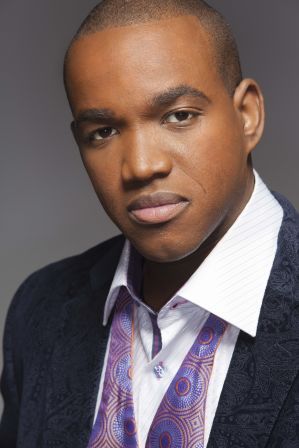
Above: tenor Lawrence Brownlee
Tuesday April 22nd, 2014 – This performance of Bellini’s I PURITANI at The Met marked one of the few evenings this season that I have stayed til the end of the opera. It was to hear Lawrence Brownlee in the Act III love duet and Arturo’s aria “Credeasi, misera” that I endured two intermissions – the first over-extended, the second reasonable – and a less-than-memorable Mad Scene from soprano Olga Peretyatko and a mixed-bag rendering of the great baritone-basso duet “Suoni la tromba”. It was Mr. Brownlee – along with the basso Michele Pertusi – who made the evening worthwhile vocally.
There were the usual rather alarming number of empty seats at The Met tonight, and the audience had thinned out even further by Act III. The evening started with an announcement that Mariusz Kwiecien was ill and would be replaced as Riccardo by Maksim Aniskin. Mr. Aniskin has a pleasant enough voice but had some passing flat notes in his Act I aria and his coloratura was a bit labored. His verse of “Suoni la tromba” was on the flat side, but he rose to his best work in the duet’s cabaletta. Overall he seemed out of his depth here: he should probably be singing Marcello, Sharpless, and Guglielmo. Still, I don’t regret not hearing Mr. Kwiecien tonight, after experiencing his vocally drab Onegin earlier this season.
Mr. Pertusi has a real sense of bel canto and his singing all evening was beautifully molded and expressive, most especially in the gentle aria “Cinta di fiori” and later in his flowing passage “Se tra il bujo un fantasma vedrai” in the big duet. Conductor Michele Mariotti did his baritone and basso no favors, his orchestra slugging away at “Suoni la tromba” as if it was NABUCCO.
The conductor in fact did his wife, Ms. Peretyatko, no favors either, often pushing her at the climaxes where her thinned-out high notes carried no impact in the House. The soprano’s voice is tremulous and despite good musical instincts the sound is simply not particularly attractive, and the voice is a size too small for this iconic role in a big space like The Met. Her coloratura was reasonable, and she did produce some striking piano singing along the way, notably the very sustained high B-flat at the end of her offstage solo with harp in Act III. But the high notes at the end of her duet with Giorgio and to climax “Son vergin vezzosa” were pretty much covered by the orchestra. Her Mad Scene was lacking in vocal colour; there’s nothing really distinctive about her timbre, and her interjection of laughter was lame. The cabaletta “Vien diletto” was reasonably effective but again the conductor over-played his hand while the soprano sustained a rather wan high E-flat. A couple of guys in Family Circle shouted desperate ‘bravas’ after the Mad Scene, but the applause was not prolonged. The warmth of Mr. Brownlee’s voice gave the soprano a nice cushion in the love duet though they really didn’t need to hold the final high-C as if waiting for the cows to come home. The opera concluded with “O sento, o mio bell’angelo”, the ‘lost’ cabaletta discovered by Richard Bonynge, and again Ms. Peretyatko’s thinned out concluding note was covered by the orchestra. (The cabaletta isn’t even in the score; was it ever authenticated?).
Before lavishing praise on Mr. Brownlee, I must mention Elizabeth Bishop’s excellent performance in the thankless role of Enrichetta. The mezzo made the very most of her brief role, with a real sense of dramatic urgency in her vocalism. Brava!
Mr. Brownlee’s opening “A te, o cara” was as finely sung as any rendering of this aria I’ve ever heard; it was in fact right up there with my personal favorite: Alfredo Kraus singing it in Chicago in 1969. Mr. Brownlee’s singing was golden, gorgeous and ardent, with a spectacularly sustained high-C-sharp in the second verse. After the second verse, the soprano joins in and the lovers exchange tender declarations of affection. In Chicago, Mr. Kraus had the advantage of the beautifully expressive lyricism of Margherita Rinaldi to further heighten the impact of his singing. Ms. Peretyatko tonight was nowhere near as lovely, but Mr. Brownlee had triumphed anyway.
Arturo vanishes and is not seen or heard from in Act II; he reappears, having saved Enrichetta from execution, to find himself declared a traitor and his girl-friend transformed into a mad woman. After jolting Elvira back to the reality of their love with his honeyed “Vieni fra queste braccia” and a vibrant, prolonged foray to a top-D, Mr. Brownlee launced the arduous “Credeasi misera” in which he successfully negotiated the treacherous, written high-F: of course this note sounds very un-natural and I generally feel it’s just as well not to include it, but I admired Mr. Brownlee all the more for taking the risk. In the end, it was his vocalism that lifted this PURITANI out of the ordinary and made staying til the end worthwhile.
Listening to Ms. Peretyatko in Act I, I was reminded of an evening in 1991 when Marina Bolgan was singing a dutiful, rather pallid Elvira. Then suddenly before Act II there was an announcement: the soprano had withdrawn and Martile Rowland would make her Met debut in Act II. The audience was so thrilled by Ms. Rowland’s large-scale singing and her zany assault on the climactic E-flat of “Vien, diletto” that a huge ovation erupted the moment she let go of the note. I was kind of hoping something like that would happen tonight.
Metropolitan Opera House April 22, 2014
I PURITANI
Vincenzo Bellini
Elvira..................Olga Peretyatko
Arturo..................Lawrence Brownlee
Riccardo................Maksim Anishkin
Giorgio.................Michele Pertusi
Enrichetta..............Elizabeth Bishop
Gualtiero...............David Crawford
Bruno...................Eduardo Valdes
Conductor...............Michele Mariotti
 Oberon's Glade
Leave a comment