
Above: Ashley Laracey and Sean Suozzi in Robert Schumann’s Davidsbündlertänze, photo by Paul Kolnik
Tuesday May 20, 2014 – Created in 1980, George Balanchine’s setting of Robert Schumann’s Davidsbündlertänze was one of the choreographer’s last works. It’s a unique ballet, deeply moving in its depiction of the composer Robert Schumann’s descent into madness.
During the winter of 1854, Schumann’s developing insanity took a dramatic turn: he began hearing “angelic” voices which evolved into the bestial cries of wild animals. One February morning he walked to a bridge over the Rhine and threw himself in; he was rescued by fishermen. Schumann himself asked to be institutionalized, to prevent his becoming a burden on his wife, Clara. He was placed in a sanatorium. His doctors prevented Clara from seeing him for more than two years, until days before his death.
The Rouben Ter-Arutunian setting for this ballet, which has an antique look, surrounds the dancing area with gauzy curtains. The backdrop shows a body of water – perhaps alluding to Schumann’s attempt to drown hmself – and a far-shining cathedral hovering in the sky, the source perhaps of the “angelic” voices summoning the composer. At one point, mysterious figues all in black and holding large quill pens appear: these represent the Philistines, whose admonishing writings were poised to oppose art or innovation in the arts and against who the Davidsbündler (the League of David – the composer’s imaginary society of artists) took a firm stance.
The ballet, danced by four couples, seems to depict various phases of the relationship between Schumann and Clara; it may also hint as certain aspects of Balanchine’s many romances. In Suzanne Farrell’s book, Holding Onto The Air, the great ballerina says that Balanchine never told her what Davidsbündlertänze was “about” during the course of the ballet’s creation. It wasn’t until later that she made the connection to Schumann’s own life.
Suzanne Farrell came very much to mind tonight in the ballet’s opening duet, for Rebecca Krohn reminded me more than ever of Farrell, who was of course Balanchine’s longtime muse. Partnered by the dashing Zachary Catazaro, Rebecca’s sweeping lyricism and the communicative range of her expressions and gestures kept me riveted to her throughout the ballet. This was Farrell’s role (the girl in blue) at the ballet’s premiere and – like Suzanne – Rebecca may eventually take on the “Clara” role (the woman in white). Tonight her dancing was spell-binding.

Above: Rebecca Krohn in Robert Schumann’s Davidsbündlertänze, photo by Paul Kolnik
This evening’s entire cast in fact were new to this ballet, having all debuted in it together the previous week. Continuing to make a vibrant effect in each new assignment, Ashley Laracey was at her most delightful here…impetuous, charming, and dancing so very well. Sean Suozzi, who always brings his own distinctive energy to each role he undetakes, was her excellent cavalier. Tyler Angle, dancing with space-filling generosity and fineness of line, courted Tiler Peck with gentle urgency. Tiler, who to my mind seems to move from one pinnacle to another in the progress of her career, was just spectacular, her lush swirls of pirouettes radiating confidence and grace.
In her portrait of Clara, Teresa Reichlen, so elegant in her presence and so refined in her line and port de bras, strove poignantly to comprehend the changes that were overtaking her beloved. Her attempts to draw him back to her embracing tenderness became increasingly desperate, and Tess at the end must finally accept their parting: in an exquisite moment, she bows her head in silent grief as the light fades.
In a major career leap, the tall and poetic Russell Janzen’s portrayal developed a melancholy acceptance of Schumann’s tragic destiny. At the end of his very first duet with Tess, Russell’s visage showed an early indication of madness with a far-away look. These momentary drifts away from reality eventually overtake him, and at the end of the ballet he withdraws with an expression mingling fear and resignation. Earlier, Russell’s solo – set to the score’s most haunting melody – was beautifully danced.
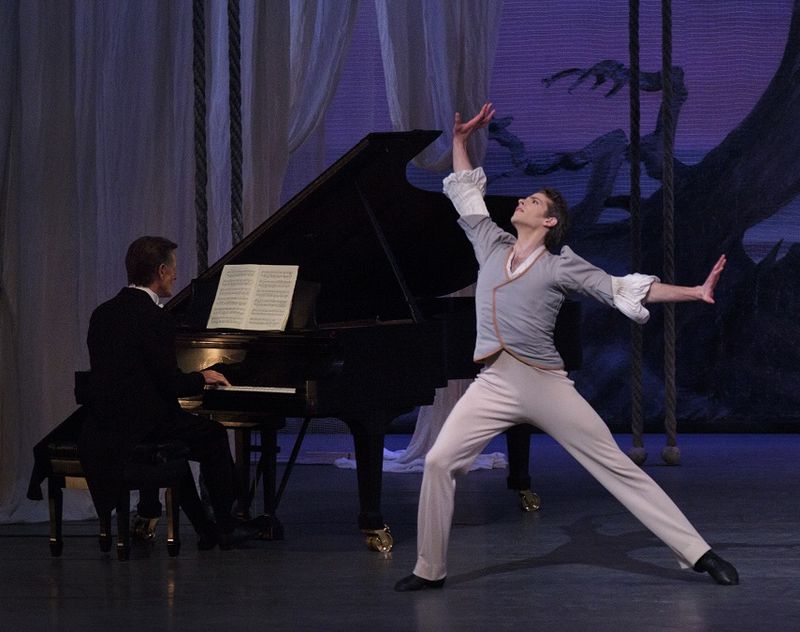
Above: Russell Janzen, with Cameron Grant at the piano, in Robert Schumann’s Davidsbündlertänze, photo by Paul Kolnik
Cameron Grant, seated at the onstage grand piano, played the Schumann score with clarity and with tempos that seemed to propel the dancers while allowing them opportuniy for nuance.
Just as singers have sometimes told me they can’t sing anything after performing Franz Schubert’s “An die Musik”, it’s difficult to imagine watching (or dancing in) another ballet after Davidsbündlertänze, such is the haunting atmosphere it creates. And so I didn’t stay beyond the intermission: even going out to the Promenade seemed too hasty a return to reality. I was in a very subdued mood, and glad of a peaceful train ride home to reflect on the beauty of Schumann and touching artistry of tonight’s dancers.
ROBERT SCHUMANN’S “DAVIDSBÜNDLERTÄNZE”: Reichlen, Krohn, Laracey, T.Peck; Janzen, Catazaro, Suozzi, T. Angle [Solo Pianist: Grant]
 Oberon's Glade
Leave a comment