
Above: pianist Anne-Marie McDermott
Sunday October 26th, 2014 – Works by the Belgian violinist/composer Eugène Ysaÿe and his better-known French contemporary Gabriel Fauré were on the bill at Alice Tully Hall as Chamber Music Society of Lincoln Center presented this dusk-hour concert on a cool Autumn day. My friend Monica Wellington and I are both very much admirers of the Fauré works used by George Balanchine in his poetic ballet EMERALDS, but neither of us were much familiar with the music of Ysaÿe.
The opening work: why is it called the Dolly Suite? Excellent question, and one I’d never thought to delve into until now, when I’m hearing it played live for the first time. ‘Dolly’ was the affectionate nickname of Helene Bardac, the young daughter of Fauré’s long-time mistress, Emma Bardac. Fauré composed the brief works that comprise the suite between 1893 and 1896, to mark birthdays and other events in Helene’s life.
The suite’s movements are:
- Berceuse (a lullabye), honoring Helene’s first birthday (Allegretto moderato).
- Mi-a-ou, which gently mocks Helene’s attempts to pronounce the name of her elder brother Raoul, who later became a pupil of Fauré’s.
- Le Jardin de Dolly (Andantino); this was composed as a present for New Year’s Day, 1895. It contains a quotation from Fauré’s first violin sonata, composed 20 years earlier.
- Kitty-valse: this is not about a cat, but rather about the Bardacs’ pet dog, named Ketty.
- Tendresse, an andante, was written in 1896 and presages the composer’s beloved Nocturnes.
- Le pas espagnol (Allegro) denotes a lively Spanish dance tune which brings the suite to its close.

The suite is set for piano four-hands, and as I watched Wu Han (above) and Anne-Marie McDermott together at the keyboard, I couldn’t help but think of them as the Dolly Sisters. In her opening remarks, Wu Han spoke of the intimate nature of chamber music and the fact that there’s nothing quite so intimate as playing piano four-hands. She and Ms. McDermott seemed to be having a grand time with this music. Their immaculate playing illuminated the six contrasted movements, which veer from boisterous to delicate, sometimes in the twinkling of an eye. The audience were as charmed by the work as by the players.
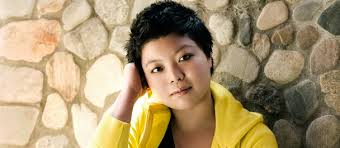
Yura Lee (above) is a favorite with CMS audiences; she seems most often to be heard here as a violist, but tonight she had a lovely opportunity to bring forth her violin for a subtle and ravishing performance of Ysaÿe’s Rêve d’enfant (a CMS premiere) in which she played with clear lyricism and great control. Ms. McDermott at the Steinway underscored her colleague’s transportive musicianship with playing of calming refinement.

In a rare performance of Ysaÿe’s Sonata in A minor for Two Violins (tonight marked the work’s CMS premiere), a duet sometimes deemed unplayable, Yura Lee and Nicholas Dautricourt (above) remained undaunted by the composer’s overwhelming technical demands, and they formed a spirited team, spurring one another on in a friendly atmosphere of “Anything you can play, I can play sweeter…softer…faster…” Mr. Dautricourt appeared for this piece in his shirtsleeves, tieless and untucked: clearly he meant business. The two virtuosos sailed on and on through the intricacies of this long duet, the audience with them every step of the way and saluting them sincerely at the end for having triumphed against improbable odds.
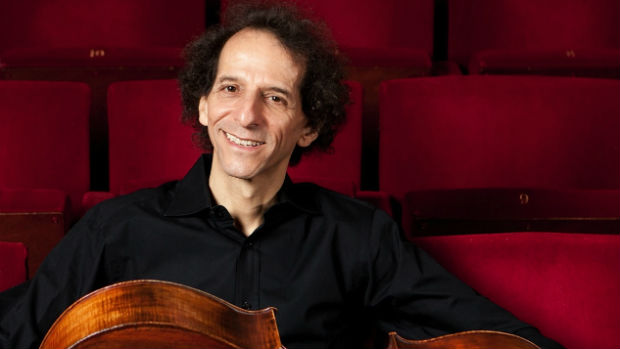
After the interval, cellist Colin Carr (above) indeed charmed Monica and me with his gorgeous playing of Fauré’s Sicilienne; originally set for cello and piano, as we heard it performed tonight, this melodious gem was later re-worked by the composer into his score of incidental music for a production of Maeterlinck’s Pelléas et Mélisande; and from that incarnation, Balanchine plucked it to be part of his elegant ballet EMERALDS. Mr. Carr, with Wu Han’s polished support, brought his warm tone and a particularly nice, merlot-flavoured lower register to this evocative performance. As a contrast, cellist and pianist gave us another Fauré miniature: Papillon (‘Butterfly’) in which the cellist’s fingers flutter up and down the strings, twice pausing in more sustained passages.
In Fauré’s Quartet No. 1 in C minor for Piano, Violin, Viola, and Cello, Op. 15 – the concluding work tonight – Ms. McDermott summoned up the rhapsodic qualites of the opening movement, then turned vividly playful in the scherzo which follows. Ms. Lee – her viola really singing – along with Mssrs. Dautricourt and Carr treated us to some genuinely poetic playing, especially in the adagio where the three voices passed the melodies between themselves with playing of a satiny eloquence. Indeed, the level of playing throughout the evening left me yet again in awe of the Society’s unique roster of artists.
The Program:
Fauré Dolly Suite for Piano, Four Hands, Op. 56 (1894-96)
Ysaÿe Rêve d’enfant for Violin and Piano, Op. 14 (1895-1900)
Ysaÿe Sonata in A minor for Two Violins (1915)
Fauré Sicilienne for Cello and Piano, Op. 78 (1898)
Fauré Papillon for Cello and Piano, Op. 77 (before 1885)
Fauré Quartet No. 1 in C minor for Piano, Violin, Viola, and Cello, Op. 15 (1876-79)
The Participating Artists:
- Anne-Marie McDermott , piano
- Wu Han , piano
- Nicolas Dautricourt , violin
- Yura Lee , violin
- Colin Carr , cello
 Oberon's Glade
Leave a comment