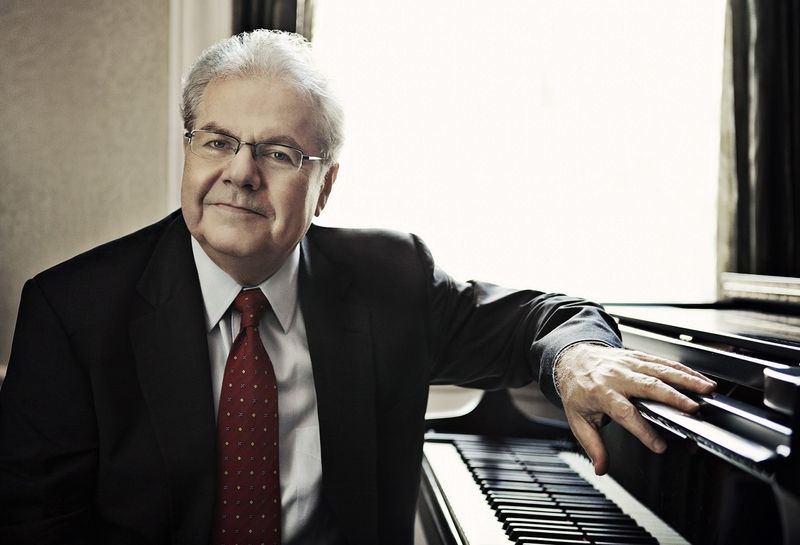
Above: Emanuel Ax
Thursday January 29th, 2015 – The esteemed pianist Emanuel Ax, enormously popular with New York Philharmonic audiences, was warmly cheered tonight after his performance of the Chopin piano concerto #2. David Robertson was on the podium for a programme that proved highly enjoyable and that allowed several of the individual players of the orchestra to shine.

Above: David Robertson
As a brief and savorable prelude, the Vocalise of Sergei Rachmaninoff was rendered in full romantic bloom by Mr. Robertson and the orchestra. Originally a wordless composition for soprano, the Vocalise was written in 1915; the composer went on to orchestrate the work which is perhaps his best-known melody, whether performed in the arrangement for soprano and orchestra or for orchestra alone. So many of Rachmaninoff’s best-loved works are in a minor key, giving the music a mood of melancholy and gentle regret. The orchestra played it with distinction; the melodic familiarity of the piece has the poignant effect of encountering an old friend one has not seen for many years.
Mr. Ax then appeared for the Piano Concerto No. 2 of Frédéric Chopin. In the summer of 1829, the 19-year-old Chopin, recovering from the breaking of an unhappy romantic attachment, sketched out the F-minor concerto and when he returned to Warsaw for the winter season, he performed this new concerto at the National Theatre the following March. The concerto gained Chopin the public exposure and audience acclaim that his numerous private salon performances could not have achieved.
As the years passed, musicologists began to denigrate the Chopin concertos as being inferior to much of his writing for solo piano. Tonight’s superb performance made an emphatic stand in the concerto’s favor: it’s simply a beautiful piece of music.
A contemporary account from the concerto’s premiere in 1830 records: “How beautifully (Chopin) plays. What fluency! What evenness!” And the same could be said of Mr. Ax’s performance tonight. In a refined partnership with Maestro Robertson, the pianist let the music flow with grace and charm, allowing us to savour the thematic generosity of Chopin in an illuminating performance. The unfortunate ringing of a phone just as the concerto’s first movement ended prompted a witty exchange between pianist and conductor. But order was immediately restored as Mr. Ax commenced the Larghetto, a movement full of lyricism in which the pianist’s glowing tone captivated the audience. With flourishing agility, the pianist then took wing in the final Allegro vivace. Near the end, trumpet calls herald the concerto’s final rippling cadences; it all ends with Mr. Ax striking a single low note as the orchestra takes the final chord. The audience’s warm expressions of admiration drew Mr. Ax to offer us a Chopin encore, summoning up visions of the Jerome Robbins ballet DANCES AT A GATHERING.
The Firebird (Suite/1919) – Igor Stravinsky arranged three suites from the full score of The Firebird, in 1911, 1919 and 1945. It is the second of these which is most frequently played today, containing as it does approximately half the music of the complete score. This suite follows the narrative of the original ballet scenario, so familiar to admirers of the Balanchine/Chagall incarnation often seen across the Plaza at New York City Ballet. The atmospheric score – Stravinsky at his most colorful and melodious – casts a spell of enchantment. It includes themes from two Russian folk songs: one a lyrical melody danced by the captive princesses, and the second the regal anthem which closes the ballet.
Maestro Robertson and the Philharmonic players reveled in this extraordinary music, with oboist Sherry Skylar particularly impressive in her plaintive theme. The conductor drew forth some ravishing, shimmering piani as well as the lulling tenderness of the Berceuse; and the nightmarish Infernal Dance of Kastcheï’s ghoulish slaves was given the full, brilliant treatment.
The Miraculous Mandarin (Suite) is drawn from Bela Bartók’s pantomime-ballet of the same title. The original theatrical setting of the piece (written 1918-1919) was considered too vulgar in its portrayal of lurid sex, violence, and the macabre. After its 1929 premiere at Cologne, it was banned after a single performance. But Bartók, perhaps foreseeing that the ballet would not survive as a stage work, had already arranged the Suite, which we heard tonight in a thoroughly engrossing performance.
Opening with a big, noisy clatter of sound, the score employs a wide range of instrumentation to ear-tingling effect: piano, flute, harp, xylophone, and celeste all play a part in this sonically intriguing piece. Ms. Skylar’s oboe artistry and Anthony McGill’s remarkable clarinet playing were especially clear and colourful. And a broad, dancing passage with drums near the end served as a reminder of the Suite’s balletic beginnings.
I at first wondered how the Stravinsky and Bartok would play back-to-back, but the cumulative effect was indeed rewarding: both works have a similarity of texture at certain points, and there’s even some over-lapping of effects – trombone glissandi and frequent interjections of solo winds – which made second half of tonight’s concert every bit as satisfying as the first half.
 Oberon's Glade
Leave a comment