
Tuesday February 17th, 2015 – Young Concert Artists presenting an evening of chamber music by young composers at Merkin Hall. I invited my choreographer-friend Claudia Schreier to join me, as she is always in quest of music to set dances to.
It was a cordial and wonderfully satisfying evening of music, the four composers showing an expansive range of styles and influences, and a fine mastery of writing for the chosen instruments. The level of playing was high and mighty, and how lovely to re-encounter Ursula Oppens, who throughout her career has been a champion of new music.
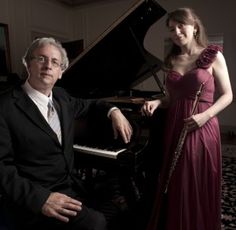
Things got off to a shining start with BENJAMIN C.S. BOYLE‘s Sonata-Cantilena (NY premiere) performed by pianist Charles Abramovic and flautist Mimi Stillman (above). This four-movement work opens with a Debussyian shimmer; it wends its way thru melodious passages – sometimes doleful and sometimes evoking the warblings of exotic birds – with some sprightly, witty cascades of impetuous coloratura added to the mix. Ms. Stillman, in a fetching pale-violet frock, played beautifully and Mr. Abramovic was a congenially artful partner.
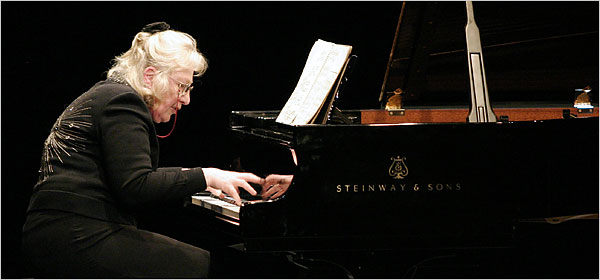
Ms. Oppens (above) was then joined by violinist Paul Huang and clarinetist Narek Arutyunian for DAVID HERTZBERG‘s Orgie Céleste (Premiere), a fantastical evocation of heavenly delights. Complex and ear-tingling in its textures, much of the music has an ethereal quality as the piano and violin linger in their high registers; meanwhile the clarinet murmurs a two-note motif endlessly, like a subtly pulsing heartbeat. Mr. Huang showed extraordinary technical control as he met all the composer’s demands with alacrity, including some ironic glissandi. The intermingling of the three voices kept everything in a constant state of freshness, Ms. Oppens was wonderfully vivid in her silvery filigree and Mr. Arutyunian seizing melodic opportunities his mellow, expressive tone. The audience responded enthusiastically to both the music and the musicians.
The only one of tonight’s composers previously familiar to me was KENJI BUNCH, who I had met several years ago while I was working at Tower Records. Since then I have heard quite a bit of his music, but I had not had the pleasure of hearing him play live. He’s a superb violist, with a marvelous mastery of the instrument, making it sing for him is two very contrasted works.

Above: Kenji Bunch and pianist Monica Ohuchi
In I Dream in Evergreen, Kenji revealed the viola’s depth of lyricism in a poignant reflection on the sundering aspects of death, when mortal friendships end and are transformed into memory. Ms. Ohuchi’s gently shimmering opening theme is soon joined by the viola intoning its poetic recollection of past affection and regret. Together the two musicians provided a reflective interlude, impeccably played.
Kenji’s Étude No. 4 (from a set of twelve études he composed for his wife, Ms. Ohuchi, under the title Monica’s Notebook) is a brief and brilliant piece. Lasting all of 90 seconds, it sends the pianist’s hands rippling up and down the keyboard in a delightful display of dexterity. Ms. Ohuchi nailed it, and she was rightly given sustained applause which wouldn’t quit til she returned for a solo bow (personally, I was hoping for an encore of the piece!)
In Étouffée for solo viola, Kenji’s panoramic exploration of the viola’s possibilities was truly impressive and enjoyable; his playing is mesmerizing – there’s no other word for it. Inspired by a favorite dish from the Cajun culture, the work opens with a hazy, out-of-focus quality as if the viola was drunk on Southern Comfort. This evolves into a big country dance-tune, captivating in its combination of rhythmic drive and sexy rubato. Bravo, Kenji! His entire set was really impressive.
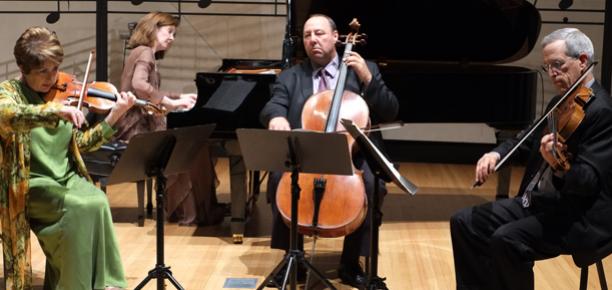
Having musicians of the caliber of the Opus One quartet (above) play the New York premiere of your work must have given composer CHRIS ROGERSON a thrill. His Summer Night Music for Piano Quartet is full of musical marvels and how superbly it was played tonight by the Opus One artists: Ida Kavafian, violinist; Steven Tenenbom, violist; Peter Wiley, cellist; and Anne-Marie McDermott, pianist.
In four movements, Summer Night Music opens with a sense of quietude at Twilight. First the cello, then viola, and then the violin introduce themselves in gentle motifs. Ms. McDermott reaches inside the body of the Steinway to pluck the piano’s strings as the cello murmurs plaintively and the violin plays high and pensive. In Fireflies, the piano spins forth with fluttering restlessness and sparkling little interjections. There’s a dense passage from all four players until, until – with a high fade-away from violin and piano – the memory of a Summer night slips away.
The third movement, Evening Prayers, sounds like a gentle lullabye; the violin lingers on high and the viola and cello blend thru the music in simpatico phrases. The concluding Sleep Music commences with a gently vibrant quality, soft and high; a mellowness of cello and viola evoke deepening night. There is a broad melody for unison strings – and a passionate piano theme – before the music finally vanishes into thin air on Ms. Kavafian’s violin strings.
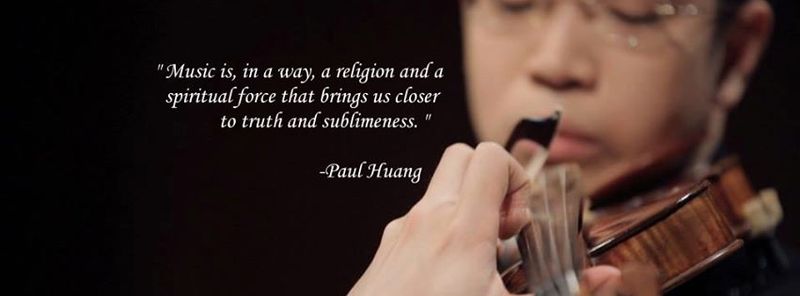
In researching some of the participating artists, I came upon the above quote from the young violinist Paul Huang. He has expressed something here that I have always felt.
 Oberon's Glade
Leave a comment