
Above: James Ehnes, violinist, performing with The New York Philharmonic tonight
Wednesday January 27th, 2016 – The New York Philharmonic playing masterworks by Beethoven and Bruckner under Juanjo Mena’s baton, with James Ehnes the featured soloist.
The Philharmonic’s been the talk of the town this week with the announcement of the appointment of Jaap van Zweden as the orchestra’s next music director; read more about the good news here.
Tonight, Mr. Ehnes played the Beethoven violin concerto with silken tone and technical aplomb, evoking an atmosphere of hushed attentiveness in the hall and finishing to a prolonged ovation with a triple “curtain call” and with the artists of the Philharmonic joining in the applause. The tall violinist is as congenial to watch as to hear, and he and Maestro Mena formed an elegant musical affinity as the concerto progressed, sharing a warm embrace at the end.
Beethoven’s violin concerto was written and first performed in 1806 and – after it’s premiere performance by Franz Clement, the 26-year-old principal violinist and conductor at the Theater an der Wien in Vienna – it took years for the concerto to catch on. That first performance must have been something of a nightmare: Beethoven completed the work just two days before the premiere, and the surviving autograph score is a mess of crossings-out, over-writings, and alternative ‘versions’. The soloist, having had no time to learn and rehearse the long and complex work, had to use the score for the premiere; for much of the time he was virtually sight-reading. One reviewer wrote: “Beethoven could put his undoubtedly great talents to better uses”.
Prior to publishing the work, Beethoven modified and clarified it following the 1806 premiere. The concerto finally began to work its way into the standard repertoire after a highly-praised performance in London in 1844, conducted by Felix Mendelssohn and played by the 12-year-old prodigy Joseph Joachim. It comes down to us as one of the greatest works of the violin concerto genre.
James Ehnes gave a lovingly detailed performance; a series of high trills in the opening movement were dazzlingly clear, and his dynamic control throughout was simply exquisite. Maestro Mena sculpted the opening passages of the central Larghetto to perfection, the violinist then joining in with playing of sweetly sustained lyricism. The ‘Kreisler’ cadenzas were spun off with serene virtuosity. At every moment – whether playing fast or slow – Mr. Ehnes maintained an enchanting sheen on his tone. Thus the audience’s grateful show of the enthusiasm at the end was eminently deserved.

Following the interval, Maestro Mena (above) and the Philharmonic musicians gave a thoroughly impressive performance of Bruckner’s 6th symphony. It’s always pleasing to have Sheryl Staples in the concertmaster’s chair, and to have Cynthia Phelps and Carter Brey leading their sections with such committed artistry. I often wish that the wind players could be seated on risers so we could better savour their individual performances: passages of wind chorale in the Bruckner were beautifully blended.
The orchestra were at their finest in the compelling themes of the symphony’s Adagio. Both here and in the opening Majestoso, Maestro Mena was deeply involved in drawing forth the inner voices to give a full range of colour to each gorgeous passage.
In the third movement, a Scherzo, it seems to me that Bruckner’s imagination flags ever so slightly. The concluding movement – wonderfully played – felt over-long, almost as if the composer was unsure of how he wanted the piece to end. This ‘finale’ was not publicly performed until 1899, three years after Bruckner’s death; perhaps he would have tailored it more concisely if he’d been able to judge the effect in an actual concert performance. We’ll never know. Yet overall, the sonorous grandeur of the 6th makes a vivid impression.
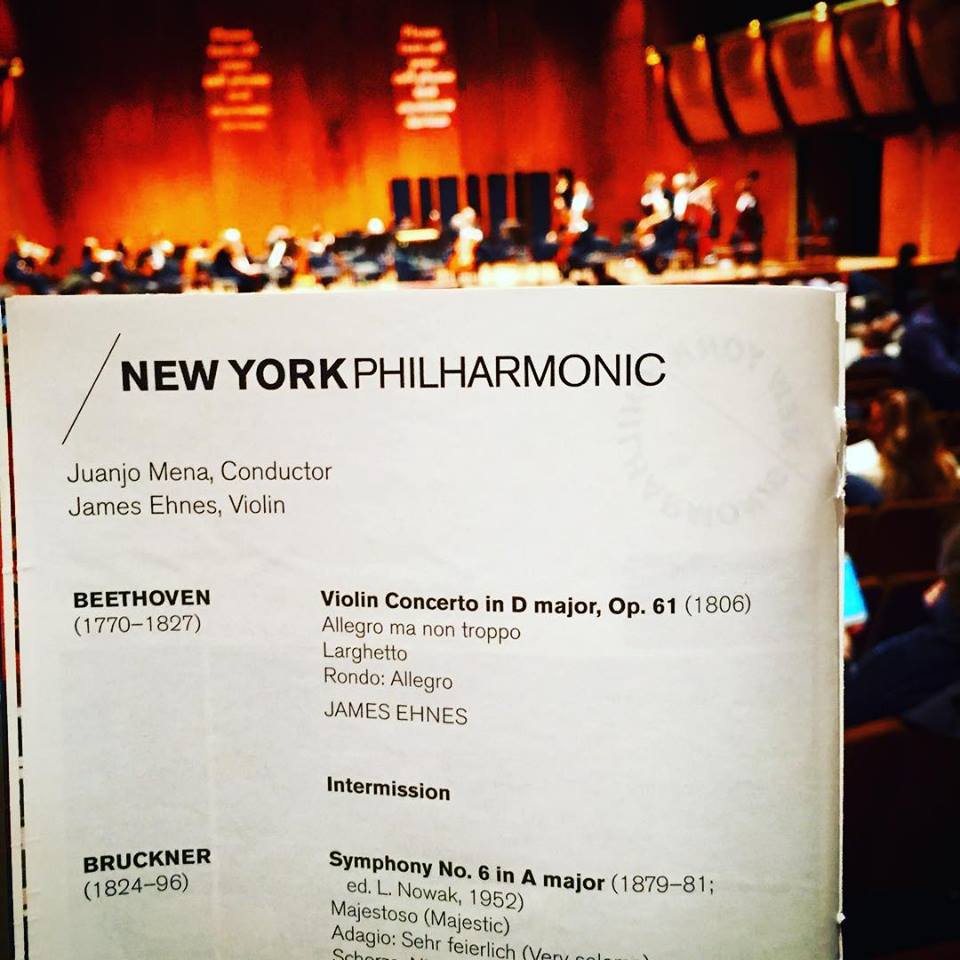
Pre-concert photo by my friend Dmitry.
 Oberon's Glade
Leave a comment