
Above: Lindsey Felix, Daniel White, and Genaro Friere of the Joffrey Ballet Concert Group in Gerald Arpino’s Suite St. Saens; photo by Lucas Chilczuk
Friday May 27th, 2016 – The JOFFREY BALLET CONCERT GROUP, under the Artistic Direction of Davis Robertson, performing a mixed program of classics (Gerald Arpino’s Suite St. Saens, and Balanchine’s Valse Fantaisie) along with newly-created pieces by Gabrielle Lamb, Robert Jeffrey, and Dwight Rhoden plus an Asaf Messerer pas de deux à la Russe to music by Rachmaninoff which brought down the house. A very attractive company of dancers held the audience in an attentive, appreciative state; excellent lighting (David Moodey) enhanced each ballet as this highly enjoyable program of dance unfolded before us.

Above: Shaina Wire and Sergio Arranz in Valse Fantasie; photo by Lucas Chilczuk
To start a ballet evening with Balanchine is always a good thing, and Valse Fantaisie – to the intoxicating Glinka score – engaged us immediately. Stacey Caddell has staged the ballet on the young Joffrey dancers, and they did very nicely by it. Four lovely ballerinas sailed thru the lyrical (and sometimes tricky) Balanchine choreography with a sense of joy; in the principal roles, Shaina Wire and Sergio Arranz were appealing in both appearance and technique, displaying a fine mixture of nobility and charm.
Mr. Arranz was back onstage moments later, in silhouette, for the opening of Robert Jeffrey’s Confianza. This intimate, moody pas de deux is set to a collage of music by Benjamin Brown, Steven Stern, Eric Satie, and Max Richter. The choreographer gives the dancers – Victoria Santaguida and Mr. Arranz – complex and demanding partnering motifs which the couple handled with persuasive aplomb, bringing tenderness tinged with sensuousness to their dancing.
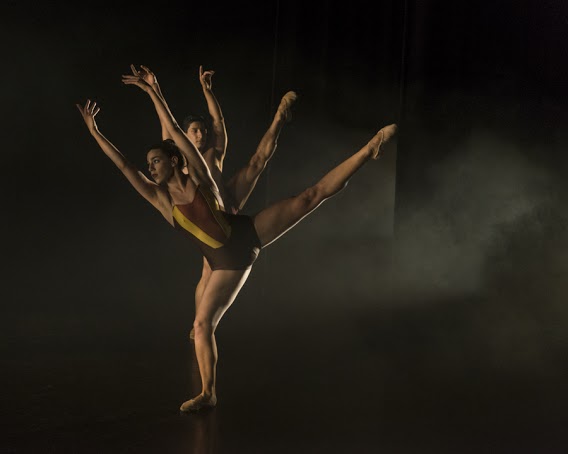
Above: Sierra French and Genaro Friere in And So It Was…photo by Lucas Chilczuk
Dwight Rhoden’s And So It Was… is danced to Bach’s Partita #2 in D-minor. As smoke wafts across the dramatically-lit stage, a sexy atmosphere is developed with the seven boys in silky briefs and the girls sleekly costumed. The choreographer’s sense of musicality serves up a succession of duets – sometimes with all seven couples duetting at the same time – with an endless flow of dancers coming and going. As is so often the case in using Bach’s music, the ballet eventually began to feel repetitive; the dancers were able to sustain this longish work thru their personal attractiveness and commitment.
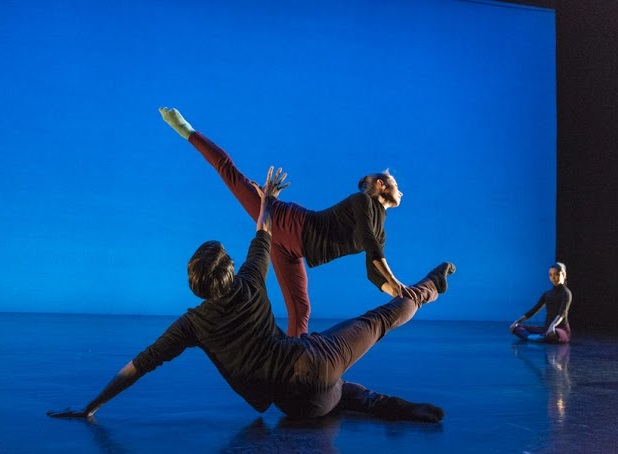
Above: Shayla Hutton and Sergio Arranz in Tesselations; photo by Lucas Chilczuk
Gabrielle Lamb’s Tessellations provided a wonderful change of pace; using a brilliant mix of music by The Amestoy Trio and Cat Power, Gabrielle’s ballet at first seems to be just another ‘loner vs community” narrative, but it is far more quirky – ironic, moving, and witty by turns – and was expressively danced by the Joffrey troupe.
The dancers wear dark clothing and socks. The Amestoy Trio’s fresh meshing of gypsy, Parisian, and Latino influences is a kick to hear, and Cat Power’s vocals for a pas de deux has its own slightly gritty appeal. Periods of silence allow us a bit of reverie before the dancing moves on. The dancers alternately dance and observe, forming fleeting cliques and chains, standing in ordered designs, communicating in gestures, and creating a world in which alternating currents of sentiment and low-key street savvy hold us under a spell. It’s been a while since I’ve seen any of Gabrielle’s work, and this was really refreshing to experience.

Above: Mariana Perez and Jon-Paul Hills in Spring Waters; photo by Lucas Chilczuk
Asaf Messerer’s Spring Waters, the boyish and muscular Jon-Paul Hills wowed the audience with the fearless strength of his partnering, placing his ballerina – Mariana Perez – in improbable lifts with the assurance of an Olympic athlete, catching her as she rushes to his arms and sweeping her overhead. The duet ends with a spectacularly high lift as Mr. Hills rushes across the stage and into the wings, bearing Ms. Perez aloft like an exulted icon: the audience simply went nuts as they sped away.
Gerald Arpino’s Suite Saint-Saëns was the closing number this evening, a large-scale work filled with movement and alert to the music’s many fragrances. The dancers enter one by one, with brisk jetés and meeting up in fleeting partnerings. Lindsey Felix, a featured soloist in the first two movements (Caprice Valse and Serenade) was agile and lovely to watch.
The Serenade has a dreamier quality; four couples to start, with other dancers joining. The simple act of walking takes on its own resonance. An intimate pas de trois for Ms. Felix, Maria Sol Maratin, and William Hall evolves beautifully as other dancers come and go.
A march-like theme jolts us, but soon settles in to a Minuet with a ‘classic’ pas de deux – and another big lift – before hastening on to the concluding Pas Redoublé which features leaping boys and even a set of fouetté turns. The music is bouncy, the dancing exuberant.
Amid all the bustle and swirl of this wonderful ballet, a dancer who had not appeared earlier in the evening – Haojun Xie – made a very fine impression with his lithe jump and sincere presence.
 Oberon's Glade
Leave a comment