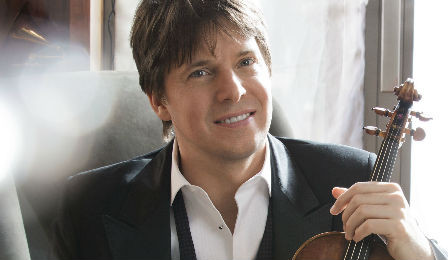
Above: violinist Joshua Bell
Wednesday August 17th, 2016 – Geffen Hall was packed to the rafters for Mostly Mozart tonight: all the stage seats were taken, and there was a line for ticket returns: could it have had something to do with Joshua Bell being the scheduled soloist? Mr. Bell certainly impressed in his performance of Mozart’s 4th violin concerto, and the program overall was highly enjoyable.
Any hearing of Felix Mendelssohn’s overture to A Midsummer Night’s Dream is bound to summon up visions of Balanchine’s enchanted forest – it’s quite amazing, in fact, when you think of the amount of narrative and dancing Mr. B was able to fit into this 12-minute overture, without ever for a moment seeming over-busy. The Mostly Mozart Orchestra coped well with the brisk tempi set by the youthful-looking conductor, Matthew Halls, and it was so much sheer fun to hear these familiar themes played live again. I must mention Jon Manasse’s lovingly-phrased clarinet solo.
Joshua Bell then appeared to a warm greeting from the crowd. In this rendering of the Mozart violin concerto #4 in D-major, the violinist and the conductor formed a steady rapport. Unobtrusively using a score, Mr. Bell launched the solo line in the stratosphere and went on to play the Allegro vivace‘s capricious music with easy aplomb. There’s a lot of high-velocity coloratura in play here, and it culminates with a florid, witty cadenza of Mr. Bell’s own design.
On a high, sweetly sustained note, Mr. Bell lures us into the Andante cantabile; the melody eventually dips into a lower range where his playing a balm to the ear. An elegant ‘interlude’ has a different sort of appeal; then the main theme recurs, before the violinist ascends to another high-lying cadenza.
After an elegant start, the Rondeau turns sprightly – a delicate mini-cadenza teases us and then there’s another more extended cadenza. The soloist joins the massed violins in a sort of chorale, and Mr. Bell continues to seize opportunities for yet two more cadenzas, the first having an ironic buzzing quality.
As ever, Mr. Bell’s physically engaged playing is as enjoyable to watch as to hear. The random smudged note here or there was nothing to deter from the ongoing sweep of his music-making, and though I agreed with my companion that the cadenzas sometimes seemed rather too ‘modern’, they gave the performance an individuality that was refreshing in its own right.
This evening’s performance was finely-wrought by Maestro Halls, and most attractively played. The contrasting themes of anger and tenderness express the theme of the play: the betrayal of his duty as a Roman general by Coriolanus, and his mother’s entreaties to abandon his plan to lead the enemy forces in an attack on Rome. Her pleading is effective: Coriolanus abandons his scheme and faces his punishment.
A warm and appealing performance of Beethoven’s “little” symphony – the 8th – concluded the evening on an optimistic note. The last time I heard this symphony performed live was in December 2013 when the Spanish conductor Rafael Frühbeck de Burgos, then in his 80th year, led the New York Philharmonic in the work and left my friend Dmitry and I with wonderful memories of the highly-respected Maestro, who passed away in June 2014. We still speak of that Philharmonic concert with special affection.
Timed at around twenty-five minutes, this four-movement symphony flies by: there’s no adagio to make us stop and ponder, but rather a charming and often witty flow of themes with the congeniality of dance rhythms ever-ready to buoy the spirit.
A lively podium presence, Maestro Halls was well in his element here, and the musicians seemed fully engaged in this music which successfully blends elegance with folkish gaiety. The horns sounded plush, and again Mr. Manasse made his mark: an outstanding musician.
 Oberon's Glade
Leave a comment