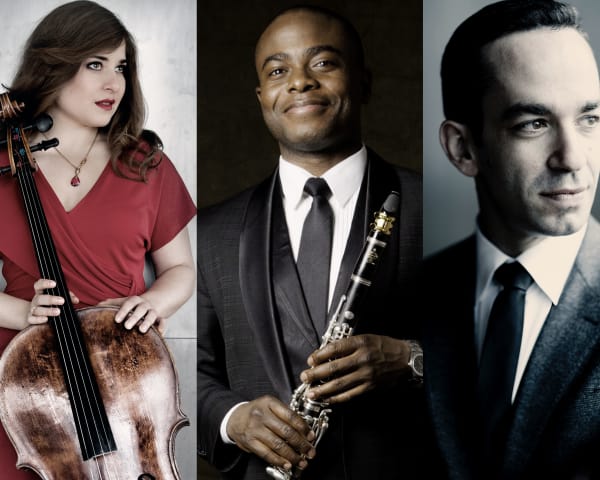
Tuesday January 24th, 2017 – Cellist Alisa Weilerstein, clarinetist Anthony McGill, and pianist Inon Barnatan sharing the Alice Tully Hall stage in a program of piano trios presented by Chamber Music Society of Lincoln Center. Beloved works by Beethoven and Brahms book-ended the New York premiere of Short Stories for Clarinet, Cello, and Piano by Joseph Hallman. The presence of three such superb artists on the program signaled this as a red-letter event in the current season; I’d been looking forward to this evening for months, and it truly surpassed expectations.
The three artists took the stage, Ms. Weilerstein in a beautiful deep violet gown, and launched the Beethoven Trio for Clarinet, Cello, and Piano, opus 11; it quickly became evident that we were in for a night of exceptional music-making. In this particular work, exuberance and delicacy alternate in perfect measure, and the three players relished both the propulsive passages and – most enticingly – those moments when nuance is all.
One of Beethoven’s early masterpieces, this clarinet trio shows the influence of Haydn and Mozart; but once can clearly sense that Beethoven is already finding his own voice. The writing for the three instruments is often conversational, and how lovingly our three musicians this evening spoke to one another.
The opening Allegro con brio is alive with rhythmic delights, including a touch of syncopated witticism. Mr. Barnatan’s scintillating agility was a constant attraction, and it was a great pleasure to watch the communication between the three players.
Ms. Weilerstein opened the Adagio with a cello theme; her heartfelt playing took this simple, straight-forward melody to the heights. She and Mr. McGill duetted tenderly, both playing with great subtlety. The music becomes achingly gorgeous.
Good humor abounds in the Theme and variations setting of the finale: drawing on an aria wildly popular at the time, “Pria ch’io l’impegno” (“Before I begin, I must eat”) from Joseph Weigl’s opera L’AMOR MARINARO, Beethoven sets up bravura hurdles for the three musicians, all of them joyously over-leapt by our intrepid trio. Mr. Barnatan revels in the cascading piano passages, peaking in a perfect cadenza which ends with king-sized trills. Meanwhile Ms. Weilerstein and Mr. McGill seem to finish each other’s sentences, indulging in an amiable game of “Anything you can play, I can play finer!” Again, the sense of camaraderie, and of the players’ anticipation of the sheer pleasure of playing the next phrase, kept the audience visually engaged.
Short Stories, the new Hallman work, is a five-movement trio; it might also be called Scenes from a Relationship. One doesn’t, however, need any narrative reference to enjoy this purely as a musical experience, for Mr. Hallman is an excellent craftsman, and a colorist as well. The composer was sitting just a seat away from us; I can only imagine how delighted he must have been to hear his music being played by three such paragons…a veritable dream come true.
The opening movement, the Break-up, gets off to a stuttering start. The cello shivers before going deep and mournful, whilst the clarinet comments on her predicament. Then they switch roles, like a therapist taking over the couch from his patient. They play in unison, and things turn temporarily witty. But the music ends in the depths.
familial memories at a funeral opens with Mr. McGill’s clarinet in a whispering, misterioso mood. After briefly perking up, a pensive quality develops with a repeated two-note motif for the piano. The clarinetist’s astounding breath-control and his sustained beauty of tone throughout the dynamic range keep the audience mesmerized.
back-and-white noir: hardboiled with a heart of gold is the whimsical title of the third story. It begins agitato, developing an off-kilter rhythm. Mr. Barnatan sweeps up to the high register, while the clarinet and cello play a droopy duo. Ms. Weilerstein then descends to her velvety deep range. The music ebbs and flows, both rhythmically and tonally, as the composer explores the coloristic possibilities of the three instruments.
regret is for the weak is a title that hits home. Mr. Hallman here sets up an eerie, hesitant start. The clarinet percolates briefly, then settles into a very quiet mood whilst the cellist plucks; later, the cello trembles while the piano sounds softly. We seem to be in a moody memory, with Mr. Barnatan drawing forth fleeting surges of melody. Ms. Weilerstein and Mr. McGill sing sadly before the pianist dips down to a punctuating low note.
In the path of the curve, Mr. Barnatan sometimes reaches inside the piano to manipulate the sound. The music here is very quiet, until the clarinet starts warbling. Fluttering and swirling motifs sneak in, then the music seems to run down and the cello again deepens. The piece ends in a sustained quietude.
The only slight reservation I had about Short Stories was that the final movement is perhaps a bit too drawn out; my companion felt the same way. It was unfortunate that, during the work’s quiet closing moments, a cellphone went off directly behind us. At the same time, someone in the from row had a violent coughing fit. Such unfortunate timing. Yet despite these distractions, the Short Stories each cast their own spell, and they were spectacularly played.
Following the interval, the Brahms trio (opus 114) found the three artists on the heavenly heights of tonal and technical perfection, their playing so generous and emotive. From Ms. Weilerstein’s sublime playing of the yearning opening theme, thru the plaintive entry of Mr. McGill’s clarinet and the ever-expressive beauty Mr. Barnatan drew from keyboard, the music took on an impassioned glow. In my scrawled notes, the word “gorgeous’ appears over a dozen times.
Mr. McGill’s spellbinding playing of the sweetly serene theme that opens the Adagio was a magical passage, taken up by the soulful spirituality of Ms. Weilerstein’s cello. The luminous qualities of clarinet and cello are set in high relief by the profound tranquillity evoked by Mr. Barnatan. A long-lined clarinet solo leaves one grasping for adjectives to describe the McGill sound, and his ardent tapering of line. One wanted this meditation by the three players to linger on and on.
A questioning clarinet passage and more marvelous phrasing from Mr. Barnatan set up the waltz-like grace of the Andantino. After a brief diversion, we dance on towards the movement’s end; unexpectedly, Brahms tucks in a calming coda to make a lovely finish.
Restraint is cast aside as the trio dig into the concluding Allegro. A tinge of gypsy colour weaves thru this music. Ms. Weilerstein takes up a melody which she passes to Mr. McGill; then they harmonize. Things speed up. “More cello passion!” was my last dashed-off remark; the Brahms sailed on to its joyous conclusion, and the three stellar artists were greeted with immediate shouts of approval. They took a double curtain call, delighting the crowd.
A thought that recurred to me frequently during the evening was: if Mozart had met McGill, Amadeus would have written DIE ZAUBERKLARINETTE.
- Beethoven Trio in B-flat major for Clarinet, Cello, and Piano, Op. 11 (1797)
- Hallman Short Stories for Clarinet, Cello, and Piano (CMS Co-Commission) (New York premiere) (2016)
- Brahms Trio in A minor for Clarinet, Cello, and Piano, Op. 114 (1891)
 Oberon's Glade
Leave a comment