
In the days leading up to this evening’s concert at Chamber Music Society of Lincoln Center, it was announced that violinist Paul Huang was among the recipients of the 2017 Lincoln Center Awards.
Tuesday February 21st, 2017 – In the midst of their season celebrating Mendelssohn, Chamber Music Society of Lincoln Center offer two programs contrasting the joyous and the sorrowful. Today we reveled in the positive, sunny side of chamber music; on Sunday, February 26th, melancholy will prevail.
The Variations in E-flat major, Op. 44, by Ludwig van Beethoven, is a series of fourteen variations on a theme written for piano, violin and cello. The theme is set forth, plain as day: the musicians play a series of arpeggios at a moderate pace. From thence, the variations proceed in a variety of rhythms, instrumentation, harmony, and embellishment. Orion Weiss (piano), Sean Lee (violin), and Paul Watkins (cello) played deftly, and I greatly enjoyed observing their musical camaraderie and silent communication with one another.
The evening’s two pianists, Huw Watkins and Orion Weiss, gave us Mendelssohn’s Andante and Allegro brillant for Piano, Four Hands, Op. 92. And “brillant” aptly describes their performance, for they followed up the melodious Andante with a striking virtuoso display in the Allegro. Mr. Watkins took the lower octaves, and Mr. Weiss the upper, but they sometimes invaded each others domain. When things got fast and furious, each player had to lean out of the way to give the other access to the full keyboard in alternating solos. Thus their performance was as appealing to watch as to hear.
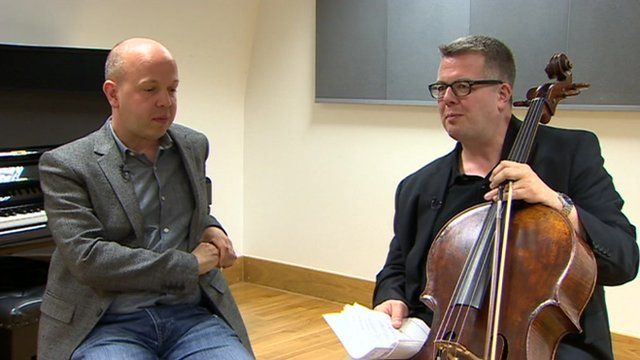
Above: British brothers Huw and Paul Watkins
Cellist Paul Watkins was joined by his pianist/brother Huw Watkins in a magnificent rendering of Mendelssohn’s Sonata in D-major for Cello and Piano, Op. 58. Their performance was truly engrossing, with the cellist’s soul-reaching depth of tone and the pianist’s perfect blend of elegance and vitality combining for a spell-binding musical experience.
In the D-major Sonata, Mendelssohn exults in the outer movements, giving the pianist a barrage of arpeggios with which to delight us while the cellist sings felicitous melodic passages.The sonata gets off to a fast start, with a lively pulse; both players bring mellifluous tone which they are able to maintain even in the most rapid phrases. Paul’s cello buzzes while Huw plays melody for a spell; then they seem to reverse roles. The word ‘amazing’ is so over-used these days, but that’s what I wrote as this fabulous Allegro assai vivace carried us along. The playing hones down to great subtlety before re-bounding and sweeping onward.
The second movement starts with a sprightly piano tune, with the plucking cello commenting, and then humming low. A lovely cello theme leads onto a more boisterous, slightly gritty passage before recurring. This little scherzo ends with a gentle whisper.
Rhapsodic phrases from the piano herald the Adagio, the heart of the matter. A poignant melody wells up from the cello, Paul Watkins’ glowing tone like a transfusion for the soul. Huw rhapsodizes again, then takes up his own melody over long-sustained tones from the cello. This Adagio seemed all too brief when played so nobly as it was this evening; the brothers then took only the briefest pause before attacking the opening of the final movement.
In this Molto allegro e vivace, both players flourished in the coloratura passages and in the melodic exchanges that ensue. After a lull, a slithery scale motif from the cello made me think of the moment in Strauss’s ELEKTRA before the murder of Klytemnestra – a far-fetched association to be sure, but there it is. The music ebbs and flows on to the finish, the Watkins brothers rightly hailed with spirited applause for their remarkable performance.
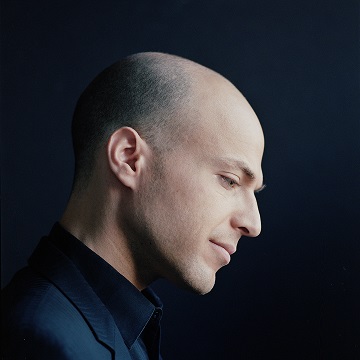
Mr. Weiss (above, in a Jacob Blickenstaff portrait) returned to the Steinway for Chopin’s Ballade in A-flat major for Piano, Op. 47, a piece long-familiar to me thru its appearance in the Jerome Robbins ballet The Concert. The pianist savoured the music, displaying a vast dynamic spectrum (blissful high pianissimi) and a keen appreciation for the shifting rhythmic patterns. When the music gets grand, Mr. Weiss’s playing is absolutely regal.
The Mendelssohn Quintet No. 2 in B-flat major for Two Violins, Two Violas, and Cello, Op. 87, drew together a most impressive string ensemble: Paul Huang and Sean Lee (violins), Paul Neubauer and Matthew Lipman (violas), and Paul Watkins (cello): their performance might be sub-titled ‘The Glory of Mendelssohn‘.
The players plunged immediately into the music with a vibrant agitato rhythm, from which Paul Huang’s violin soars up to the heavens. Throughout the performance, Mr. Huang’s tone shone with an achingly beautiful polish, his profusion of technique and his uncanny ability to mix refinement and passion in perfect measure defined him an artist of exceptional gifts.
This ensemble of wonderful musicians created a blend of particular cordiality, and each player took up their solo opportunities with stylish élan. Paul Neubauer’s playing was – as ever – aglow with poetic nuance; Matthew Lipman seconded him handsomely, displaying his trademark love of and commitment to the music, and Sean Lee’s suave phrasing is ever-pleasing to the ear. I found myself wishing that Mendelssohn had given the cello a bit more prominence, simply because I could not get enough of Paul Watkins’s playing.
The quintet’s Adagio e lento found all the musicians at their most expressive, a reassurance in uncertain times; we so desperately need great music at this point in our lives when the future seems poised on the edge of a knife. With the dedication of such artists as we heard today, the light of hope continues to shine as a testament against the powers of darkness.
- Beethoven Variations in E-flat major for Piano, Violin, and Cello, Op. 44 (1804)
- Mendelssohn Andante and Allegro brillant for Piano, Four Hands, Op. 92 (1841)
- Mendelssohn Sonata in D major for Cello and Piano, Op. 58 (1843)
- Chopin Ballade in A-flat major for Piano, Op. 47 (1841)
- Mendelssohn Quintet No. 2 in B-flat major for Two Violins, Two Violas, and Cello, Op. 87 (1845)
 Oberon's Glade
Leave a comment