
Above, the Calidore Quartet: Ryan Meehan, Estelle Choi, Jeremy Berry, and Jeffrey Myers
Author: Scoresby
Thursday May 18th, 2017 – The Calidore Quartet and violist Paul Neubauer in the first of two performances scheduled for this evening (the first at 6:30 PM, and the second one at 9:00 PM), marking the end of this season’s Rose Studio series at Chamber Music Society of Lincoln Center. The quartet consists of Jeffrey Myers and Ryan Meehan, violins, Jeremy Berry on viola, and cellist Estelle Choi. It was a short program of seventy minutes, without intermission, featuring two great works.
First up was one of my favorite pieces in the genre: Ligeti’s 20-minute String Quartet No. 1 for Strings, “Métamorphoses nocturnes”. This piece is structured into different small character pieces, each propelling the theme posited in the first few notes forward. While it is a fantastic piece in its own right, it is stylistically quite different than the rest of Ligeti’s output, instead feeling like one of the Bártok quartets, if he had lived another ten years.
Ligeti uses a variety of different effects through the piece and the quartet handled every challenge well. The music starts off with a dry mysterious introduction with various whole tone scales appearing and builds in a large crescendo to a rollicking theme that launches the piece forward into its other sections. The Calidore Quartet did a superb job of building from a whisper into a bang making the performance a thrill.
Equally enjoyable was the way the quartet embraced all of the sound effects from string snaps to lightly played harmonics near the bridge. Multiple times I saw audience members craning their necks to see how the quartet was producing these otherworldly sounds. While some quartets emphasize the overlying structure, the Calidores focused individual characters of each section. This leads to larger dynamic and tempo contrasts. The languid night music sections became infused with color. My favorite part of the evening was during the section in which the first violin has a sustained trill while the rest of the quartet plays slow consonant chords – in the midst of so much else going on, this part felt like being elevated into a misty plain.
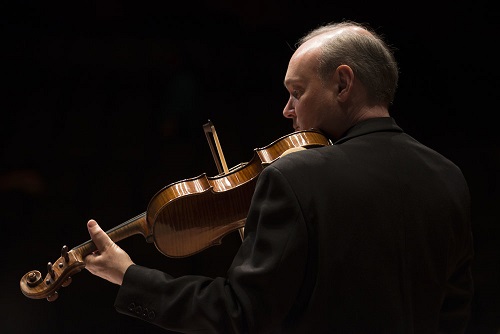
Above: violist Paul Neubauer in a Tristan Cook photo
The second piece on the program was Mozart’s Quintet in C major for Two Violins, Two Violas, and Cello, K. 515 with Paul Neubauer as the additional violist. I had never heard this piece and I found it quite intriguing. When I typically think of quintets, I picture one instrument that functions as a quasi-solo instrument. This piece is pure chamber music in that the distribution of voicing is more even.
The tone of the strings here was warmer than in the Ligeti. Of particular note was the buttery round sound of Ms. Choi’s cello – she seems able to blend with every individual voice in the ensemble and supply a steady bedrock for the group to fall back on. The opening Allegro was delightful, they did an excellent job highlighting all of the inner textures that typically get brushed aside for melodic content.
It was interesting to me that the players managed to have a smooth, legato tone throughout most of the work. Until the fourth movement where some particular sections require more articulation, it felt like one large lush body of sound (even during pizzicatos) without one harsh tone. One of the highlights was the third movement with its interruptions between Mr. Berry’s melody and Mr. Myers. They did a good job with the theatrics of cutting each other off, while still managing to match vibrato and style of playing. It was lovely to hear the difference in timbre between the violin and viola here.
It is great being able to hear strings in a hall like this – it feels like being in someone’s living room in which you can hear every note. These players took advantage, really making every resonant note and dynamic shift count. While I enjoyed the performance, I would have preferred program order in reverse. It was hard for me as a listener to follow up an electrifying, colorful piece with something much more subdued and refined – even when it was as well played as it was here. Nonetheless, the members of the Calidore Quartet proved that they are well worth the acclaim and accolades that they have been receiving. It was a great way to end the last of the Rose Studio concerts for the season.
~ Scoresby
 Oberon's Glade
Leave a comment