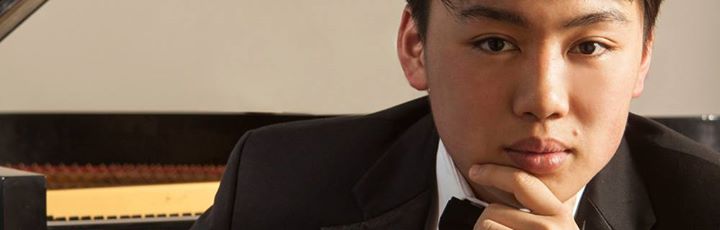
Above: George Li
~ Author: Oberon
Friday October 27th, 2017 – I first heard the young Chinese-American pianist George Li when he appeared at the 2015 Young Concert Artists gala; read about his marvelous performance here. Tonight I was glad of an opportunity to hear Mr. Li again, in a solo recital at Weill Hall.
Small of stature, the 21-year-old pianist is a titan of talent. In a well-devised program this evening, he captivated his large and very attentive audience with playing on the grand scale: and while he is capable of massive volume and of veritable thunderbolts hurled from the keyboard’s lower octaves, Mr. Li also shows expert dynamic control in nuanced phrases and great sensitivity in passages of poetic expression.
Mr. Li’s choice of Haydn to open his program proved ideal. In the composer’s B-Minor Sonata (1776), the pianist was able, within moments, to display his broad dynamic range. The opening Allegro moderato alternated subtle turns of phrase with full-bodied, emphatic motifs. The sonata’s Minuet, a simple melody, turns somewhat grander in the trio section; Mr. Li delineated this shift to perfection. In the somewhat rambunctious final Presto, the pianist teased us with charming pauses between scales and trills, tossing off all the coloratura passagework in this unusual and inventive movement with complete clarity.
The centerpiece of Mr. Li’s program was his interpretation of Chopin’s second sonata, which is built around its famous third movement: the Marche funèbre.
From its turbulent opening, the opening Grave – Doppio movimento gave us a breathtaking display of the pianist’s gifts. The music is alternately seething and pensive, with a rising theme corresponding to a rise in the player’s passion. My notes on his playing were reduced to “Huge!”, “Thrilling!” and “Epic turmoil!” After a brief display of tenderness, the pianist became so searingly rhapsodic that I simply wrote “DAMN!”. In an electrifying moment, Mr. Li sustained the movement’s concluding chord and then suddenly pulled his hands off the keyboard to his chest. It was a gesture I’ll never forget.
Following an agitato start and some darkly wild passages, the second movement turns into a slow waltz. Mr. Li wandered beautifully thru this musical landscape, reveling in his dynamic control. After a return to speediness, the music ends on a fading note: more magic.
The doleful Marche funèbre was poignantly played; we felt the weight of the world upon us in Mr. Li’s deeply mournful phrases. Then a clear, sentimental melody rises from the bleakness. With heartfelt modulations and a caressive softness of touch, the pianist’s playing here was transportive. The march then returns, and gloom settles in once more.
With a scurrying feeling, the sonata’s concluding Presto seems almost like an afterthought in its brevity. After about a minute, Mr. Li’s nimble hands suddenly hesitate and the sonata ends with a briskly struck chord.
The Chopin elicited prolonged applause from the audience, and Mr. Li was called back for two bows; he acknowledged our enthusiasm with a lovely hand-over-heart gesture.
Following a longish interval during which the piano tuner seemed to be performing major surgery on the Steinway, Mr. Li returned with works by Rachmaninoff and Liszt.
I found Rachmaninoff’s Variations on a Theme of Corelli, written in 1931, to be the least interesting music on the program. The theme itself is nothing to write home about; then Rachmaninoff throws everything but the kitchen sink into the variations. Mr. Li brought all his prodigious gifts to this piece, from the simple setting forth of the theme thru the panoramic rhythms and harmonies of the endless variations. The audience were with him every step of the way, but – for all the delights of his playing – I found myself wishing he had programmed something else.
Such notions were swept away with Mr. Li’s choices of the concluding works for his recital: ideally contrasted, Franz Liszt’s meditative the Consolation in D-flat Major found its perfect counter-poise in the mad virtuosity of his Hungarian Rhapsody No. 2.
In the Consolation, the pianist created a dreamlike atmosphere with his delicate, contemplative playing. Then there was a brief silence and Mr. Li launched the Hungarian Rhapsody with its vibrant gypsy themes. Sparkling virtuosity, and a sense of playfulness in his variances of speed and witty pauses, the pianist kept the audience enthralled. The sight of his fingers flying up and down the keyboard at super-speed with mind-boggling.
Engulfed in waves of heartfelt applause, Mr. Li offered two encores from the operatic repertoire, displaying both his sensitive and his uninhibited sides. In the gentle and simple clarity of the Blessed Spirit theme from Gluck’s ORFEO ED EURIDICE and then in the sexy brilliance of the Chanson bohème from Bizet’s CARMEN, Mr. Li summarized his dual nature: as a poet and a virtuoso.
The Program:
- HAYDN Piano Sonata in B Minor, Hob. XVI: 32
- CHOPIN Piano Sonata No. 2 in B-flat Minor, Op. 35
- RACHMANINOFF Variations on a Theme of Corelli
- LISZT Consolation No. 3 in D-flat Major
- LISZT Hungarian Rhapsody No. 2 in C-sharp Minor
~ Oberon
 Oberon's Glade
Leave a comment