~ Author: Oberon
Saturday January 27th, 2018 matinee – The Met have fortunately replaced their unsightly and theatrically tedious Luc Bondy production of TOSCA with a traditional setting of the “shabby little shocker”; it opened on New Year’s Eve with a cast and conductor that had undergone changes in the run up to the prima.
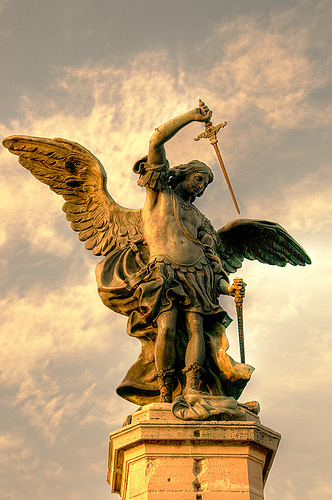
Aside from the dramatic show curtain depicting the Archangel Michael with blood-red wings, I could not see anything of the sets and costumes from my score desk. In April, I’ll get a full-view when the ‘second cast’ takes over.
Other than at performances of TURANDOT, this was the fullest house I have seen at The Met in the past few seasons. Apparently many in the audience found the MetTitles in Act I to be hilarious today, for there was much unbridled laughter.
The orchestra sounded great, and I’ve always liked Emmanuel Villaume’s conducting both in the opera house and the concert hall. His TOSCA was on the grand scale, painted in broad strokes, with tempi that pressed forward; yet there were also the needed lyrical respites where orchestral detail could be savoured. Villaume also allowed his singers to cling to favorite notes, without losing the shape of the music. A volcanic eruption of orchestral sound as the ‘Scarpia Chords’ heralded the Baron’s entry was actually thrilling.
Sonya Yoncheva has been singing her first career Toscas in the present run. My past experiences with her in the theater have been as a pleasant Mimi and a moderately attractive Desdemona. In both those roles, a rather generic timbre and a tendency to sing slightly above pitch rather frequently offset her physical appeal and pretty but unexceptional vocalism. Making a sudden leap (oops!) to Tosca seemed like an unwise move for her; but, since I’m not a fan, do I really care if she blows her voice out?
Her Tosca was sung with unrelenting loudness; it’s a one-colour voice to begin with, and she seemed indifferent to the markings in the score, seldom if ever singing less than mezzo-forte. Being a shade sharp much of the time did not help matters. She’s pushing the lower range, and the top now tends to waver a bit. Overall there was a sense of forcing to fill the big hall.
The “Vissi d’arte” was over-sung, without the pulling back at “Nell’ora del dolore…” that personalizes the aria. In terms of declamation, Ms. Yoncheva melodramatically veered from ‘shrilling’ on “Tu non l’avrai stasera…giuro!” to shouting on “Sogghigno di demone!” Overall, she often seemed fully-extended. Yet her big aria won her a big applause, and I feel she’ll be encouraged to make further forays into roles calling for a more dramatic sound than is hers by nature. I would guess in three or four years she will find herself in a similar situation vocally to the woman she replaced in these performances.
Vittorio Grigolo’s Cavaradossi is likewise a step or two in vocal heft beyond the roles we’ve heard him sing to date. A generous singer, Grigolo pleases the crowd with his unfettered sound; he can zing out top notes that have a real spark but – unlike Ms. Yoncheva – he does on occasion throw in a piano note or turn a phrase more gently.
In the past, Željko Lučić has sometimes annoyed me with his errant sense of pitch in the Verdi roles, but today as Scarpia that problem cropped up only in passing. Following the thundering chords that announce Scarpia’s arrival in the Church of Sant’Andrea della Valle, Mr. Lučić unleashed his own thunderbolt with “Un tal baccano in chiesa?!”, catapulting to a house-filling top note. He alone of the three principals seemed to be doing something with the the words, and his singing veered from ripe power to velvety insinuation. As Tosca fled the scene after their encounter, Mr. Lučić’s Scarpia laid the groundwork for his plot. In the ensuing Te Deum, baritone, chorus, and orchestra combined forces for genuinely exciting finale to the first act.
Lučić continued to impress in Act II, despite the occasional flat note. Ferocious in his questioning of Cavaradossi, feigning cordiality as he drew Tosca to the bargaining table, brazenly expounding on his lechery in “Gia, mi dicon venal”, the Serbian baritone joined the ranks of my favoured Scarpias over the decades: Anselmo Colzani, Cornell MacNeil, Sherrill Milnes, Robert Hale, Frederick Burchinal, and Justino Diaz.
It’s rare to hear a Sacristan who really sings: Patrick Carfizzi put the emphasis on the notes, and let the comedic aspects of the character take care of themselves. He sounded fantastic.
I was planning to stay for the third act, but as so often happens at The Met, the endless intermission got on my nerves and so, after a while, I packed up and headed home.
~ Oberon
 Oberon's Glade
Leave a comment