~Author: Scoresby
Tuesday April 17 2018 – Oddly, I have never had the chance to hear the pianist Richard Goode before. While a seminal figure in the American piano scene, I always seemed to not be able to make his performances. Thus, I was grateful to hear him live first on Lincoln Center’s Great Performers Series in program that ran in chronological order (spare the encore) over 300 years of music history.
The program opened with the Second and Third Pavians and Galliardes from Byrd’s My Ladye Nevells Booke of Virginal Music. While stunning music due to Mr. Goode’s pinpoint articulation – I couldn’t help but feel a layer was missing from the music by hearing it on the piano. The many trills and ornaments sound far heavier on a piano. Nonetheless Mr. Goode highlighted the harmonic progressions and layered the voicing so the audience could always hear the melody through those ornaments. In the Second Pavian, Mr. Goode let the large groupings of arpeggios having a flowing sound – he crafted melodic line to be joyous and full of energy. In the Galliarde to the Second Pavian, Mr. Goode loosened some and let the music have a more spontaneous feel, but still captured the dance form.
The second work on the program was Bach English Suite No.6 in D minor, BWV 811. In the opening Prelude, Mr. Goode seemed to have an improvisatory feel to the music – a lot less structured than the Byrd earlier. As the prelude turned into a fugal section, Mr. Goode seemed to eschew the carefree style for rigid structured and lucidity. It was a wonderful transition that let him highlight the quiet beauty in the inner voices and left hand of this denser section. As the prelude escalated in intensity, he took advantage of the piano’s wide dynamic range to let it boom like an organ. Mr. Goode took a brisker pace for the later movements. This worked particularly well in the charming Gavotte I and II. With the speed of the trills and folk-like allure, the Bach seemed to echo the Byrd from earlier. This seemed quite intentional every part of the program seemed to be strung together with a few different ideas. In the speedy Gigue that ends the suite, Mr. Goode seemed to at once capture the rhythm and get into a more dancelike idiom. His left hand’s clarity is rare in a pianist and he used it to build the intensity in each of the scales, adding drama to this finale. Despite having a light touch to the keys, Mr. Goode seemed to be able to build a large sound without sacrificing clarity.
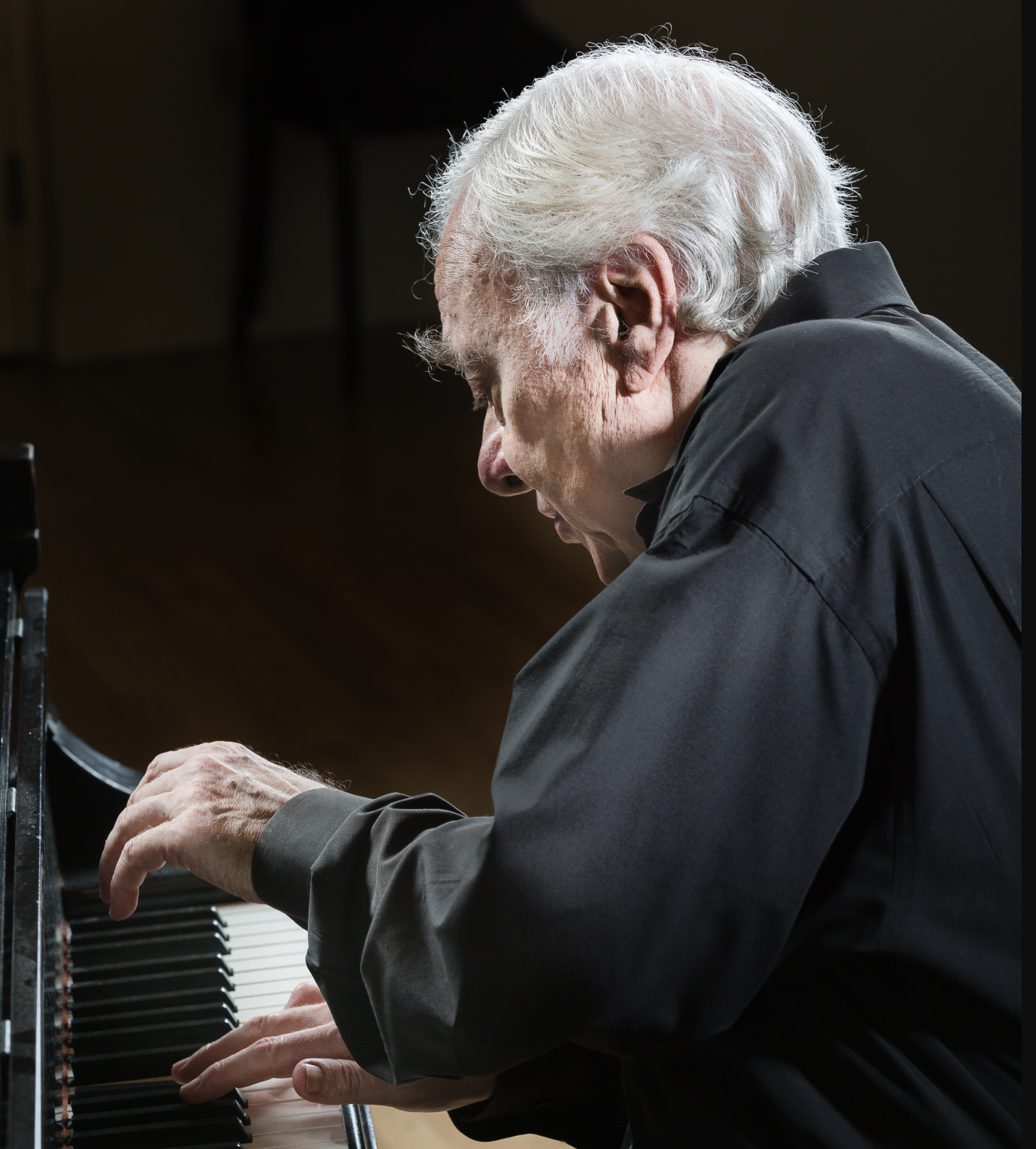
Above: Pianist Richard Goode; photo credit: Steve Riskind
The highlight of the program was hearing Mr. Goode’s interpretation of Beethoven Sonata No. 28 in A major, Op. 101. Mr. Goode was the first American pianist to record all 32 of Beethoven’s sonatas; his expertise in the music showed this evening. Mr. Goode’s style of playing seems to revolve around painting the exacting structure of the music, so in the Beethoven he eschewed some of the more sentimental elements of the work to do this. While I personally find it sometimes a bit cold, it is interesting to hear a fresh and insightful interpretation. In the lyrical opening, Mr. Goode seemed to take a straightforward approach that pushed the music along. At first he kept his playing quiet and measured, but he seemed to emphasize the expansions into different registers and bell-like chords that appear littered through the work. While some pianists use these chords as a simple break, Mr. Goode made sure that each time they appeared they were a harmonic feature that drove the piece. Similarly as the first movement unfolded, he let the left hand’s drone sing clearly.
The second movement is famous for its odd Schumann-esque march. Mr. Goode let the driving rhythmic structures take precedent, echoing the bell-like motif from the first movement. He also made sure all the jazzy riffs had spunk to them, which echoed the Debussy to come. The most fun part of the night was during the giant fugue that ends the work. Mr. Goode managed to make the exciting fugue have pristine clarity, only to be quiet in to the romantic opening of the piece. The humorous coda at the end of the work seemed to have a few audiences members smiling as he finished.
The final work on the program (after intermission) were the Debussy Préludes, Book 2. Mr. Goode’s interpretation, while beautifully played, felt a little too monotone for my taste. Nonetheless, in the third image La puerta del vino, he managed to capture both the Spanish rhythms and bursts of different colors. The Ondine suited his style of playing well, letting each of the arpeggios ripple through with exacting phrasing. He capture the eccentricity of Hommage à S. Pickwick Esq. P.P.M.P.C., getting an earthier, Rachmaninoff- sort of sound. The tinkling of the folksy dance and humor during the contrasting section of the work harkened back to the Barqoue works earlier. It is clear that Mr. Goode manages to unify his programs by highlighting the common strands between works.
The audience seems to love Mr. Goode, giving him a hearty ovation following the exciting Feux d’artifice. After all the applause Mr. Goode played an extended encore: Chopin Barcarolle in F-sharp major, Op. 60. While the perfect closing piece for the program (according to Mr. Goode’s remarks the Barcarolle was a favorite of Debussy’s) and a pleasurable indulgence it felt a little long-winded to add on to the end of the performance. Nonetheless, Mr. Goode’s playing was just as thoughtful and free as earlier, closing the recital on a high-note.
 Oberon's Glade
Leave a comment