
Above: Alfred Roller’s 1903 set design for Act II of TRISTAN UND ISOLDE
Ben Weaver writes about some of his favorite recordings (and a DVD) of Wagner’s TRISTAN UND ISOLDE. Ben, a longtime TRISTAN addict, helped me to break down my resistance to this opera when we stood thru three performances of it – including Waltraud Meier’s only Met Isolde – in 2008. Prior to that, I had only seen the opera once, in 1971, with a stellar cast in a then-new production. In part, it was the magic of that performance that kept me from seeing it again for so many years: I felt nothing could compare.
Earlier this year, I watched several video versions of the opera, becoming thoroughly immersed. The Met’s DVD, in the production that has moved me so much, is rightly hailed by Ben Weaver at the end of his article. Levine and the orchestra are splendid, and if Jane Eaglen and Ben Heppner are not physically everyone’s idea of how the lovers should look and move, to me they create all that is needed with their voices. Add Dalayman, and Pape, and the marvelous settings, and…voilà!…TRISTAN!
Here is Ben’s article:
“Richard Wagner’s 1859 opera Tristan und Isolde was declared unplayable by orchestra musicians and un-singable by singers. Wagner spent nearly 6 years after completing it trying to get it staged. He failed repeatedly. Rio de Janiero, Strasbourg, Paris, Karlsruhe, Dresden, Weimar, Prague were all failures. Over 70 rehearsals in Vienna led to cancellation of the scheduled premiere. Finally the generosity of King Ludwig II of Bavaria – who would also pay for Wagner’s theater in Bayreuth – allowed the world premiere to take place in Munich on June 10, 1865 with the husband and wife team of Ludwig and Malvina Schnorr von Carolsfeld singing the title roles, with Hans von Bülow – with whose wife Wagner was having an affair – conducting. After only 4 performances, on July 21st, the tenor suddenly collapsed and died. Rumors began circulating that the exertion of singing the part of Tristan killed him. That’s probably not true, although the opera did additionally claim the lives of two conductors: both died in the orchestra pit during Act 2 – Felix Mottl in 1911 and Joseph Keilberth in 1968.
Tristan is certainly one of the most challenging operas in the repertoire, and great Tristans and Isoldes do not come around very often. There are even fewer who can sing the voice-wrecking parts for long without damaging their voices beyond repair. Some opera houses have gone decades without mounting it for lack of adequate singers. On record, the opera has fared better, in part because some singers who never attempted it in the theater agreed to sing it for a microphone.
The first complete studio recording of Tristan und Isolde came in 1952 courtesy of EMI and the great Wagnerian Wilhelm Furtwängler. Furtwängler’s take on the opera is uber-Romantic. His conducting style could be traced back to von Bülow. Furtwängler’s tempos are slow, but the music never sags and never loses its pulse. His grasp of the totality of the work – the control over Wagner’s revolutionary redefining of tonality and chromaticism – is total. Sometimes the slow tempos reveal facets of the narrative that other, speedier performances don’t: for example when the sailors mock Isolde in Act 1 – the deliberateness of the tempo under Furtwängler makes their words far more threatening than the usual light mocking laughter. The Philharmonia Orchestra – at the time one of the finest ensembles in the world – plays exceptionally well. The opening Vorspiel builds magnificently, its climax washes over like an ocean wave.
Kirsten Flagstad, who by 1952 had been singing Isolde for decades (albeit usually in heavily abridged form) and would soon retire from the stage altogether, is Furtwängler’s regal Isolde. But though her large voice is still in fine shape – warm, rich, for the most part even throughout the range – Flagstad is more of an aging Queen Isolde, not a spirited princess. And her highest notes can turn acidic and tight. (There’s a myth that Flagstad’s high C in Isolde’s Curse was actually sung by Elisabeth Schwarzkopf.) Flagstad’s exchanges with a youthful Blanche Thebom as Brangäne rather emphasize her advanced age. Tenor Ludwig Suthaus is an excellent Tristan: a true heldentenor, his voice is big, warm and rich. And he is tireless in Act 3. He has excellent grasp of the words too, doing far more word-painting than Flagstad. For all her considerable stage experience with the role Flagstad can be indifferent to details; for the big moments she always finds the necessary vocal and dramatic bite, but some of the longer monologues – her Act 1 confrontation with Tristan – can cause drowsiness. Even masterful orchestral accompaniment and Furtwängler’s genius can’t make up for a sometimes absent soprano. The young Dietrich Fischer-Dieskau is a superb Kurwenal: cocky in Act 1 and terrified for his master in Act 3.
A note on the 1952 recording, produced by Walter Legge: disappointing…the mono sound, though clean and full, in the louder moments loses a lot of detail, especially where the voices are concerned. In spite of its historical significance, the chance to have a complete Isolde from Flagstad (alas, too late) and the superb musicianship of Wilhelm Furtwängler, this famous recording would not be a first choice in a collection.
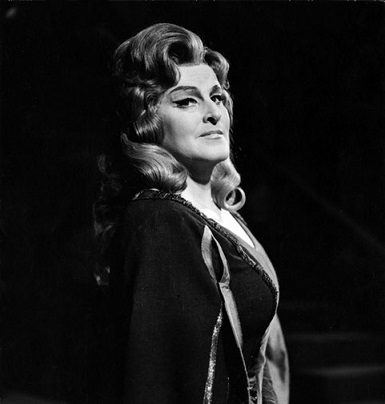
Above: Birgit Nilsson recorded Isolde commercially twice
As Flagstad retreated from the stage, legendary Swedish soprano Birgit Nilsson became the leading Isolde (and Brünnhilde) of the post-war era. Her huge, tireless, piercing Nordic soprano – soaring effortlessly over any orchestra and conductor – was known to pin listeners to their theater seats. She sang Isolde in any opera house worth its reputation. Her debut as Isolde at the Metropolitan in 1959 made the front page of the New York Times. One staffer at the Royal Opera House in London once told Gramophone magazine that everyone was always surprised to find the back wall still standing after a Nilsson performance. But for all her vocal supremacy, Nilsson was also often criticized for being too cold and generalized in her interpretations. She was not a natural-born dramatist and in the theater the singular glory of her voice may have been enough, but how do her interpretations fare on record?
Nilsson recorded the role of Isolde on two official sets (and numerous pirates.) The earlier Nilsson recording captures her in the early stages of her stardom with conductor Georg Solti. Made in Vienna in 1960, just as he began committing his legendary Ring to disc with producer John Culshaw, Solti’s Tristan (also produced by Culshaw, but lacking the Ring’s sound-effects orgy) is very much in keeping with Solti’s general approach to music making: the fiery Hungarian could whip an orchestra into a frenzy like no one else. And “frenzy” doesn’t necessarily mean speed. Some conductors think they are achieving excitement by playing fast. The fury Solti could bring out from musicians was a combination of volume and sheer intensity of feeling. The apocalypse was never far off the page in a Solti performance. But he was not incapable of introspection and tenderness. That was one of the glories of a great Solti performance.
So it is with his Tristan und Isolde. It is a great Solti performance, with the glorious Vienna Philharmonic making each note glow, seethe and sigh. The Prelude is a gorgeously executed tone poem, recorded with crystal clarity by Culshaw. The plucking strings are like hammer blows, which is dramatically apropos. Birgit Nilsson establishes her vocal supremacy right off the bat. Her steady, steely voice presents a resentful Irish princess you don’t want to mess with. At the end of Isolde’s Curse, Nilsson launches fearless and fearsome vocal daggers – perhaps unequaled by another soprano. Nilsson’s voice is in supreme shape here. But the criticisms of coldness are not invalid. While Nilsson’s fury can be second to none because of the natural power of her voice, in her interactions with the Tristan of Fritz Uhl, Nilsson hints at but never fully embraces tenderness and desperation. In many ways she’s the perfect foil for Solti. Their approaches to music and drama are on the same page. To achieve true pathos Solti needs a naturally dramatic performer and he does not have that in a young Nilsson. By focusing on Nilsson’s natural vocal strengths he does not help her bring out Isolde’s love for Tristan or true transfiguration in her Liebestod – which is magnificently sung, but cool.
Fritz Uhl, today a nearly forgotten Austrian tenor, comes much closer to true pathos as Tristan. Uhl had a warm, sturdy voice, with weight and power and easy high notes, and his transformations from a cold soldier who swore to bring his friend King Marke a beautiful bride in the first half of Act 1 – to a surprised lover after drinking the potion – to a lovesick romantic in Act 2 and finally to a tortured and abandoned lover in Act 3 – are mostly believable, even if they lack the very last ounce of conviction to be complete.
The Brangäne of Regina Resnik is a matronly disappointment here; she sounds like Isolde’s nagging grandmother (though Resnik was actually younger than Nilsson.) Perhaps she would have been a better partner for Flagstad. Tom Krause is a fine Kurwenal and Arnold van Mill’s booming bass is perfectly acceptable and unexceptional. The great tenor Waldemar Kmentt appears in the brief role of the Young Sailor.
Nilsson’s second official recording of the opera – made live in Bayreuth in 1966 with conductor Karl Böhm – is one of the great performances of any opera committed to record. Here Nilsson found a perfect foil in Böhm, whose ability to inspire singers to feel was far greater than Solti’s. Böhm’s is a less hectic reading, too; it may come as a surprise that Böhm’s tempos are actually significantly faster: he clocks in at 20 minutes under Solti. And yet, for all his speed, Böhm manages to present a warmer reading of the score, a more romantic one, with more ebbs and flows than Solti. With that, Böhm surrenders nothing on intensity in the opera’s dramatic moments. There are passages of unforgettable power: Nilsson puts to rest accusations of dramatic indifference. Her Isolde here is a complete portrait. Haughty in Act 1, shattering rage and fury in her Curse and melting tenderness after taking the potion and in the Love Duet in Act 2. The sorrow of her Liebestod is transformative. And she is in spectacular vocal shape as well, tossing off every high note effortlessly, her middle shimmering with warmth.
Nilsson’s partner is Wolfgang Windgassen, the most famous Wagner tenor of the post-war era. Wolfgang Wagner once joked that “When Windgassen stops singing we might as well close the Festspielhaus.” Windgassen’s voice is an acquired taste. He was singing essentially outside of his natural vocal abilities, but sheer will power and strong technique kept him signing Wagner’s voice-wrecking roles for many years. He can sometimes sound dry and frequently at the absolute limit of his abilities. But his command of the role is undisputed. In the Love Duet, Windgassen and Nilsson sing as if truly only to one another. And in Act 3 Windgassen creates a devastating portrait of a man coming undone.
Above: Christa Ludwig as Brangäne, with her potions
The supporting cast could hardly be improved: Christa Ludwig’s Brangäne (her perfectly-judged fussiness in Act 1, heavenly warnings to the lovers in Act 2), Eberhard Wächter’s gruff Kurwenal and Matti Talvela’s youthful, devastated King Marke (the shimmer and sob in his voice could melt stone) are vocally and dramatically perfect. Also lovely to have a young Peter Schreier as the Young Sailor to open the opera. The Bayreuth Festival Orchestra is magnificent too, though coming from the covered pit of the Festspielhaus the recording creates a far different soundscape than Solti’s studio balanced Vienna Philharmonic. Many have commented that Böhm’s Tristan provides a great example of Bayreuth’s famed acoustic. The fully integrated sound between voices and orchestra, often imitated but never duplicated, was beautifully captured by the engineers.
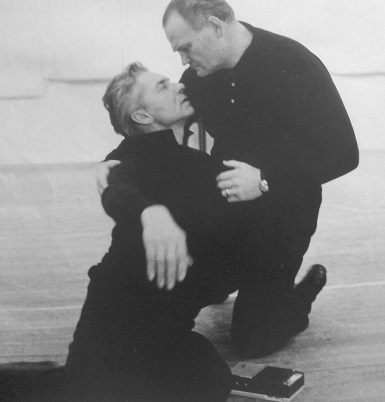
Above: Herbert von Karajan and Jon Vickers rehearsing for Karajan’s Walküre production, 1967
Herbert von Karajan’s recordings of the Ring in the late 1960s surprised many listeners because Karajan took what many called the “chamber” approach to the scores. He lightened and thinned out the textures to reveal hidden layers. They are magnificent performances and fascinating recordings. If anyone expected Karajan’s Tristan to do something similar with Wagner, they were sorely disappointed. Karajan’s Tristan is like granite: heavy and humorless. This would not be a problem if only the recording’s producer, Michel Glotz (no doubt with the conductor’s approval), did not create a highly manipulated soundscape with the volume of the magnificent Berlin Philharmonic flying from extreme ‘Is anybody making a sound?’ to ‘Holy shit, my ears are bleeding.’ The extreme – very extreme – dynamic range makes the recording practically unlistenable. It is an exercise in futility to find some sort of middle ground with the volume knob. Perhaps future remastering of this recording will give listeners something more aurally reasonable.
When it comes to the performance itself, it is echt-Karajan as he began entering his autumn years: there’s a heaviness and a lack of flexibility, no matter how virtuosic the orchestra. Although I find this to be more true of his recordings made for EMI in the 1970s (like this Tristan, but also his Fidelio and Der fliegende Holländer) than for DG. (The one happy exception was Karajan/EMI’s stunning, lights as a summer breeze Die Meistersinger von Nürnberg with the Staatskapelle Dresden.)
Karajan found the perfect Tristan to match his heavy approach: Canadian tenor Jon Vickers. Vickers’ Tristan has, frankly, never been equaled on record. His is an overwhelming, searing portrayal of a proud Knight who sacrifices his pride for love. Vickers’ Act 3 is the stuff of nightmares; his anger, rage, misery and hopelessness will send chills down a spine. No other tenor, no matter how good he is, has come close to the devastation Vickers leaves in his wake.
It’s almost unfair to the rest of the cast, but they manage to hold their own. The Isolde is Helga Dernesch and though Dernesch sang many heavy soprano roles – including Brünnhilde and Beethoven’s Leonora for Karajan – she was not a true soprano. In fact, in just a few years she transitioned to the more comfortable mezzo roles and sang for many more years. There are signs of vocal strain in her Isolde; Karajan’s leisurely tempos certainly don’t help her cope with Wagner’s demands. But Dernesch is an imaginative, sensitive actress and her shimmering, moving performance only needed a more sensitive conductor. Christa Ludwig repeats her familiar Brangäne, but everything about her performance was better for Böhm. Walter Berry is a reliably excitable and sensitive Kurwenal, and Karl Ridderbusch’s magnificently sung Marke is one of the finest on record.
About 10 years would pass before another new Tristan would surface on record. Carlos Kleiber’s notoriously limited repertoire fortunately did include Tristan. He conducted it for several seasons in the 1970s at the Bayreuth Festival and recorded it for DG in the early 1980s with the glorious Staatskapelle Dresden. Always the meticulous musician not prone to cheap thrills, Kleiber’s performance is cerebral, fast and lean. His tempos occasionally feel rushed, but overall his performance clocks in close to Solti’s. The Staatskapelle Dresden, producing one of the most unique orchestral sounds in the world, is a balm for the ear. Not even Vienna and Berlin Philharmonics could produce such consistently gorgeous, warm sounds and they respond to Kleiber’s aristocratic view magnificently. The real uniqueness of this performance, though, are the singers, all of whom had extensive experience with Lieder. Kleiber’s is the most word-conscious and conversational Tristan on record. Every word is etched out by the cast as if writing in stone, every reaction is rooted in the words that came before. Tristan is at its core a series of dialogues and no other group of singers on record has collectively paid the kind of attention to Wagner’s text as Kleiber’s singers do.

The Welsh soprano Dame Margaret Price (above) was Kleiber’s surprising choice to sing Isolde. It’s a part she never sang on stage and Wagner was not part of her repertoire. A true Mozartian, Price possessed one of the most beautiful voices in opera. Rich, pure, warm, lyrical, even throughout its extensive range, Price never produced an ugly sound. Her Isolde is the most feminine princess of all. At the most dramatic moments she is singing at capacity, but never falters. Her faithful companion Brangäne is sung by the great Brigitte Fassbaender and their conversations in Act 1 and 2 are truly conversations: there’s an intimacy and warmth between them other singers don’t replicate. Tristan is sung by the veteran heldentenor René Kollo. Kollo’s is not a traditionally beautiful tenor. (But he is a real tenor). There’s a rawness to his sound and occasional unsteadiness in the upper reaches of the voice. But he’s an intelligent enough of an artist to make Tristan truly interesting. He never approaches Vickers’ overwhelming hysteria, but this is a different type of performance. Kollo fits perfectly into Kleiber’s Lieder interpretation. Kollo’s confrontation with Isolde in Act 1 borders on the angry, but in the Love Duet (the orchestra shimmering as if stars themselves were singing) Kollo and Price are glorious. They nearly whisper their lines. Kollo’s Act 3 hallucinations expose his ravaged voice, but his commitment to the drama and the beauty of the orchestral accompaniment wash the vocal flaws away.
The same is also true of Dietrich Fischer-Dieskau’s Kurwenal. Long past his vocal prime, if anyone can claim the crown of Lieder King, it’s Fischer-Dieskau. Vocally gruff, he makes every utterance count. And then there’s the Marke of Kurt Moll. Possessing one of the most extraordinary and unique voices in opera – ever – Moll is a giant among basses. He could sing the phone book and I would want to bask in the beauty of the sound. The fact that he is such a moving actor makes his Marke’s Monolog one of the most glorious things ever recorded.
Other notable recordings of Tristan include Leonard Bernstein’s: the conducting is stunning. Karl Böhm is said to have attended some rehearsals and declared it to be the finest Wagner conducting he’s ever heard. Bernstein is fortunate to have a deeply moving Isolde of Hildegard Behrens. But the tenor Peter Hoffman is really not to everyone’s taste – he certainly is not to mine. His mushy, core-less voice all but ruins what could have been an all-around great performance.
Daniel Barenboim’s very fine recording with the Berlin Philharmonic is beautifully conducted as well. Barenboim is one of our finest living Wagnerians. His interpretation is broad and dramatic; and it is wonderfully recorded. Waltraud Meier delivers a powerful Isolde; it became a signature role for Meier, one of the most intelligent and powerful singing actresses of our time. (Meier’s performance of Isolde’s Narrative and Curse at James Levine’s 25th Anniversary Gala at the Met is truly one of the most memorable operatic performances. Everyone watching collectively held their breath for 10 minutes.) Here she is perhaps slightly studio-bound, but the comfort of the studio also lets her sing without fear. Meier is really a high mezzo, definitely not a soprano, so her extensive forays into the soprano realm (Isolde, Sieglinde, Beethoven’s Leonora, Berg’s Marie) came with some risk and occasional concern. Not so here: she sings gloriously. Siegfried Jerusalem’s Tristan is a predictably solid interpretation: he is vocally secure and dramatically sensitive. Matti Salminen’s majestic Marke is unforgettable.
Antonio Pappano’s studio recording boasts a unique Tristan of legendary tenor Plácido Domingo. It is a role Domingo never attempted on stage and perhaps he waited just a little too long to take on the role. He is slightly paternal to the youthful Isolde of the young Swede Nina Stemme. But Domingo sings – lord, does he sing it! The warm, rich Italianate tenor, a lifetime of singing bel canto and Verdi, truly shows. He understands the drama too, even if he doesn’t have the word-painting of Vickers and Kollo. Nina Stemme, just starting her international career, is in glorious voice as Isolde. A tad too young for Domingo, but she can sing it beautifully too. The voice is rich and steady, even throughout the range, and beautiful in its slightly icy Nordic timbre.
Christian Thielemann’s live Vienna recording of the opera is surprisingly forgettable for a conductor as good as he is. All the notes are there and Vienna Philharmonic, of course, knows their way around the score. But there’s little sympathy between conductor and his singers. The star of the set is Deborah Voigt, who sings quite movingly and beautifully. But the whole proceeding is thrown into chaos with the opera’s final note: Voigt lands on the final note way off pitch. These things happen, of course, and this is a live performance. But why would Deutsche Grammophone not fix this before releasing it commercially? Why would Voigt not insist on fixing this glaring mistake which is the last impression we have of the whole thing?
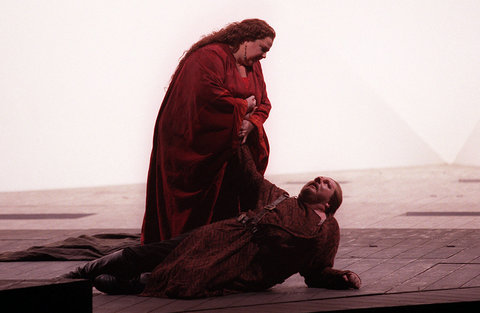
Above: Jane Eaglen and Ben Heppner in The Met’s DVD recording of Tristan und Isolde
And very much worth mentioning is the video recording of Tristan from the Metropolitan in 1999, conducted by James Levine. With these performances the Met broke a 20 year drought of Tristan – last time they staged staged the opera was in the early 1980s because they did not think anyone after that was up for the challenge … until the arrival of Jane Eaglen and Ben Heppner. Eaglen’s voice – large, rich, feminine, with a solid middle and bottom and an easy top – all effortlessly produced – was perfect for the role. And her successes singing parts like Bellini’s Norma and Mozart’s Donna Anna, Eaglen had the much needed flexibility and warmth. Because she was a very heavy woman, and not a particularly graceful one, inspiring many mean-spirited comments from nasty nobodies, people often project dullness to her dramatic involvement and musicality. That has always been simply false. Eaglen was, in fact, an extremely musical singer with a keen sense of drama and humor. I have listened to audio-only recordings of her performances (Isolde and Brunnhilde from the Met especially) and the care Eaglen puts into her reading of the text is really beyond reproach. And her singing is marvelous too. She truly was a unique Wagnerian soprano who combined a big, easy sound with a beautiful voice and stamina to sound like she could do another round at the end of every performance.
Ben Heppner was a frequent partner for Eaglen. Though Tristan was perhaps just a tad too heavy for him – and I often feared that he would not make it through the performance (he almost always did) – Heppner always sang beautifully and intelligently. He and Eaglen made a glorious couple. The Met production, staged by Dieter Dorn and designed by Jürgen Rose with lights by Max Keller, was one of the most greatest things in the Met’s arsenal. Dorn staged it perfectly for Eaglen and Heppner, taking their physical limitations (especially Eaglen’s) and using them as strengths, and the stunning semi-abstract designs by Rose and magnificent lighting Keller created truly unforgettable imagery. (Magically, Eaglen and Happen sing the Love Duet in the dark.) The supporting cast of Katarina Dalayman as a superb Brangäne and a searing Marke of René Pape – with the glory that was the Met Orchestra under Levine in what we now recognize was everybody’s heyday – make this video one of the finest the Met ever produced and the finest video recording of Tristan und Isolde. What a shame that Peter Gelb threw it out – after only 20 performances – for something vastly inferior.”
~ Ben Weaver



 Oberon's Glade
Leave a comment