~Author: Scoresby
Thursday October 25 2018 – The difference between hearing a particular musician live versus hearing a recording of them can be extraordinary. For Pierre-Laurent Aimard and Tamara Stefanovich‘s two piano performance in Carnegie’s Zankel Hall, I was excited by the repertoire but unsure how it would be performed. Familiar with Mr. Aimard’s many recordings but never having heard him live, I have always thought of him as a thoughtful, but somewhat understated pianist. This duo proved me wrong in one of the most exciting and beautiful performances I’ve heard in the past few years.

Pierre-Laurent Aimard and Tamara Stefanovich during last night’s recital; Photo Credit: Steve Sherman
This was a concert of equals, exchange, and contrasts. To begin the program, they selected seven works from Bartok’s Mikrokosmos. For those who haven’t studied piano, the Mikrokosmos occupy an odd place: wonderful short studies meant to illuminate aspects of technique/musical thinking ranging from the beginner (Book 1) to virtuoso performer (Book 6). Bartok made sure that each of these were compositionally interesting and many are imbued with folksy melodies.
The short selection Ms. Stefanovich and Mr. Aimard drew from covered the range of styles. One was the Debussy like Chord and Trill Study in which Mr. Aimard played a constant Debussy-like trill to Ms. Stafanovich’s chordal melody. The light touch and exquisite pedaling made this short study shine. In the aptly named New Hungarian Folk Song (originally for voice and piano), they brought out the Messiaen-like textures in the base chords below the lyrical melody. To end the selections they played the Ligeti-like Ostinato trading accents and rhythms with each other. It was a nice launching point for the rest of the evening.
Next was Ravel’s very early work Sites auriculaires which consists of a Habanera in the first movement and a second movement titled Between bells. In the Habanera, Mr. Aimard plucked out a sensual low pulse that is kept quietly moving through the movement while Ms. Stefanovich brought a clean sound to the more melodic part. The performers made the most of the luscious bell-like sonorities in the opening of Between bells that sound like later Ravel, full of whole tones with large dynamics. The silken middle section was given a soft pedaling and lots of space to let the notes resonate.
The major work on the first half of the program was the US Premiere of Harrison Birtwistle’s Keyboard Engine, A Construction for Two Pianos. Like the rest of the program, this piece is a study in opposites: ranging from dynamics, thematic material between performers, rhythmic contrasts, toccata like lines paired with heavy chords, and many others. The two pianos seem split in this material – always interrupting the other with its contrast, sometimes aligning to produce a new sonority altogether. After a dodecaphonic sounding start of quiet repetitious notes the music roars to life with sudden loud dynamics in the extreme registers of the piano. The pianos are slowly exchanging a call and answer type format and the dialogue between them becomes more frenzied. After a brief respite with dreamy material, a rapid pace ensues with an ostinato that is punctuated by polyrhythms in both instruments. Both performers seemed to gleefully indulge interrupting the other’s lines and hitting giant chords in sync.
These spacious and frenzied passages continue to alternate for the remainder of the work and each time a passage moves in to the opposite extreme it takes on slightly different material. Ms. Stefanovich and Mr. Aimard managed to capture the frenzy, intimacy, and mischievousness that this piece has – it would be fantastic for two dancers to stage given the many contrasts. One of my favorite sections was near the end when Mr. Aimard’s piano begins to create sympathetic vibrations with the other piano by holding down specific keys with the sustain pedal. These transfers of sound and timbre gave a bell like quality to some of Ms. Stefanovich’s chords. I found myself transfixed in the jazzy riffs of rhythm and spinning themes of the piano. It must take incredible coordination to pull off such an assured performance of this work that seemed to be perfectly both in and out of sync. It was a pleasure to see both pianists studying each other carefully for cues.
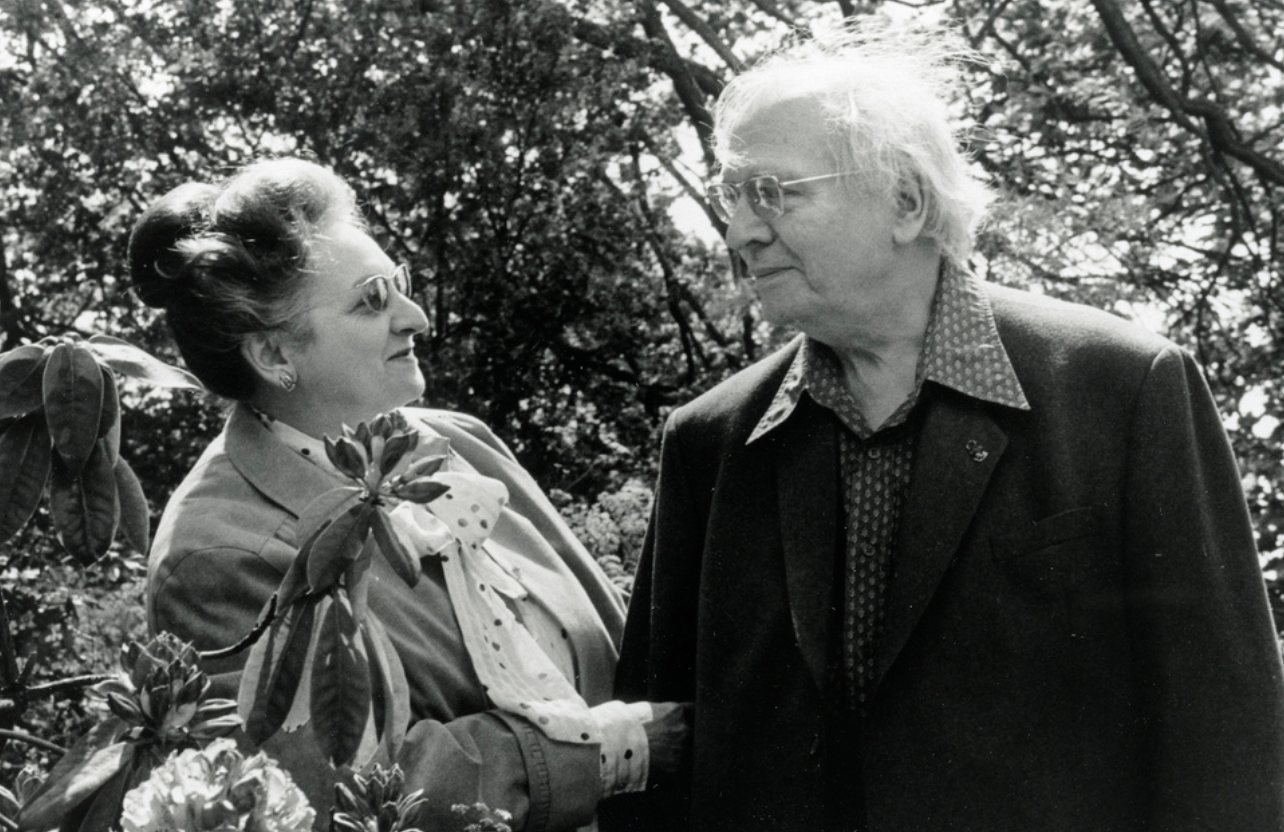
Above: Loriod and Messiaen many years later, still in love
The treat of the evening came after intermission in the form of Messiaen’s Visions de l’amen. This sprawling seven movement, 50-minute (small for Messiaen’s standards) work is a classic two piano piece with each of the movements dedicated to a vision of a reason to be thankful (or an amen as Messiaen puts it) – this is a cosmic, mystical piece of music in a way only Messiaen can deliver. Like the Birtwistle work, each piano has its own distinct voice – a fleeting, fast ethereal part that was written for Messiaen’s future wife Yvonne Loriod and an earthier chordal part written for himself. Ms. Loriod was perhaps the greatest contemporary music pianist of the 20th century and the dedicatee of almost all of Messiaen’s piano music – they had a partnership of equals. Ms. Stefanovich took on Loriod’s voice and Mr. Aimard took Messiaen’s.
Before the opening Amen of creation, the performers took a good two minutes on stage letting the audience quiet down and the rumbling of the subway beneath to pass before beginning. Mr. Aimard managed to make the ppp in the score for his primordial opening sound like a whisper coming out of the slight noise from the crowd earlier before introducing the main melodic theme of the work. Meanwhile, the pppp high-pitched bells from Ms. Stefanovich rang in a soft, but lucid texture. The creeping in Ms. Stefanovich’s part is classic Messiaen – a song of the stars that is continually moving atop Mr. Aimard’s expanding chords. The interaction between the two is like light hitting stained glass and creating refractions – the light being Ms. Stefanovich’s bending colors. The music continued getting faster and louder as the “Creation” unfolded until the resonance from the piano held in the air with one last loud chord. In the next movement’s long introduction, Mr. Aimard nailed the jazzy harmonies and riffs barrowed from the Quartet from the End of Time’s sixth movement in the low register. Ms. Stefanovich’s managed to play through the rapid bird like sequences in the high reaches of the piano in a sing-song fashion in perfect time with beefy chords from Mr. Aimard. This exchange and dialogue of thematic material was so much fun to both watch and hear.
One of my favorite moments from the evening was after the first outburst of passion in the Amen of desire. The music got very quiet producing a moment of éblouissement. Mr. Aimard played a tender love theme while Ms. Stefanovich in the tinkled a taught, but honeyed variation of the original ‘star’ melody in the upper registers. The quiet sensitivity of Ms. Stefanovich’s made the music sing. This gave way to a loud run of manic, effervescent love at the climax of the movement with both performers seemingly investing all of their energy. It was clearly that this work is personal to both of them. Only the ending of the Amen of the consummation got even louder, more manic, and extreme in its sound.
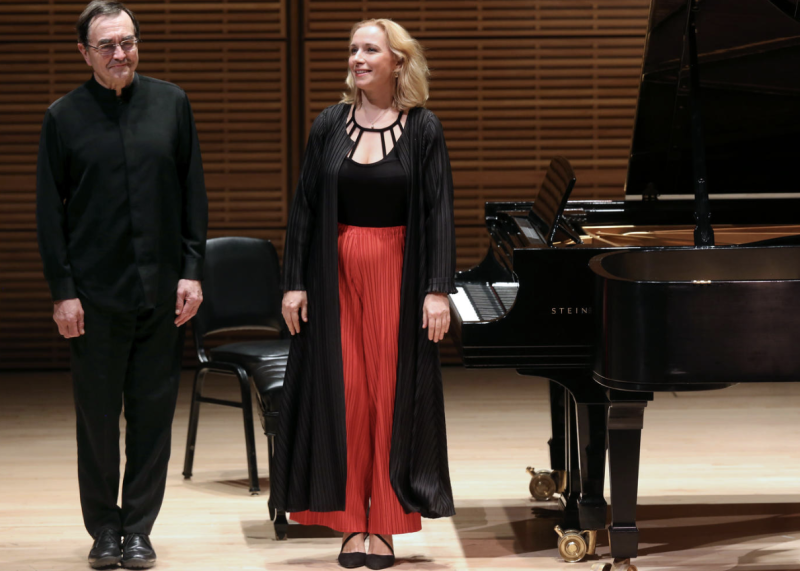
Pierre-Laurent Aimard and Tamara Stefanovich; Photo Credit: Steve Sherman
Through all the dense textures, both performers managed to emphasize Messiaen’s stunning language taking through the virtuosic runs of Ms. Stefanovich’s high register and the huge chords of Ms. Aimard’s lower register. In the fffff final, organ like chords spanning the register of the entire piano the audience gave a well-deserved rapturous applause before the notes even decayed. They ran the gamut of textures, timbres, and emotions – ending in exaltation. As one more conservative in taste neighbor near me put it “I never thought I’d like that sort of modern music, but hearing that piece in person was like a religious experience!” Indeed it is and it is difficult to get a sense of the proportions of such a piece from a recording.
— Scoresby
The Performers:
Pierre-Laurent Aimard, piano
Tamara Stefanovich, piano
The Repertoire:
Bartók: Seven Selections from Mikrokosmos
Ravel: Site auriculaires
Birtwistle: Keyboard Engine, A Construction for Two Pianos
Messiaen: Visions de l’amen
 Oberon's Glade
Leave a comment