
Above: violinist Maxim Vengerov
~ Author: Oberon
Tuesday October 30th, 2018 – Three wonderfully contrasted violin sonatas were on offer tonight at Carnegie Hall as the renowned Maxim Vengerov took the stage, joined by the excellent Roustem Saïtkoulov at the Steinway.
About ten years ago, Mr. Vengerov – as most classical music-lovers know – developed a mysterious arm/shoulder ailment that took nearly four years to diagnose and treat. He returned to the stage in 2012, and I first heard him live in 2015, playing the Tchaikovsky violin concerto with the New York Philharmonic. It was a thrilling performance, and tonight I was very excited to be hearing him again. In the grand and glorious setting of Carnegie Hall tonight, Mssrs. Vengerov and Saïtkoulov made a most congenial collaboration, to the great benefit of the music they’d chosen, and to the great delight of the audience.
Johannes Brahms’ Violin Sonata No. 3 in D-Minor is in four movements rather than the more usual three. It opens with an achingly romantic lyrical theme, aglow with passionate colours. The Vengerov/Saïtkoulov partnership brought a lot of nuance to the music, with a lovely dynamic palette and finely dovetailed modulations. In a heartfelt piano passage, Mr. Saïtkoulov’s playing moved me. An intoxicating, soulful finish seemed to entrance the audience.
The Adagio commences with a wistful melody, sublimely tailored; the players’ astute attention to dynamics again kept up their intriguing effect. The familiar descending theme of this movement brought a feeling of plushy, Olde World magic, but then a dropped program booklet and a cellphone intrusion ruined the ending.
Rhythmic vitality, and some charming plucking motifs, adorned the Scherzo, which has a somewhat sentimental quality: no mere jesting here.
Then players immediately launched the concluding Presto agitato, full of great swirls of notes and a rich mix of colours. Syncopations are at work here; the music builds and subsides, and then re-bounds in a rush to the finish. Prolonged applause, but the players did not come out for a bow.
George Enescu wrote his Violin Sonata No. 2 in F-Minor at the age of seventeen, reportedly in the space of a fortnight. Mssrs. Vengerov and Saïtkoulov play in unison for the sonata’s rather mysterious start. Turbulence is stirred up, but reverts to the unison motif. The piano then shimmers as the violin sings above with rising passion. Vengerov and Saïtkoulov both demonstrated great control of dynamics as the music took on a restless quality. They play in unison again, moving to a quiet finish.
A sad song opens the second movement, marked Tranquillement, pervaded by a strangely lovely feeling of melancholy. Again Mr. Vengerov displays pinpoint control of line in an affecting soft theme that rises to an exquisite sustained note. There’s a darkish quality from the piano as the violin is plucked. Then: a sudden stop. The music resumes – so quietly – with a shivering violin tremolo. The ending is simply gorgeous.
The concluding movement, marked simply Vif (“Lively”), starts off all wit and sparkle; both musicians savor the animation, tossing in wry soft notes from time to time. The music turns briefly grand, then softens, and the liveliness resumes. The players are on the verge of exceeding the speed limit when they suddenly veer into an unexpected ‘romance’. But wit prevails in the end.
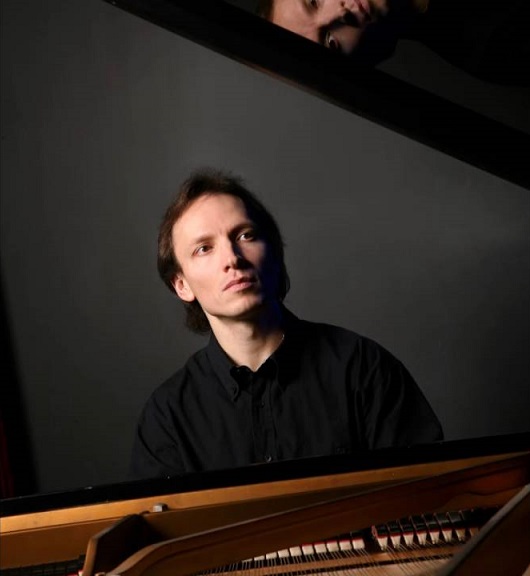
Above: pianist Roustem Saïtkoulov
Maurice Ravel’s Violin Sonata was premiered in Paris on May 30, 1927, with none other than George Enescu as violin soloist, and Ravel himself at the piano. The opening Allegretto starts quietly, with a piano theme that is taken up by the violin. Mr. Vengerov sweetens his tone here, making the most of the melodic possibilities. The violin trembles over a shadowy piano passage, and then a transportive lyricism builds, with the violin rising and lingering. A heavenly conclusion: sustained violin tone over a shimmering piano.
To open the Blues: Moderato, the violinist plucks in altering soft and emphatic notes. The piano sounds rather glum at first, then starts pulsing persuasively as the violin gets jazzy, bending the phrases enticingly.
From a gentle start, the Perpetuum mobile finale lives up to its name. The piano goes scurrying along, and Mr. Vengerov turns into a speed demon. The music rocks along – Rhapsody in Blue and Fascinatin’ Rhythm are evoked briefly – with the violinist verging on manic whilst Mr. Saïtkoulov’s playing stays light and luminous.
The concluding works on the printed program both felt very much like encores: Heinrich Ernst’s decorative incarnation of The Last Rose of Summer and Nicolo Paganini’s super-elaborate take on the great aria Di tanti palpiti from Rossini’s TANCREDI (arranged by Fritz Kreisler) each had an “everything-but-the-kitchen-sink” feeling. Mr. Vengerov managed the fireworks well, drawing a celebratory audience response. My feeling was that one or the other of these two virtuoso pieces would have sufficed.
As an encore, Fritz Kreisler’s Caprice Viennois was beautifully played. The audience then began streaming out. We were in the lobby when we heard a second encore commencing; but it was too late to double back.
~ Oberon
 Oberon's Glade
Leave a comment