
Above: composer and conductor Matthias Pintscher
~ Author: Brad S. Ross
Thursday February 21st, 2019 – It was an evening of exquisite sounds Thursday night at David Geffen Hall as the guest conductor Matthias Pintscher led the New York Philharmonic in music by two early 20th-century greats sandwiching one of his own, composed almost exactly a century years later. Pintscher, a German-born composer and conductor now residing in New York City, has quickly built a reputation as one of the finest younger composer–conductors of recent memory to emerge on the world stage. On this night, he brought with him a much-welcomed performance of his recent violin concerto, featuring the talents of the renowned French violinist Renaud Capuçon.
The evening began with Maurice Ravel’s “Alborada del gracioso” (“Dawn Song of the Jester”) from his 1905 piano suite Miroirs, which he had transcribed for orchestra in 1918. Ravel, a master of orchestration above all, peppered this score with myriad and most enjoyable colors, including numerous pizzicato phrases, muted brass, and varied percussive bursts. Pintscher brought the best out of the Philharmonic, which performed here with precision and grace. It made for a lively and dynamic opening piece.
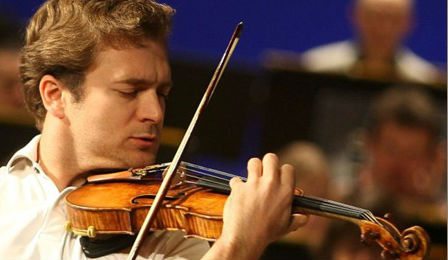
Above: Renaud Capuçon
Next up was Pintscher’s own mar’eh, a concerto for violin and orchestra composed in 2011 on a commission from the Lucerne Festival, Alte Opera Frankfurt, and the London Philharmonic Orchestra, which was here receiving its New York premiere. Its title comes from a Hebrew word meaning “face sign” or, as the composer’s note indicates, “the aura of a face, a beautiful vision, something wonderful which suddenly appears before you.” Why he chose to write it in lower case is as mystifying to me as any other inexplicably ungrammatical contemporary music title.
The piece began quite eerily on a single suspended note played high on Capuçon’s violin, joined only by an ominous rumble in the percussion. A languid melody soon entered, trading between Capuçon and various brass soloists, as dark colors began to emerge throughout the orchestra. Following this menacingly silent introduction, a series of tantalizing full-ensemble swells seemed to indicate a change of direction for mar’eh before the work fell back into another series of quietly shifting timbres. This carried on for some time until the same solitary high note and percussive rumble returned to bookend the concerto.
Extended technique abounded throughout mar’eh and the players, including Capuçon, were at their absolute finest, but it was nevertheless hard to shake a sense of dissatisfaction when it was all over. What the piece lacked was a sense of direction—momentum. Its tempo always leaned toward the adagio, if that, and its dynamics, aside from the occasional fortissimo burst, rarely seemed to escape mezzopiano. For a duration of roughly 23 minutes, this made for a hard-going listening experience. The audience was politely receptive to it, however, even if their enthusiasm seemed more directed at its soloist than the composer.
After intermission was the third and final piece of the night: Igor Stravinsky’s mighty Firebird. Written in 1910, The Firebird marked the first of the composer’s many fruitful collaborations with the ballet impresario Sergei Diaghilev—a relationship that would also produce the likes of Petrushka and The Rite of Spring. Premiering only eight days after his 28th birthday, it was also Stravinsky’s breakout piece and one that placed him on the world stage as one of the finest composers of his time and beyond.
The audience knew it was in for a treat from the moment it began, as those memorable and ominous opening bars in the cello and bass harbingered the danger ahead. The First Tableau was equal parts beautiful and menacing leading up to its volatile climax (the unforgettable “Infernal Dance of All Koschei’s Subjects”) and the haunting lullaby that follows. The Second Tableau redeemed this carnage and misery with its exuberant and triumphant finale—one of the grandest in all classical music.
The experience of hearing these magnificent bars played live by an orchestra as fine as the New York Philharmonic is one I wish every person on Earth could experience for himself. The ethnomusicologist John Blacking once defined music as “humanly organized sounds…” if this be so, then these are no doubt some of the finest sonorities ever compiled by a single person.
The crowd was quick to its feat upon conclusion with many shouts of “Bravo!” This was easily one of the most animated displays of approval I’ve witnessed all season. Pintscher and company received several curtain calls and every section of the ensemble was given a chance to take their bows. The adulation was much-deserved for Pintscher and this stupendous orchestra, the gem of New York City. Bravo, indeed.
~ Brad S. Ross
 Oberon's Glade
Leave a comment