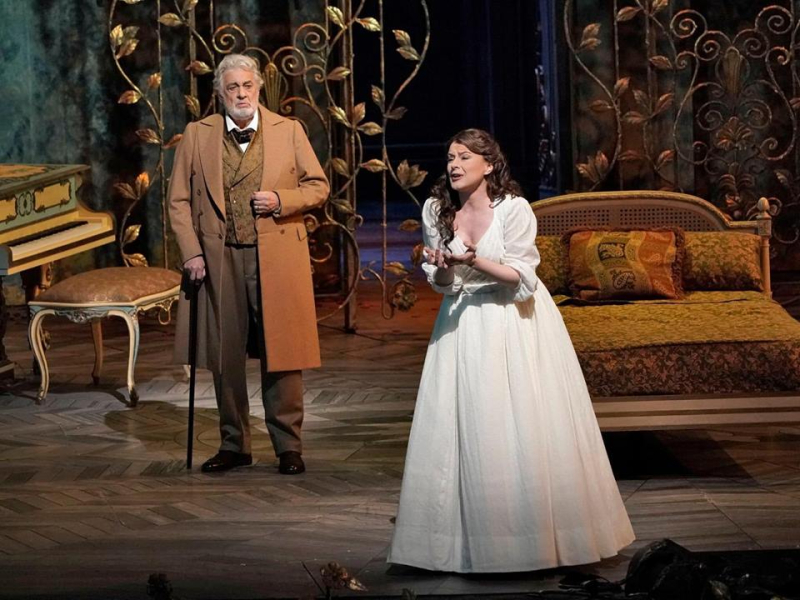
Above: Placido Domingo and Anita Hartig in LA TRAVIATA; a Ken Howard/Met Opera photo
~ Author: Oberon
Wednesday April 24th, 2019 – TRAVIATA is the opera I’ve seen more than any other. Along with Tosca and Turandot, Violetta is my idea of a test role; I’ll go to see almost anyone who tries it. From A to Z – from Licia Albanese to Teresa Zylis-Gara, from Ainhoa Arteta to Virginia Zeani – I’ve experienced every kind of Violetta: good, bad, or indifferent. Patricia Brooks, Anna Moffo, and Diana Soviero remain among the most memorable in the role; and in recent seasons, Hei-Kyung Hong and Marina Rebeka have struck gold in the part. Inexplicably, I missed seeing Tucci, Sutherland, Lorengar, Scotto, and Sills as the fragile courtesan. But as Lois Kirschenbaum always said: “You can’t go to everything!”…a notion she herself seemed to disprove.
Knowing I’ll be seeing the Met’s current TRAVIATA (which some have described as Disneyesque) next season, when Lisette Oropesa takes on the role of Violetta at The Met, I took a score desk for tonight; my main reason for being there was to hear Anita Hartig, whose Mimi and Liu in recent season captivated me.
Ms. Hartig’s voice, with a mixture of enticing vibrato and curiously effective straight tone, was sadly beset by pitch problems tonight (and, from comments I have read, throughout her run here as Violetta). The voice was annoyingly sharp, at times excruciatingly so. The allure of her timbre, her sense of lyricism, and her brightish upper range should have made her a fascinating Violetta; instead, it became something of a trial to listen to her.
Stephen Costello’s Alfredo has improved considerably since I last heard him in the part, though he too showed some vagaries of pitch during the evening. I sometimes feel that Mr. Costello doesn’t sense the heartbeat of the music, but tonight he sounded like an ardent, passionate young man with reckless streak.
Hearty applause greeted the entrance of Placido Domingo, the beloved tenor-turned-baritone, as Germont. After sorting out the voice for a bit, he settled in at “È grave il sacrifizio…” and thereafter sang quite beautifully, finding a nice emotional connection to Ms. Hartig’s Violetta in the great duet “Dite alla giovine“, which is the very heart of the opera. Some small chokes or sobs, perhaps to indicate empathy, were unnecessary; but Domingo impressed by singing the phrase “Dio mi guido…dio mi guido…” in his big aria without breaking for breath.
In comprimario roles, so important in the opera, the male contingent excelled: Scott Scully (Gastone), Jeongcheol Cha (D’Obigny), Paul Corona (Dr. Grenvil), the characterful singing of Dwayne Croft (Baron Douphol), and even – in the very brief role of Giuseppe – tenor Marco Antonio Jordão, each made an impression.
Maestro Nicola Luisotti’s TRAVIATA was overall on the fast side, which is fine. He suddenly sped up the final reprise of the Brindisi, which felt exhilarating in a way, and he took “Di Provenza” at a fast clip: maybe that’s what Mr. Domingo wanted. I could have done without that aria’s cabaletta, though.
The ballet music had gypsy charm at first, and vigor as the matador theme took over. I was recalling the many times I heard it at New York City Opera, when the incredible Esperanza Galán transformed this scene with her Flamenco flair, castanets blazing.
Listening to Violetta’s touching reply to Alfredo’s public insult, “Alfredo, Alfredo, di questo core…”, I was yet again reminded of one of the most painful things in life: living with remorse.
~ Oberon
 Oberon's Glade
Leave a comment