Author: Oberon
Sunday September 24th, 2023 – This evening at Westbeth, dancers Miki Orihara and Ghislaine van den Heuvel joined a fantastic ensemble of musicians in a program entitled ONOKORO – creations/beginnings. The production, Tokyo to New York, is under the artistic direction of Thomas Piercy; the performance took place at the Martha Graham Studios.
Onokoro comes from the ancient Kojiki, Japan’s oldest mythology; it was the name of the first island formed by the gods Izanagi and Izanami when they were creating Japan. The evening’s program took us on a musical and spiritual journey from “Ryoanji” (the first sounds) to “Netori, Netori” (the emergence of organized sound and music), and onward thru to “Onokoro” (which combines the Eastern and Western styles of music and movement).
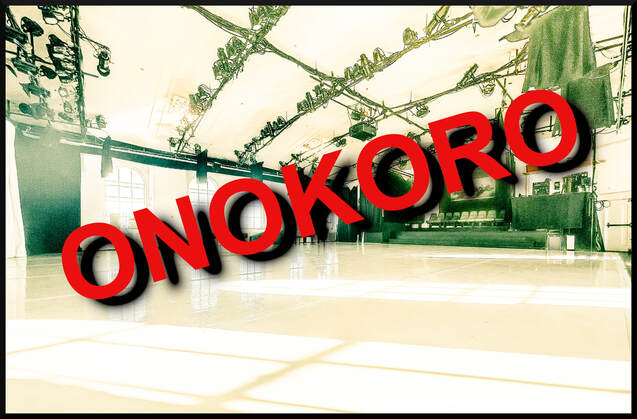
The Graham space at Westbeth was the perfect setting for this production. As the house lights went out and silence fell over the space, the studio’s large windows created a feeling of l’heure bleue, that fleeting time when day yields to night. In the darkness, the musicians took their places to perform John Cage’s 1985 work “Ryoanji”. The only source of light in the room was the tablets from which the musicians read their scores. The piece opens with a kneeling percussionist, Marina Iwao, striking a bell; this summons is repeated insistently throughout the piece. Thomas Piercy plays the hichikiri, a small double-reed Japanese instrument which seems like a cross between flute and oboe. Mr. Piercy is joined by two other hichikiri players: Lish Lindsey and James Joseph Jordan. The sound of their instruments veers from sighs and whispers to squawking and whining. The audience seemed intrigued by the music.
Mr Piercy now took up his clarinet for Bin Li‘s clarinet concerto “Netori, Netori”. A seated Gagaku ensemble – Ms. Lindsey and Mr. Jordan joined by Harrison Hsu (sho) and Masayo Ishigure (koto) – create fascinating, otherworldly musical colours which are plucked or piped. As Mr. Piercy begin to play, dancer Maki Yamamae appears, dressed as a young warrior and carrying a ceremonial spear. The space is illuminated in golden light as the the slow ritual dance evolves in a series of poses. Mr. Piercy illuminates the music with soft trills and warblings, and the sound of escaping air; his dynamic control is uncanny. There are silent pauses in the music, and eventually the ensemble rejoins. Following the dancer’s exit, there is a quirky coda for the clarinet.
Two works having their world premieres at these concerts came next. The first, Gilbert Galindo‘s “Primordial” for clarinet, cello, and piano, opened with a somber cello passage, introducing us to an extraordinary cellist: Daniel Hass. Mr. Piercy again took up his clarinet for this work, and Ms. Iwao was at the keyboard. Galindo’s pensive music is hauntingly beautiful, bringing us a magical mixing of timbres. Mr. Hass produced shivering tremolos while Ms. Iwao found poetic depths in the piano’s lower octaves, and Mr. Piercy’s lambent tone and dynamic variety made for an engrossing experience.
After the briefest of pauses, the players proceeded to the second premiere, Miho Sasaki’s “黎明 – reimei – Dawn”. Here Mr. Piercy traded his clarinet for the ohichiriki. This music is intense, with threads of melody woven in amidst jarring harmonies. From this emerges high, delicate figurations from Ms. Iwao’s keyboard, while Mssrs. Piercy and Hass create a very distinctive tonal blend. The music, veering from disturbing to reassuring along the way, was very impressively served by these three musicians. And both the Galindo and the Sasaki works seemed to me ideal candidates for choreography.
 Oberon's Glade
Leave a comment