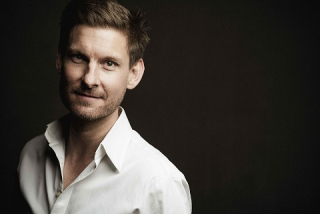
Above: Kristian Bezuidenhout, photo by Marco Borggreve
~ Author: Oberon
Tuesday June 25th, 2024 – The Orchestra of St. Luke’s brought their Bach Festival 2024 to a close tonight at Zankel Hall with a program titled Bach and Sons. Kristian Bezuidenhout (above) was conductor and soloist. The concert was sold out, with audience enthusiasm running high. The popularity of the series has prompted to OSL to announce a 4-performance festival for next year.
This evening’s program featured works by J S Bach and two of his sons, and ended with Mozart. The opener, Johann Christian Bach’s Symphony in G-Minor, Op. 6, No. 6, immediately engaged the audience. From the scurrying start of the opening Allegro, the music sounded thoroughly fresh and inviting. Horns and oboes join the strings, and the OSL’s bass player, John Feeney, marked the epicenter of the entire evening. The Andante opens with a unison passage, leading to a steady, pulsing beat decorated with stealthy trills. A lovely violin theme is heard. An urgent start to the concluding Allegro molto develops into roller coaster up-and-down scale passages, hunting horns, and exaggerated string tremolos.
Next, Mr. Bezuidenhout at the pianoforte commenced J. S. Bach’s Contrapunctus XIV from The Art of Fugue, BWV 1080, performed in an adaptation for strings. The cello, viola, and bass – and eventually the violins, seemingly one by one – join in this lament-like work. Poignant harmonies abound, the music gradually becoming somewhat animated.
Music of C. P. E. Bach came next, with Maestro Bezuidenhout taking up the Keyboard Concerto in D-Minor, Wq.17, H 420. The energetic opening Allegro was masterfully played, with a cadenza that displayed Mr. Bezuidenhout’s technical assurance and intriguing subtlety. The ensuing Adagio has a dreamy feeling, with periodic interjections of drama. Gracious harmonies invite the keyboard to join, with enticing turns and trills woven in. The turbulent opening of the final Allegro has a trace of a Spanish feel. Delicious playing from Mr. Bezuidenhout kept the audience entranced.
Following the interval, more from C.P.E. Bach: his String Symphony No. 3 in C-Major, Wq. 182, H. 659. From its speedy start, swirling violin motifs come to a sudden change of mood when the Adagio suddenly takes over: here, an interlude of affecting violin passages is interrupted by urgent stabbing tones from the bass. In the final Allegretto, melodic phrases are intruded upon by insistent bass and cello comments.
What finer end for a Bach Festival than music of Mozart! While Bach and his progeny are the source from which all musical blessings flow, their music – so meaningful to the mind and spirit – seldom touches heart. Thus, Mr. Bezuidenhout’s outstanding rendering of the Mozart’s Piano Concerto No. 9 in E-flat Major, K. 271, “Jeunehomme”, reached me on an altogether different level.
The 9th, composed in 1777, is considered Mozart’s first truly mature piano concerto. In terms of musical scope, technical demands, and depth of feeling, it seems to signal a new phase for the composer. The string ensemble, reinforced with horns and oboes, plays a unison introductory passage, and then Mr. Bezuidenhout immediately captivates us with a sustained trill. His playing throughout is remarkable for its dynamic range, with a delicacy of touch that charms the ear.
Having been a frustrated horn player in my teens, a brief horn solo reminds me of the fact that I didn’t take it seriously until my senior year: a lesson too late for the learning. Mr. Feeney’s bass resonance – such a pleasure to hear all evening – was of special appeal here. The piano cadenza, a jewel in the musical diadem of the evening, included spine-tingling nuances and hushed pianissimi which were vastly pleasing to the ear.
Dolorous might be too heavy a word for the concerto’s Andantino…wistful is perhaps more apt. All I know is, this music went straight to my heart…which has been in a tormented state of late. A full-bodied theme, brief but later repeated, was impactful. And the Bezuidenhout cadenza was immaculate and engrossing: a series of trills was a joy in and of itself.
But…no time for reverie. The pianist commences the concluding Rondo as a solo, which will recur; of particular charm was a keyboard cantabile played over plucked accompaniment.
Mr. Bezuidenhout has always been a prince among pianists, and with the redoubtable artists of St. Luke’s all on such fine form, the evening was a balm to the ear and the soul. I simply did not want this concert to end; it was the final live musical event of my seventy-fifth year; next week, the fourth act of my life/opera commences. For the moment – like Alceste – “Je sens une force nouvelle.”
~ Oberon
 Oberon's Glade
Leave a comment