
~ Author: Oberon
Tuesday December 24, 2024 – I spent Chrstmas Eve with a dear, long-time friend at Carnegie Hall, where the The New York String Orchestra were offering their customary Christmas Eve concert. The all-Mozart program brought us an overture, a concerto, and a symphony – all by the Master, and all beautifully played by the young musicians of this large and unique orchestra.
Maestro Jaime Laredo opened the evening with the overture to The Impresario, a comic singspiel which Mozart composed in 1786. This overture is short…I might even say too short!
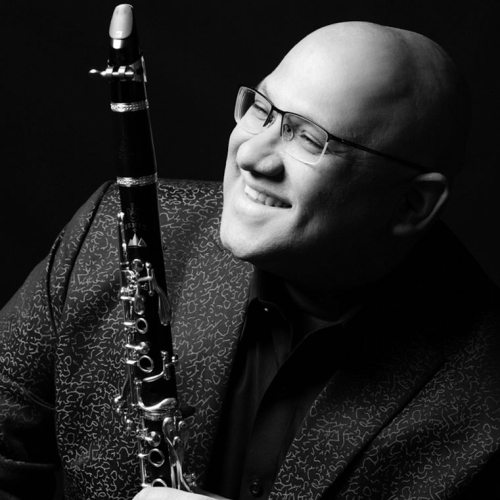
Ricardo Morales (above) then took the stage as soloist in Mozart’s heavenly Clarinet Concerto. I’ve never forgotten hearing music from this celebrated piece for the first time: in the film Out of Africa, Baroness Blixen (Meryl Streep) and Denys Finch Hatton (Robert Redford) are on safari; Finch Hatton has brought along a gramophone, and he puts on an old 78 rpm of the concerto, which attracts a pair of curious monkeys who – after listening raptly for a few moments – attack the gramophone.
The first movement, Allegro, has a pulsing, melodious start. Dulcet clarinet roulades immediately introduce us to Mr. Morales’ mastery of dynamics, and his gift for incredible subtlety in his playing. His silky-smooth sound is captivating, and his agility astounds, with fabulously clear scale-work and a charming passage where he deftly bounces from low to high notes. A mini-cadenza leads to the movement’s finale, where the Morales clarinet warbles like a magical bird over the orchestra’s plush playing.
The Adagio – the heart of the concerto, and perhaps of Mozart’s entire oeuvre – introduces the clarinet’s simple but heartfelt melody, soon taken up by the orchestra. A fresh, wide-ranging theme evolves, in which Mr. Morales’ control and breath support are mind-boggling to experience. Following a brief cadenza, the main theme returns, hauntingly lovely; a heavenly trill from the clarinet draws the movement to a close.
The concerto’s final Rondo has a sprightly start; Mr. Morales commences a flow of fantastical fiorature. The orchestra has an exotic, minor-mode passage, and then the clarinet’s wide range – from gleaming highs to velvety low notes – is explored in colorful playing. A magical performance, full of wonders. Bravissimo, Mr. Morales!
Symphony No. 36, “Linz”, closed the evening. Mozart was en route to Vienna when he stopped at Linz to visit an old friend, Count Thun-Hohenstein. On learning that a concert was scheduled just 5 days after his arrival at Linz, Mozart worked feverishly to compose a new work for the occasion: the result was a symphony in C-major, which soon earned the nickname the “Linz” Symphony.
The first movement has a regal start. In the ensuing melody, bassoon and oboe stand out. A wistful mood sets in for a bit, then more joyous music sounds…with an odd rhythmic echo of Handel’s Hallelujah chorus. The music flows on, by turns thoughtful and grand.
The ensuing Poco adagio begins elegantly. The music darkens, but only slightly, with the timpani evoking a sound of distant thunder. Somber moments alternate with courtly ones. The third movement – Menuetto – feels stately and grand at first, then becomes a conventional minuet, with some outstanding playing by bassoonist Laressa Winters.
Mozart’s chose a Presto rather than a Rondo for the symphony’s finale, wherein swift and gracious themes alternate with lyrical lulls.
Heading to the train home, I asked my companion if he felt that Mozart sometimes went on and on in his symphonies – something one rarely feels in his operas. He replied: “I was just thinking the same thing!”
~ Oberon
 Oberon's Glade
Leave a comment