
Above: Felix Mendelssohn
~ Author: Oberon
Tuesday February 25th, 2025 – Chamber Music Society of Lincoln Center offering an all-Mendelssohn evening featuring a de luxe ensemble of musicians: pianist Anne-Marie McDermott, violinist Arnaud Sussmann, cellist Nicholas Canellakis, and the Escher Quartet.
This concert was a much-needed lift of my spirits after weeks of unbearably frigid weather and a weekend of unsettling health issues. Just setting foot in Alice Tully Hall made me feel better; and then the music – and the musicians – provided just the right antidote to my malaise. By the end of the program, I was thoroughly rejuvenated.

Mr. Canellakis and Ms. McDermott (above photo by Da Ping Luo) opened the program with the Sonata No. 1 in B-flat major, Op. 45. The sonata’s Allegro vivace commences with a unison passage; a rolling melody emerges, in which he cello’s lower range is explored. Moving into minor mode, the music becomes insistent. Arpeggios from the Canellakis cello turn into long tones sustained over a roaming piano. The music turns passionate, then grand, leading to a brisk finish full of Ms. McDermott’s marvelous playing.
The winsome piano introduction to the Andante signals the appearance of a familiar theme. Nick’s melodious cello sings over elegant passages from the Steinway; Ms. McDermott then plays a delicate dance accompanied by plucked cello figurations. An increase of passion lasts only moments; the piano resumes its lightness and the music fades away.
The concluding Allegro assai brings a flow of melody; things get more animated, sweeping forward with lyrical, haunting passages. An energetic ending looms, but Mendelssohn instead provides a peace-filled finish.

Above, the Escher Quartet: Adam Barnett-Hart, Brendan Speltz, Brook Speltz, Pierre Lapointe; photo by Da Ping Luo
The Eschers then took the stage for the Quartet in F-minor for Strings, Op. 80.
Fanny Mendelssohn, Felix Mendelssohn’s beloved older sister, had died unexpectedly at the age of 41 in May of 1847. Felix, devastated, was unable to attend the funeral; he went to Switzerland to recover. There, he hiked and painted, and forced himself to compose, managing to compete his F-minor quartet. It would be one of his last completed works; he died on November 4th at the age of 38.
The Allegro vivace assai has an agitated feel: fast, fantastical music with sentimental pauses woven in. The Eschers’ trademark blend is at its most persuasive, viola and cello emerging with darker hues. Classic harmonies abound, and then the foursome become speed demons.
Unison passages open the familiar Scherzo; while energetic, the music abounds in subtleties that hint at deeper underlying thoughts. Viola and cello sing in unison before the scherzo reaches what seems like a delicate finish, only to be extended by a sort of coda.
Anguish overtakes the mood in the Adagio as Brook Speltz’s velvety cello sings a poignant melody. This is music full of longing. Themes are passed about, each of the four voices distinctively expressive. The quartet’s dynamic range is lovingly in evidence. Almost unbearably beautiful harmonies are set forth, with violist Pierre Lapointe in a lamenting passage before before Adam Barnett-Hart’s violin makes a final, poignant ascent.
The minor mode feels ominous as the finale commences. The insistent cello carries the musicians to fresh themes, with shifts from major to minor seeming to evoke Mendelssohn’s struggle with his emotions in his mourning state. Mr. Barnett-Hart’s marvelous artistry shines in the work’s concluding measures. The Eschers, ever immaculate in their music-making, were warmly hailed by the packed house.
Following the interval, the Eschers re-appeared for an Andante and Scherzo culled from Four Pieces for String Quartet, Op. 81, opening with an Andante sostenuto filled with courtly elegance. Mr. Lapointe savors a solo viola melody, and then things speed up. Sweet violin phrases are met by animation from the cello. Mr. Barnett-Hart’s cadenza leads to a da capo, and the music comes to a pretty finish.
Next on offer was more music from Opus 81: a Scherzo in Midsummer Night’s Dream mode which introduces duetting from Mr. Barnett-Hart and his fellow violinist, Brendan Speltz. This is witty and wonderful music, thoroughly captivating.
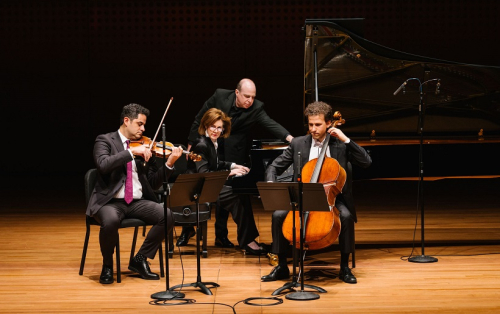
Above: Arnaud Sussmann, Anne-Marie McDermott, and Nick Canellakis; photo by Da Ping Luo
To conclude the evening, the Trio No. 2 in C-minor for piano, violin, and cello, Op. 66, was given a thrilling rendering by Ms. McDermott, joined by violinist Arnaud Sussmann and Mr. Canellakis.
Rolling piano motifs and restless strings open the main theme of the first movement, in which melodious themes are passed among the three musicians. Ms. McDermott, in some of the most amazing playing I have ever heard from her, set forth cascading keyboard passages – filled with both passion and subtlety – to dazzling effect. The Canellakis cello has a tender melody, taken up by the Sussmann violin, with magical support from Ms. McDermott; her playing was epic, and the trio swept onward with interwoven harmonies from the gentlemen. Bravi, bravi, bravi!!
The gentle Andante espressivo, with its nostalgic piano introduction, becomes waltz-like as the strings join lovingly. Piano interludes enchant; Mr. Canellakis delights with his poetic playing, while the sheer perfection of Mr. Sussmann’s artistry creates a simply gorgeous atmosphere in which we can linger and dream. Passion rises, only to settle into bliss.
Next, music that shows us why Mendelssohn is the King of the Scherzo…it’s swift and sure, the playing dazzling. The musicians seemed to be having a blast here.
The cello, and then violin, set the mood of the concluding Allegro appassionato…and passion is indeed the byword here. Bending minor-key themes are intriguing; Ms. McDemott is simply sensational at every moment. Crazy fun! But then a reverential interlude suddenly emerges, Mr. Sussmann’s violin singing sweetly over the piano accompaniment. This introspection gives way to thrilling build-up of emotion, with Ms. McDemott’s keyboard on the verge of bursting into flame.
As the last note sounded, the audience rose to salute the players with a roaring ovation that brought them forth for a second bow, much to everyone’s delight. I literally felt reborn.
~ Oberon
 Oberon's Glade
Leave a comment