
~ Author: Oberon
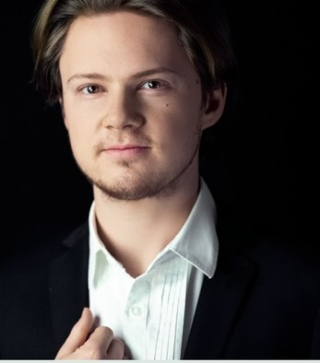
Tuesday March 25th, 2025 – Young Concert Artists presenting bass-baritone Joseph Parrish (photo above) in recital at Merkin Hall, with Francesco Barfoed at the piano.
I first heard Mr. Parrish in a performance of Pauline Viardot’s CENDRILLON given by City Lyric Opera in 2021; I was immediately impressed by his singing, acting, and charismatic personality. In 2023, he sang superbly at the Gerda Lissner Winners Concert, having won first prize in the song/lieder division. And in 2024, Mr. Parrish made a most convincing (and beautifully sung) Salieri in Rimsky-Korsakov’s opera MOZART AND SALIERI, performed by Parlando.
Tonight, Mr. Parrish showed that his is a voice that can bring people together. His stage presence is relaxed and cordial, with glimmers of humor along the way; it is a voice with an extensive range and a mastery of dynamics that allows him to veer impressively between hall-filling power and the most gentle of pianissimos. He can turn a phrase like a magician, whilst all the time his body language and expressive face draw listeners to him like a magnet. This is charisma personified.
For the first half of the program, Mr. Parrish shared the stage with a stellar pianist: Francesco Barfoed (photo above). Francesco is a musician of extraordinary talent, his playing so perfectly aligned with the singer’s vision of the music.
Mr. Parrish opened the evening with Harry Burleigh’s “Elysium”, and in this single song he set a very high standard for himself: a standard which he would often surpass as the concert progressed. “Elysium” displayed the voice’s sheer power, as well as its sense of control…the last note was simply awesome. More Burleigh next – “You ask me if I love you” – in which the singer details the sensations he experiences when with his beloved…as if to say: “Do you really need to ask? “
Classics from two masters of lieder followed: Mahler’s romantic Liebst du um Schönheit with its poetic words, so lovingly rendered, and Schubert’s immortal Ständchen, in which the pianist plays a major role; the music covers a big vocal range and part of the allure is in the detailing of subtle nuances. The song reached a majestic pinnacle but then ends quietly. Then back to Burleigh for “Her Eyes Twin Pools“; Mr. Barfoed’s playing here is essential to the song’s meaning, whilst the singer’s face, expressive hands, and slender form create a visual poem all their own.
Charles Brown’s ‘The Barrier‘ at first seems to sing of an admirer’s shyness in hesitating to approach the object of his desire, but there is another reason for his reluctance, revealed in the song’s final line. Whilst listening to the song, I was thinking: “How lovely…how poetic…” and then the last words sent a chill thru me.
“Along The Dusty Road” by Hal Johnson seems like a folksong at first; a touch of the blues takes us to a spiritual place; Mr. Parrish sang so many beautiful notes in this song until reaching a whispered final tone that hung on the air.
Charles Brown’s “Song Without Words” is just that. The singer begins with humming, then switches to what the French call “bouche fermée“ which has a slightly different feel from plain old humming. The singer opens his mouth but no words emerge, just sound. Who knew vocalizing could be so expressive?
The New York Premiere of Psalm by YCA Composer-in-Residence Alistair Coleman draws on the old German hymn “How a Rose E’er Blooming“. The words “No one…” are repeated endlessly, as Mr. Parrish displays his vast dynamic range. The words change to “We were…we are…” and the music grows more passionate. The piano then introduces the carol itself, creating an air of fragrant softness. Hypnotically, “…the thorn…” now becomes the song’s lyric.
After the interval, Mssrs. Parrish and Barfoed returned with a Margaret Bonds piece, “You Can Tell The World“, a song with a theatrical feel – so alive – and giving the pianist a chance to shine brightly; it reaches a fantastical finish. Three beloved classics came next. First, “Deep River” in which Joseph made such a poignant impression, displaying the strength, range, and awesome breath control at his command. In “A City Called Heaven“, I had that uncanny feeling that he was singing just to me. At last, the triumphant “Ride On, King Jesus” in which his singing moved me so deeply with his range, power, and vitality.
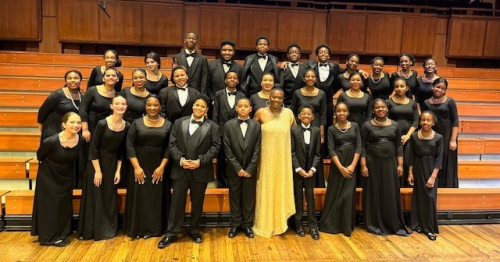
Now the young singers of the Washington Performing Arts Children of the Gospel Choir (above) took the stage, greeted by a vociferous ovation. Dressed in black gowns and tuxedos, they are just plain gorgeous to behold. And then they sang! Under the elegant and inspiring conducting of the group’s artistic director Michele Fowlin, and accompanied by the delightful pianist Anthony “Tony” Walker, they dazzled Merkin Hall with their young voices, weaving perfect harmonies, gesturing poetically, and swaying to Mr. Walker’s marvelous rhythms. Judging by the perfection their singing achieved, I would guess Ms. Fowlin can be a demanding taskmaster, but also that she has a heart of gold. She seemed to glow with pride for her young prodigies.
Their Praise Medley encompassed Greg Roberts’ Prelude to Worship, Rodnie Bryant’s We Offer Praise, and Richard Smallwood’s Anthem of Praise. The audience went crazy for these astounding kids, and Ms. Fowlin and Mr. Walker caused screams of joy to erupt as they took their bows. One boy in the choir reminded me so much of mi amor de loin, Brix, in far away Cebu; after one song, the boy fell to his knee and opened his arms as if to embrace the world.
Mr. Parrish offered three more songs – Bobby McFerrin’s Don’t Worry Be Happy, the profound Let Us Break Bread Together, and Richard Smallwood’s Total Praise (Joseph at the piano himself…!); the last two songs were arrangements by Ms. Fowlin. By then, I’d pocketed my pen and was letting the magic carry me. So much joy filled the hall as the evening came to an end.
~ Oberon
 Oberon's Glade
Leave a comment