(One of several recent articles on Oberon’s Grove that did not transfer to Oberon’s Glade. It was a fine night of music-making, and I want to hold onto the memory of it.)
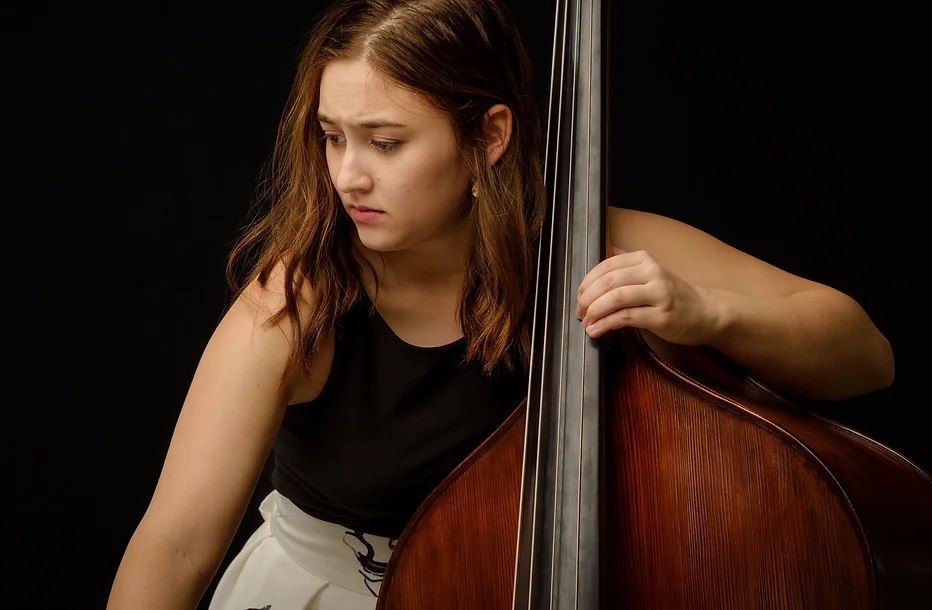
Above: Nina Bernat
~ Author: Oberon
Friday May 9th, 2025 – In the past few years, I’ve been so captivated by the sound of the double bass, whether it’s a single player at a chamber music concert or six or eight of them playing a Wagner opera from the Met Opera’s pit. The bass really is the heartbeat of classical music, and I’ve sometimes become so focused on what the basses are doing that I have to snap out of it and give the other instruments their due. In recent seasons, I’ve been very impressed by Nina Bernat, a lovely and gifted musician who I’ve heard at Chamber Music Society of Lincoln Center, and most recently with the Sejong Soloists at Carnegie Hall.
Tonight, Ms. Bernat gave a recital at Merkin Hall; this was only the second double bass recital I’ve attended…the first was given by Xavier Foley, a Young Concert Artists’ discovery whose playing really impressed me. Ms Bernat’s program looked very appealing on paper, ranging from Bach to a world premiere by Lara Poe.
But even the listing of the works to be played didn’t prepare me for the thoroughly engaging musical experience that Ms. Bernat and her colleagues presented. She, mezzo-soprano Katherine Lerner Lee, and pianist Anthony Ratinov all seem so very young – the last named looks like an Ivy League freshman – yet they are accomplished musicians: indeed, they are artists.
Setting the essentially serious tone of the evening was Ernest Bloch’s Prayer. Ms. Bernat’s playing was immediately engrossing – such richness of tone and such passionate commitment – whilst the composer also brings in some lovely writing for the piano, elegantly played by Mr. Ratinov. A haunting central section leads to an affecting cadenza. The audience had been rather distracting whilst settling in; this opening work settled the mood, and the program continued to hold the crowd under a spell until the very last note had sounded.
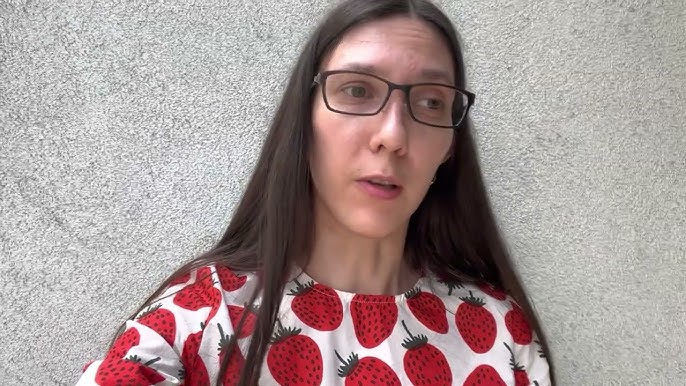
From composer Lara Poe (above) we heard a world premiere: Songs of Self. The composer spoke briefly about the four songs, which are settings of texts by female poets accompanied only by the bass.
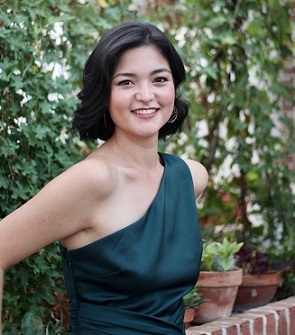
Mezzo-soprano Katherine Lerner Lee (above) – a strikingly beautiful woman in a classic maroon frock – has a wonderfully clear and expressive voice; she honored the poets with the clarity of her diction. The first song, I dwell in Possibility, is a setting of Emily Dickinson’s words. From a very soft start, the voice entwines with the wide-ranging bass line, which is laced with fiorature and trills. The two women created a silky-smooth blend. The second and fourth songs are settings of poems by Sara Teasdale – now, that is a name I haven’t heard for a very long time! An agitated bass line and shimmering, flighty singing merge in I could snatch a day. The second Teasdale poem, February Twilight, brings an extraordinary blend of sounds, with the high, lyrical voice over a bass part that has a folk-music feel.
Between the Teasdale songs came I am a Witch; the text is by Saima Harmaja, a Finnish poet who lived only to the age of 23. Ms. Lee’s voice begins in a monotone, accompanied by eerie, creepy sounds from the Bernat bass. The song casts a spell; a sustained, fading tone from the singer is heard, and the music feels sinister as the song moves toward a terrifying finish.

Above: pianist Anthony Ratinov
There’s a story behind Aaron Copland’s Violin Sonata and how it became a Bass Sonata: in 1980, bassist Gary Karr and his partner, pianist Harmon Lewis, visited Aaron Copland at his home to request a composition for double bass. Copland proposed instead that Karr give his Sonata for Violin and Piano a try. Karr proceeded to sight-read it, and the composer was so pleased with what he heard that he had it published as their joint arrangement. This sonata is a genuine masterpiece. After its completion in 1943, Copland had learned of the recent death of Harry H. Dunham, a rich and handsome young man of his social circle, shot down while serving in the Air Force, and he dedicated the piece to Dunham’s memory. The sonata thereby became an elegy.
Tonight, Ms. Bernat and Mr. Ratinov did both Copland and Karr proud. The sonata’s opening Andante semplice was lovingly shaped by both players; from a prayerful start, the music becomes more animated, taking on a fresh rhythm. This is optimistic music, in which hints of Appalachian Spring can be detected. Ms. Bernat’s bass resonates in its lowest range, and the movement has a wistful finish. The ensuing Lento has a note-by-note piano opening; the bass is pensive in this simple, poetic music which develops a gentle flow and is tinged with sadness. The concluding Allegretto is restlessly rhythmic, a steady beat from the piano – decorated by miniature fanfares – suddenly goes high. Ms. Bernat covers the wide range of the bass in agile passages. The music slows, then re-bounds and cruises along to a pulsing bass beat, swirling away before settling down to a calm finish.
Indian-American composer Reena Esmail‘s Perhaps is a double bass solo in which Ms. Bernat again impressed with the sheer richness of sound she can produce. From a thoughtful start, the music goes through shifting moods, covering a vast dynamic range. The composer was in the hall, and took a bow to warm applause.
The Adagio from J.S. Bach’s Sonata No. 3 in E Major, BWV 1016, was another marvelous interpretation from the Bernat/Ratinov duo. The pianist’s measured introduction conjured up a a haunting theme from the bass. The two players switch roles between melody and rhythm. This music evoked bittersweet memories from me, whilst photos that Ms. Bernat had found in in the apartment of her late grandmother – a holocaust survivor – must have been having the same effect on the young musician as they were projected on a screen. What stories these images could tell.
As perfect and engrossing as the evening had been thus far, in the musicians’ performance of Allan Blank‘s Poems from the Holocaust they surpassed themselves in this powerful and deeply moving set of songs about some of the darkest years the world has ever experienced; the songs are particularly – and scarily – timely now, as we seem to be on the verge of another calamitous period.
Katherine Lerner Lee again sang with sublime clarity and beauty of both timbre and expression; in terms of communicating emotion through the colourings of the texts, she put me in mind such iconic lieder singers as Barbara Bonney and Frederica von Stade.
The opening song, At Terezin, has a dramatic feeling, anxious and unsettling. The second song, Close Your Precious Eyes, to a poem by Isaiah Spiegel from a book by Frieda W. Aarin entitled Bearing the Unbearable, was painfully touching to experience. Ms. Lee found wondrously expressive colours in her singing with which to illuminate the words, whilst Ms. Bernat and Mr. Ratinov wove magical, evocative sounds around the voice, giving us a darkly captivating and thoroughly fascinating musical experience. The song ends in chilling, unearthly quietude, with ominous shivering sounds from the bass.
Continuing the Blank cycle, keyboard filigree with commenting bass phrases open The Butterfly, a poem written by Pavel Friedmann from his two years spent at The Theresienstadt Concentration Camp, where he died in 1944. Ms. Lee’s voice is lyricism personified. The cycle’s concluding Kaddish is soulful, despairing music which Ms. Bernat played so evocatively whilst Mr. Ratinov played with entrancing softness of touch. The music held us spellbound; the three artists were hailed with long, sincere applause.
To conclude the program, a Hebrew Melody by Joseph Achron (ed. Leopold Auer) was played by Ms. Bernat and Mr. Ratinov, both with overwhelming beauty of tone and expression. An amazing cello ‘cadenza’ was a highlight in an evening of marvelous music-making. The pianist resumes, whilst Ms. Bernat gives us some entrancing bass trills and a dark-tinged postlude before Mr. Ratinov plays a final chord.
Ms. Bernat had chosen “something small” as an encore; she didn’t tell us what it was or who wrote it, but it was sweet, sad, and gorgeous…a sonic feast for my Romantic soul.
While celebrations marking the 80th anniversary of the end of World War II have just taken place, threats of a recurrence of those devastating times are everywhere. The familiar line that those who ignore history are doomed to repeat it is so timely.
~ Oberon
 Oberon's Glade