(Among my reviews which somehow failed to make it from Oberon’s Grove to Oberon’s Glade, this report on a wonderful Handel performance at Carnegie Hall is one I didn’t want to leave behind.)
GIULIO CESARE @ Carnegie Hall

Above: Beth Taylor, who sang Cornelia; photo by Fadi Kheir
~ Author: Oberon
Sunday May 4th, 2025 – The English Concert presenting Handel’s GIULIO CESARE in a concert performance at Carnegie Hall; Harry Bicket was at the harpsichord, with the following cast:
Christophe Dumaux, Giulio Cesare
Louise Alder, Cleopatra
Paula Murrihy, Sesto
Beth Taylor, Cornelia
John Holiday, Tolomeo
Morgan Pearse, Achilla
Meili Li, Nireno
Thomas Chenhall, Curio
My primary reason for attending today’s performance was to hear Beth Taylor, the Scottish mezzo who made such a striking impression at the 2023 Cardiff Singer of the World competition, and who was singing Cornelia this afternoon. Immediately after the Cardiff finals, I had made friends with her on Facebook, and I have kept tabs on her ever since.
GIULIO CESARE is a long opera, and the seats at Carnegie Hall are notoriously bad for people who have lower back problems. I wasn’t at all sure I would make it thru the whole afternoon, though I knew that much of Cornelia’s music occurs in the first act: her lament “Priva son d’ogniconforto” and – the most moving music Handel ever wrote – “Son nato a lagrimar”, a mother’s poignant duet with her son as both are imprisoned.
My first-ever experience with a Handel opera was at the opening night of the New York City Opera’s GIULIO CESARE in 1966. At that time, the Early Music mania had not yet commenced. The opera was treated like any other opera; I don’t recall any period instruments being used in the pit, though I wouldn’t have known what to look/listen for anyway. It was of course the production that thrust Beverly Sills, who had been singing with the Company for years, into the spotlight with her dazzling singing of Cleopatra. Cesare was sung by the great dramatic basso Norman Treigle. There were no counter-tenors in the cast; the characters of Tolomeo and Nireno were sung by bassos.
Fast-forward 30+ years and I was working at Tower Records where counter-tenor mania was in full flourish. The Met had given its all-star RINALDO in 1984 – a big hit – and the New York City Opera presented productions of Handel operas that drew enthusiastic crowds. I dutifully attended these, though my true passion was the Wagner/Strauss repertoire.
So today’s performance of GIULIO CESARE by the English Concert was the first Handel opera I’d attended in many moons. I was expecting a rather formal opera-in-concert presentation, with the singers seated onstage, rising when their characters sang, and using scores. Instead, we had a semi-staged production which included the head of Pompey in a shopping bag, and many comings-and-goings. I found it all rather distracting, and at times overly cute, as when Cesare walked down the aisle and took a seat to watch Cleopatra appear on Monte Parnasso to sing “V’adoro, pupille”.
At any rate, it was a musically pleasing performance, with Maestro Bicket having everything well in-hand, and his orchestra full of virtuosos. There were times when the voices were covered by the musicians. Following the delicious overture, all the singers joined in the opening ‘chorus’, and then the story began to unfold.
We first meet Cesare in the person of the marvelous Christophe Dumaux, and Achilla (Morgan Pearse), who is toting Pompey’s head: a victory gift to Cesare from Tolomeo. The furious Cesare berates the messenger in the dramatic aria usually translated as “Tyrant, avoid my sight!” This is a brilliant introduction to M. Dumaux’s dazzling artistry.
Scottish mezzo-soprano Beth Taylor (the main reason I was at this performance) as Pompey’s widow Cornelia and her son – the tall, slender Paula Murrihy – are horrified by the treatment of the severed head. Cornelia’s aria “Priva son d’ogni conforto” introduces the mezzo’s unique voice, with a rich lower range and gorgeous moments of straight-tone, and an amazing dynamic range, all woven into the aria’s poignant melody. Ms. Murrihy’s Sesto replies with her own reassuring aria, “Svegliatevi nel core“, with its touching central song and a stunning cadenza.
Louise Alder’s Cleopatra is introduced with “Non disperar“, her singing at once lovely and characterful, with humorous touches in the repeat. Cleopatra is played as rather too silly and juvenile in the early scenes, but this will change as her fate alters from scene to scene. John Holiday’s Tolomeo joins the action, his “Empio, sleale!” is vividly sung, though at times the orchestra covered his voice. In a peaceful, reflective interlude, M. Dumaux’s singing is refined and poignant. Cleopatra is introduced to Cesare (she’s wearing sunglasses) as “Lydia”.
Beth Taylor returns, holding the urn of her husband’s ashes. She has a gorgeous recit, a dramatic monolog in which her multi-hued voice is fascinatingly employed. Introduced by a superb cello solo, Ms. Murrihy again brings her artistry to delight us in “Caro speme“; her subtle ornaments are captivating. Cesare’s ‘hunting’ aria, “Tacito e nascosta” was another Dumaux gem, though the horn playing was not immaculate, and the orchestra was a bit too loud; the counter-tenor’s ravishing cadenza made these concerns irrelevant. Morgan Pearse makes much out of Achilla’s big aria, and then the opera’s most magical moments unfold in the great duet for mother and son, “Son nata a lagrimar“. Mlles. Murrihy and Taylor achieved a miraculous blend of timbres, their singing exquisitely filled with subtleties and emotional shadings as they share their despair; they seemed to live and breathe as one.
I seriously thought of leaving at this point, just to carry this incredible musical experience away in my heart.
We settled in for Act II, counter-tenor Meili Li making a fine impression as Cleopatra’s help-mate Nireno. Ms. Alder’s Cleopatra was getting a bit annoying in this juvenile characterization (not the singer’s fault, but that of the staging); the soprano would soon find more depth in the character and her singing would become increasingly impressive…and moving. But for now, her “V’adoro pupille” was charmingly rendered…and the best was still to come.
Violin virtuosity from Nadia Zweiner introduced another Dumaux delight, and then Ms. Taylor has another sad song, full of wondrous soft singing. Mr. Holiday’s Tolomeo threatens Cornelia in a florid aria. Sesto prevents his mother from killing herself, and Ms. Murrihy displays her deft coloratura in “An angry serpent never rests…”
Ms. Alder’s “Venere bella” was charmingly sung, Thomas Chenhall’s Curio makes his mark, and M. Dumaux delivers some fabulous fiorature in an allegro aria. Calls for Cesare’s death are heard, and then Ms. Alder comes stunningly into her own with a heartfelt “Se pietà di me non senti”; in leaving behind the whole ‘Lydia’ conceit, the soprano now becomes truly compelling in both her vocalism and her hypnotic acting.
Another interval…the afternoon is stretching long, and my back sends me alarming signals (I’ll be paying for all this sitting in the proverbial “morning after”) but I persevered.
Tolomeo continues to court Cornelia, and Sesto tries to murder him. John Holiday’s aria here is most effectively delivered; in his anger, he makes his sister Cleopatra crawl. Ms. Alder’s “Piangerò la sorte mia” is quite magical; she’s very involved in the words and delivers some neat coloratura in the fast section. The da capo is a bit over-decorated, but very finely sung.
Now Mr. Dumaux brings all his gifts to the recit that precedes “Aure, deh per pietà“; a remarkable note swells from pianissimo to glowing power and then back to a whisper…truly astonishing. He then sings the aria with uncanny control and entrancing subtleties; a magical cadenza is the crowning touch. Cleopatra is on the brink of suicide when good news prompts a brilliant “Da tempeste” from the soprano. Tolomeo again rattles Cornelia, and this time Sesto strikes to kill. (One of the awkward things about the semi-staging is that dead people come back to life, stand up, and walk offstage…)
One wishes for a grand scena to seal Beth Taylor’s great success as Cornelia, but a rather modest song will have to do. Cleopatra and Cesare sing of their joy in an extended finale.

We met Ms. Murrihy at the stage door, such an elegant and friendly woman.
We then waited a long time for Beth Taylor to appear, but eventually we found out there was a reception going on, apparently with no end in sight. So I missed my chance to meet this woman with the fascinating voice.
And now for some Fadi Kheir photos from the evening…click on each image to enlarge:

John Holiday as Tolomeo and Louise Alder as Cleopatra

Louise Alder as Cleopatra and Meili Li as Nireno

Christophe Dumaux as Cesare and Louise Alder as Cleopatra

M. Dumaux sings from the audience

Ms. Alder and M. Dumaux
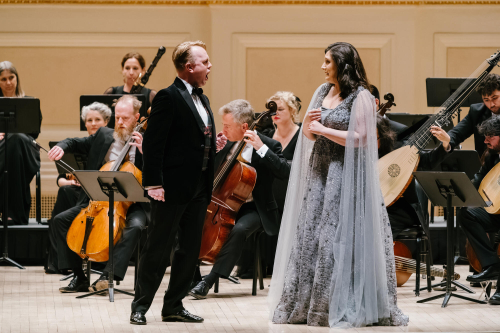
Morgan Pearse as Achilla and Beth Taylor as Cornelia
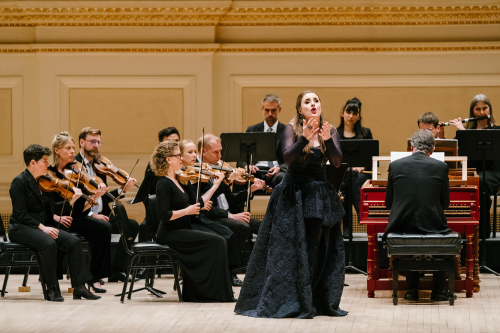
Ms. Alder as Cleopatra
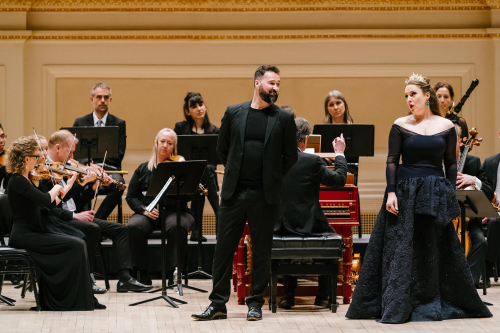
M. Dumaux and Ms. Alder
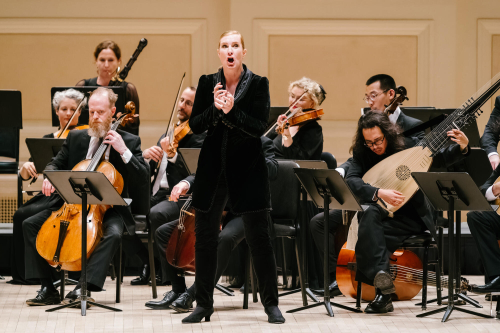
Paula Murrihy as Sesto

Christophe Dumaux as Giulio Cesare

The cast takes a bow: Beth Taylor, Paula Murrihy, Louise Alder, Christophe Dumaux, Maestro Harry Bicket, John Holiday, Morgan Pearse, Meili Li, and Thomas Chenhall.
“Let fair joy and pleasure
now return within our hearts;
relieved of all sorrow,
we may rejoice once again.”
~ Oberon
(Performance photos by Fadi Kheir, courtesy of Carnegie Hall.)
 Oberon's Glade