(Some articles from Oberon’s Grove did not make the trip to Oberon’s Glade. Here is one about a particularly lovely concert given in January 2024.)
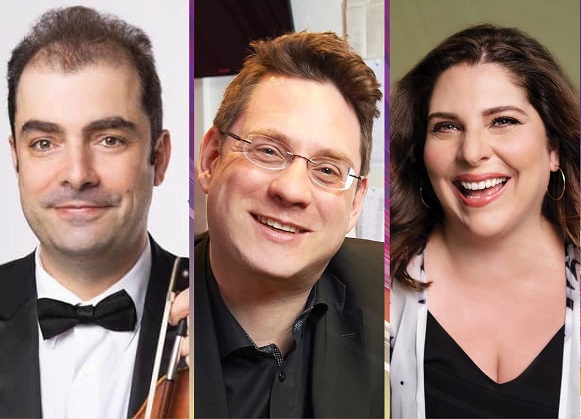
Above, this evening’s artists: Shmuel Katz, Thomas Lausmann, and Eve Gigliotti
Wednesday January 15th, 2024 – A recital at the Manhattan School of Music brought together mezzo-soprano Eve Gigliotti, violist Shmuel Katz, and pianist Thomas Lausmann for a program of works by Shostakovich, Valerie Coleman, Brahms, and Loeffler. The School’s Greenfield Hall is a perfect setting for such chamber concerts; it feels spacious, yet the sense of intimacy is palpable. And the acoustics are wonderfully immediate. I sat in the front row, and all evening could feel the music in a very personal way…like it was being sung and played just for me.
Mssrs. Katz and Lausmann opened the program with the Shostakovich Sonata for Viola and Piano, Op. 147. This was the composer’s final work; he completed it on July 5, 1975, and the next day he entered the hospital where, just over a month later, he passed away from the effects of terminal heart disease and lung cancer.
Shostakovich seems to have considered the Viola Sonata to be his farewell to music, and to life. Each of the sonata’s three movements conclude with a morendo – a “dying away.” The opening Moderato (the composer had initially called it Novella) commences with a solitary pizzicato line from the viola; the piano then joins with chromatic motifs, in contrast to the viola’s open intervals. A dialogue ensues which has an austere feeling. Mr. Katz’s simply gorgeous tone filled the lamenting theme with a deep sense of yearning; both viola and piano have a great outpouring before the music turns restless and animated. Viola tremelos and brooding passages from Mr. Lausmann’s keyboard give the feel of impending doom. Mr. Katz’s viola takes on an eerie sound as he plays a twisty theme. A burst of passion subsides, and there’s a rather sneaky, sorrowing viola cadenza before the opening pizzicati resume, leading to a fade-out of gossamer pianissimi.
The second movement – marked Allegretto – is in scherzo mode. March-like rhythms veer into folk dances, the two players in perfect alignment. The music combines humor and passion in alternating currents. Mr. Katz’s viola is plucked over a brooding passage from Mr. Lausmann; they then join in a unison dance passage. After a rich-toned viola cadenza, the two players skim onward until the viola commences a slow solo, marvelously played.
The sonata’s final movement was composed in just two days. Echoes of the iconic opening measures of Beethoven’s “Moonlight” sonata emerge, conjuring up memories. The whole movement is so poignant, all the more so for Mr. Katz’s infinite depth of tone; his stunning cadenza leads to a sense of darkening; Mr. Lausmann’s piano solo is so evocative of the moonlight. Shostakovich now looks back into the past with ghostly quotes from his earlier works. In the final moments, the composer leaves us with the purity of C-major, with Mr. Katz sustaining an incredibly long tone of impeccable beauty. The audience responded fervently to this spellbinding music, so marvelously played.

Composer Valerie Coleman (above) came to the stage to introduce her Fan Imèn (Human Family), which she had originally composed as a competition piece for flautists; tonight we were hearing the premiere of the viola setting. Ms. Coleman left us with a passage from one of Maya Angelou’s poems: “We are more alike, my friends, than we are un-alike.” If only people could grasp this notion, what a world we might be living in…free from all this chaos and strife.
Mssrs. Katz and Lausmann now did Ms. Coleman proud with a beautifully genial rendering of Fan Imèn. It opens with the pensive viola playing over shining piano motifs; turning lyrical, there is a flow of melody before becoming more animated and – finally – quite grand. After a lull, Mr. Lausmann plays shimmering notes as Mr. Katz’s viola sings eloquently. The pianist instigates a dance, the viola sailing over it. The work’s optimistic, swirling finish is a pure joy. Ms. Coleman returned for a bow and was presented with flowers by a charming a young girl.
Following the interval, Eve Gigliotti appeared in a stunning red frock to sing Johannes Brahms’ lovely Zwei Gesänge, Op. 91, often referred to as “the viola songs”. The first of these, “Gestillte Seihnsucht” (‘Longing at Rest’), is a hymn to nature sung from an unsettled soul that seeks heavenly peace. Beautifully meshing her warm, rich timbre with that of the Katz/Lausmann duo’s perfect blend, Ms. Gigliotti filled the space with her expressive, all-embracing voice. An animated interlude returns her to the rapturous melody, her singing alive with poetic subtleties and colours. Mr. Katz’s viola maintains the atmosphere in the song’s postlude.
The second song, “Geistliches Wiegenlied” (‘Sacred Lullabye’) is based on a medieval Christmas carol. Mary asks the angels to still the winds so that her child might sleep. The viola opens and closes the song with a gently rocking motif. Ms. Gigliotti brings her distinctive timbre and a sense of passion to the music, catching the poems shifting moods with a mastery of dynamics. Now I want to hear her in the Brahms Alto Rhapsody.
To conclude the evening: Poèmes, Op. 5, by Charles Martin Loeffler. These songs are new to me, and they bring us settings of poems by Baudelaire and Verlaine with an eclectic mix of musical styles.
Published in 1904, the first song is a Charles Baudelaire poem; entitled “La Cloche fêlée” (‘The Broken Bell’), it opens with a somber piano and a lamenting viola. Ms. Gigliotti’s expressive singing – with her opulent vibrato – captures the mood. After an interlude from the viola, her vocal line becomes urgent…and then quite grand. Rich, smouldering singing fills the last strophe; piano and viola offer a gorgeous postlude, Mr. Katz’s playing exquisitely soft.
The three remaining songs are to poems by Paul Verlaine. “Dansons la gigue!” (‘Let’s dance the jig!’) is a jolly, rollicking tavern song. The three musicians were clearly having a blast with this, wherein the poem describes the memories of a romance that turns out to be a ‘dead letter’ (I’ve had a few such experiences in my life). The song has an instrumental finish.
“Le son du cor s’afflige vers les bois” (‘The Sound of the Horn Wails in the Woods’) opens with hauntingly beautiful playing from Mr. Lausmann. Eve’s voice is touchingly expressive. The Katz viola takes up a sustained theme, over rapturous sounds from the pianist; the singer produces a flood of tone. The deep viola leads to a wistful finish.
The set ends with “Sérénade“. Mr. Katz strums his viola like a guitar, the music dance-like. Mood swings follow, and a marvelous interlude for viola and piano. Eve’s sense of drama is ever-evident. With some viola plucking, the song reaches a witty finish. The audience’s enthusiastic response drew the artists back for a second bow, whilst two little girls came forward with bouquets.
What an engaging concert…an ideal escape from the woes of the world.
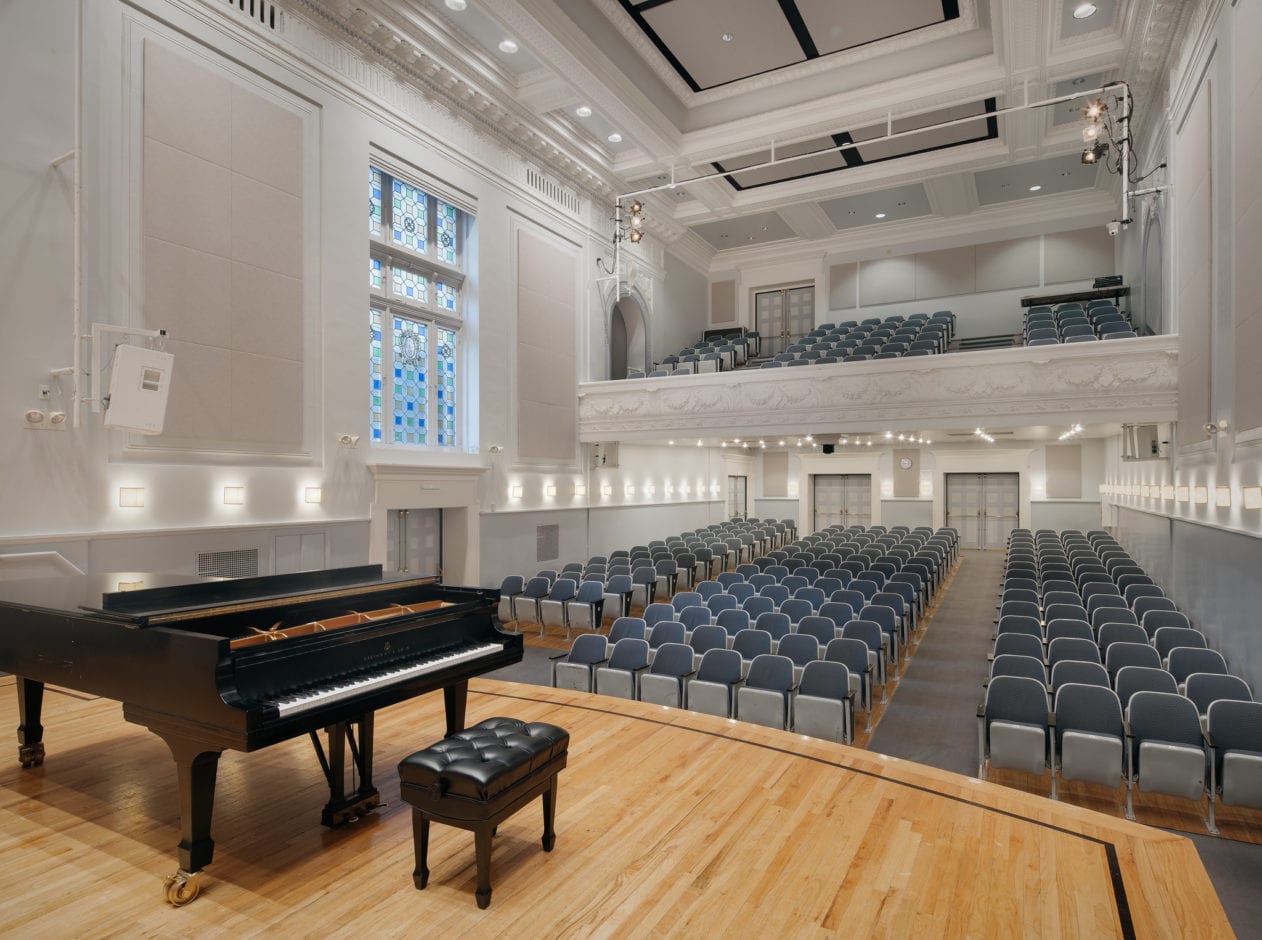
Above: tonight’s beautiful venue: the Gordon K. and Harriet Greenfield Hall at the Manhattan School of Music.
Adding to this very pleasing evening was a chance meeting with Catherine Malfitano; Catherine’s on the faculty at the Manhattan School of Music, and all day I’d been thinking, “Maybe I’ll run into her!” In this large, sprawling building it seemed unlikely but – mirabile dictu – she was suddenly passing before me. It was so nice to see her again, recalling a long talk we once had when I was working at Tower Records. She looks great – gorgeously dressed, as always – and she was very gracious.
~ Oberon

 Oberon's Glade