(My article about this phenomenal concert in May of 2024 didn’t move from the Grove to the Glade, but I couldn’t imagine leaving it to disappear. So…I’ve copied and pasted it here.)

Above: Alisa Weilerstein with the players of Sandbox Percussion; photo by Da Ping Luo
Tuesday May 7th, 2024 – Sandbox Percussion joined pianist Gilbert Kalish and cellist Alisa Weilerstein at Alice Tully Hall where Chamber Music Society of Lincoln Center presented a program of music by George Crumb and Tan Dun. The beloved soprano Dawn Upshaw was a special draw for me, at this – my last CMS concert of the current season.
It was an evening of fascinating music, thrillingly performed. The only comparable experience I can recall was the American Symphony Orchestra’s program, Requiem for the 20th Century, some ten years ago. Tonight’s concert was on a more intimate scale, and it held me under its spell from first note to last.
The Alice Tully Hall stage was set with an enormous array of percussion instruments, and a jubilant ovation greeted Ms. Upshaw, Mr. Kalish, and the Sandbox boys; special lighting for this program had been devised by Alejandro Fajardo, melding the visual and the sonic aspects of the evening into a cohesive and immersive whole.
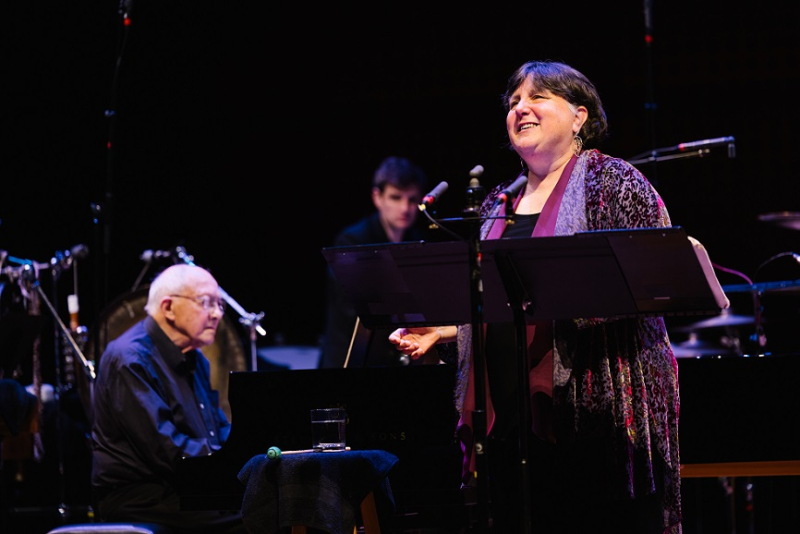
Above: Gilbert Kalish and Dawn Upshaw; photo by Da Ping Luo
George Crumb’s song cycle, The Winds of Destiny, is a setting of hymns, folk songs, and spirituals with otherworldly sounds created by an amplified piano and a percussion orchestra displaying a vast range of colours and rhythms.
From a ghostly prelude, Ms. Upshaw’s voice emerges with remarkable purity in “Mine Eyes Have Seen the Glory”; the hushed sense of mystery in her singing gave me the chills. By contrast, a deafening thunder-burst of drumming seemed to herald the end of days. The soprano became exuberant in “When Johnny Comes Marching Home”; huge percussion assaults remind us of the horrors Johnny has experienced in time of war. There is a mystical interlude – did I hear a glass harmonica? – before Ms. Upshaw resumes her singing, now in a hesitant whisper. The vibraphone creates a hallucinatory atmosphere for the soprano’s ultra-soft rendering of “Lonesome Road”, evoking the fear of death. “Twelve Gates Into the City” brings on the xylophone, and some old-school coloratura from Ms. Upshaw; the song has a big-bang finish.
The lights dim on the singer as Mr. Kalish joins the percussionists in an interlude: “De Profundis: A Psalm for the Night Wanderer”: music which conjures up spectral images in its quietude. Ms. Upshaw’s shushing whispers herald “Death’s Lullaby: All My Trials”, sung in her low register with delicate support from Mr. Kalish as an unearthly hush falls over the hall. Suddenly sparkling xylophone motifs bring a fantastical “Go Tell It On The Mountain”, alive with curiously Oriental harmonies. The music turns pensive, then celebratory as Ms. Upshaw delivers uncanny echo effects on the sung words. Two massive drumbeats punctuate the song’s end. The vibraphone – very soft – introduces the mysteries of “The Enchanted Valley” in which her singing slowly becomes spoken words, ending with a whisper. Rippling piano phrases and soft bells conjure up the river currents of “Shenandoah”, sung to spell-binding effect by the soprano.
Ms. Upshaw, Mr. Kalish, and the gentlemen of Sandbox Percussion – Jonathan Allen, Victor Caccese, Ian David Rosenbaum, and Terry Sweeney – faced a colossal, rock-star ovation from the packed house – everyone screaming and whooping it up in appreciation for this unique musical experience. A second bow was demanded – and delivered – to the delight of he crowd. The performance had captivated me, and the intermission was a slow return to the real world. But, soon, we were taken on a second musical journey of equal power…and the kind of beauty that disturbs.

Alisa Weilerstein (above, photo by Da Ping Luo) and the percussionists took the stage in darkness for a devastating performance of Tan Dun’s 1991 Elegy: Snow in June – music which reflected the composer’s reaction to the 1989 Tiananmen Square uprising and the subsequent execution of protesters. In view of the current world situation, this work takes on a new timeliness.
Snow in June derives its theme from a 13th century Chinese drama by Kuan Han-Ching, in which a young woman, Dou Eh, was executed for a murder she did not commit. Nature itself cries out for her innocence, with resulting miracles: her blood does not fall to Earth but flies upward, a heavy snow descends in June, and a devastating drought lays waste to the land. This Elegy is a lament for all the victims of the world.
Mr. Fajardo’s lighting design underscored the drama of the work; Ms. Weilerstein was seated on a low platform with the percussion array in a semi-circle around her. The movements of the percussionists seemed almost like a choreographed ritual.
As the lights slowly come up, the cello sighs…at first mournful, then agitated. Bells sound, and the music gets wilder, interspersed with more sustained motifs. The wind whines, there are whispered cries, static, and moments of silence. Ms. Weilerstein’s cello is heard in a high, pleading phrases.
Suddenly: pandemonium! Crashing cymbals and battered drums signal a dance-like rhythm, the cello swaying and stuttering. A shrill whistle blows. Through all of this, the percussionists are as fascinating to watch as to hear.
There is a cello drone, and hushed gongs create an extreme softness as long cello tones are sustained. Ms. Weilerstein takes up a forlorn melody, deep and tragic, and later becoming passionate. A crescendo…and then bustling activity among the men as they they seem to be playing multiple instruments simultaneously, alternating subtle and noisy effects. The cello strikes up afresh – animation all round – and then a massive drum attack induces a frantic cello response. Calm is restored: gongs and xylophone produce music of the spheres until a gigantic tidal wave of sound hits. A fast beat is taken up, the cellist playing mad trills and the virtuoso percussionists seem possessed by a mythic force. The whistle screams, the bass drum pounds, panic sets in.
A deep cello note sounds, the music swells to a vast forte, then fades. To the sound of chimes, the cello strays to the high range before sinking to an ominous deep passage, which finally fades away.
This thrilling Tan Dun piece elicited the evening’s second monumental ovation, with Ms. Weilerstein embracing each of the percussionists in turn. Repeated waves of cheers filled the hall as the artists returned for a second bow.
(Performance photos by Da Ping Luo, courtesy of Chamber Music Society of Lincoln Center.)
~ Oberon
 Oberon's Glade