(In a mass transfer of articles from Oberon’s Grove to Oberon’s Glade, several items inexplicably failed to make the jump. I’ve gone back to some of the missing stories that are especially dear to me and posted them individually; the lack of chronology is worth it to me in order to preserve these memories.)
~ Author: Oberon
Thursday December 12th, 2024 – Since hearing the Lithuanian soprano Asmik Grigorian (photo above by ) in her magical Met debut role as Puccini’s Madama Butterfly, I’ve been looking forward to hearing her again. She was at Carnegie’s Zankel Hall tonight for a recital of songs by Tchaikovsky and Rachmaninoff.

With her this evening at Zankel was the excellent pianist Lukas Geniušas (photo above by Jennifer Taylor), who regaled us with solo piano works by the two featured composers in the course of the evening.
By coincidence, Ms. Grigorian sang several of the same Tchaikovsky and Rachmaninoff songs that tenor Piotr Beczala had offered at his Carnegie Hall recital three days earlier. During the interval tonight, it was amusing to hear audience members comparing the two performances, and debating over who sang which songs “better”. Both singers were compelling, and such comparisons are frivolous.
Zankel Hall was full of Grigorian fans; it seems her Met Butterflies really put her on the map here in Gotham. She was welcomed tonight with genuine affection.
From its hushed start, Tchaikovsky’s “Amid the din of the ball” revealed a soprano voice so alive, and so persuasive with its modulations of dynamics and color. With Mr. Geniusas an ideal accomplice, they brought the song to a perfect finish. He then commenced the introduction to “Again, as Before, Alone” so expressively, the soprano joining with singing that was vibrantly passionate, mixed with moments of marvelous softness. The ultra-familiar “None but the Lonely Heart” was beautifully sung, with the ending so touching. The pensive piano introduction to “A tear trembles”, and Ms. Grigorian’s engaging rendering of the song, underlined the wistfulness of the words.
The pianist returned alone, to play the Romance in F-Minor, Op. 5, but unfortunately there was a late seating which he perhaps didn’t expect. To the sounds of clomping heels on wooden steps and the breathy efforts to clamber over already-seated patrons, the pianist strove to continue; the Romance has many mood swings, which he deftly introduces. The latecomers had settled in in time for the ensuing Scherzo humoristique, wherein Mr. Geniusas moved blithely between the grand and the sprightly.
Another late seating delayed Ms. Grigorian’s “I bless you, forests” in which she made much of the thoughtful song, with ravishing soft notes before things get passionate, leading to a lush outpouring of tone. The piano postlude was so persuasively played. The duo then took up “Do not Ask” which has a reflective start before turning intense; feverish emotions give way to a subdued finish.
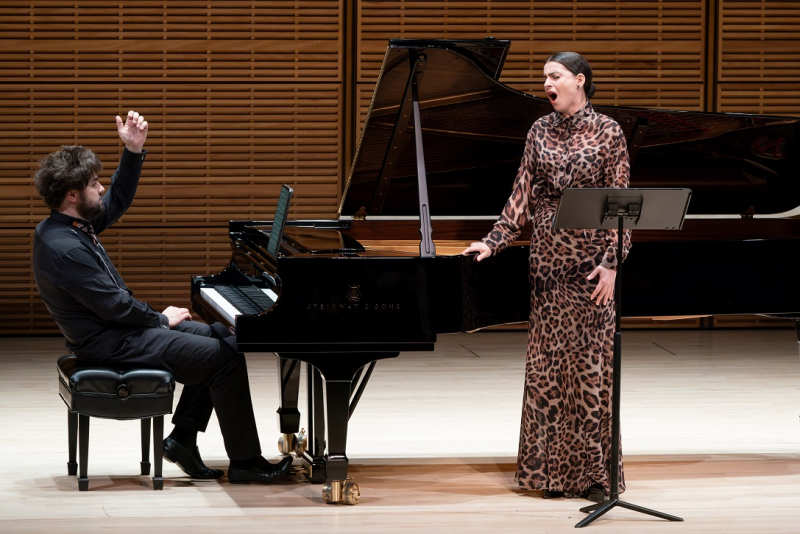
Above: pianist and singer, photo by Jennifer Taylor
If the first half of the program had seemed on the short side, this was finely balanced by a longer second half. Some of Rachmaninoff’s most familiar songs were to be heard in the first set: “In the silence of the secret night”, “Oh, Do Not Sing to Me, Fair Maiden”; “Child, thou art as beautiful as a flower”; “The Dream”; “Spring Waters”; “Oh, do not grieve!”; and “I wait for thee”. I admit I took a break from note-taking, the better to savor the many sonic delights that soprano and pianist gave us. These included top notes from Ms. Grigorian that ranged from gossamer pianissimi to astounding Turandot-like attacks: one such amazing passage caused the audience to erupt in bravas, and singer and pianist took a bow before continuing.
Mr. Geniusas returned for two Rachmaninoff preludes: the shimmering “Prelude in G-sharp Minor” and the “Prelude in D-flat Major” with its sense of grandeur climaxing in cascades of notes and an epic finish.
Ms. Grigorian then offered “Twilight”, a simple song, hypnotically sung. This was followed by “How fair this spot” with its dreamy start giving rise to more potent emotions; here the singer shone with a delectable high pianissimo, which lingered on the air. “Let Us Rest” is a somber, reflective song, and here Ms. Grigorian’s low range glowed. “Dissonance” closed the program: its intense, agitated piano introduction turns rapturous, but there’s also a feeling of uncertainty and hesitation. Then the music pours forth, pausing for yet another pristine Grigorian high note before rushing on to a grand finish from Mr. Geniusas’s keyboard.
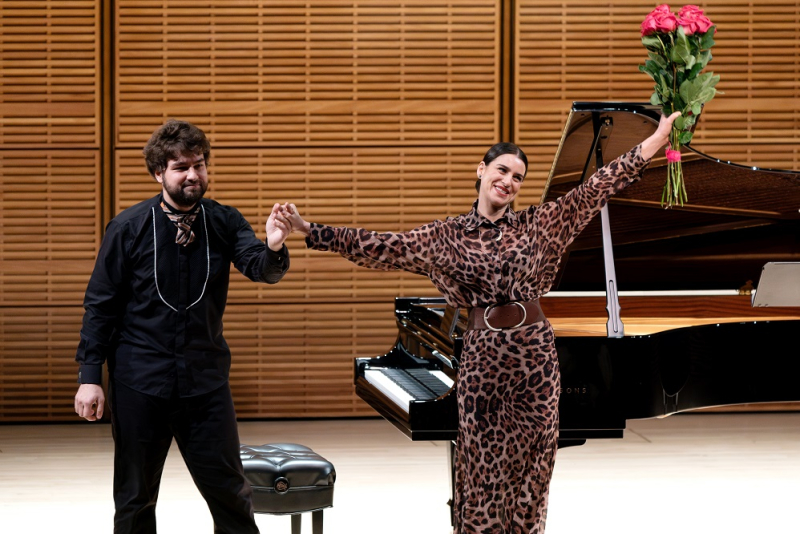
Photo by Jennifer Taylor
There was a single encore – Rachmaninoff’s “Believe me not, Friend,” Op. 14, No. 7 – and the diva was handed bouquets as she and her poetic pianist basked in the audience’s affectionate applause.
Performance photos by Jennifer Taylor, courtesy of Carnegie Hall.
~ Oberon
December 13, 2024
 Oberon's Glade