(This performance was a highlight of the 2024-2025 season at Carnegie Hall. When I realized my article hadn’t been included in the primary transfer from Oberon’s Grove to the Glade, I doubled back and did a copy-and-paste.)
Onstage: Angela Meade, John Matthew Myers, Maestro Botstein, Nate Mattingly; photo by Matt Dine
~Author: Oberon
Friday June 6th, 2025 – The American Symphony Orchestra presenting a concert performance of Richard Strauss’s first opera, GUNTRAM, at Carnegie Hall. Leon Botstein was on the podium, and the ASO were joined by the Bard Festival Chorale, under the direction of James Bagwell.
CAST:
Angela Meade, Soprano (Freihild)
John Matthew Myers, Tenor (Guntram)
Kevin Short, Bass-Baritone (The Old Duke)
Alexander Birch Elliott, Baritone (Duke Robert)
Nate Mattingly, Bass-Baritone (Friedhold, a singer)
Rodell Rosel, Tenor (The Duke’s Jester)
Katharine Goeldner, Mezzo-Soprano (Old Woman)
Bernard Holcomb, Tenor (Old Man)
At the time of the GUNTRAM premiere in 1894, Strauss had already achieved popular success with his tone poems Don Juan and Death and Transfiguration. But the composer’s first venture into opera was judged uninspiring by audience and critics alike. In his later years, the composer referred to his first opera as his “child of sorrow.”
GUNTRAM is the story of two men – the minstrel-knight Guntram and the tyrant Duke Robert – both of whom love the duke’s wife, Freihild. Having saved Freihild from drowning herself, Guntram is invited to the ducal court, where his song in praise of peace and denouncing tyranny seeks to incite rebellion. Duke Robert attacks the minstrel, who murders the duke. Guntram is denounced by the Elder Freihold for his sin. Freihild’s arrival brings Guntram to the realization that he has killed Duke Robert out of romantic jealousy rather than in the name of some lofty cause. Guntram renounces the brotherhood of minstrel-knights, and takes leave of Freihild to repent for his crime in solitude as a hermit.
Whatever listeners may feel about this opera, which musically looks back on Wagner’s LOHENGRIN and TANNHAUSER whilst at times suggesting FRAU OHNE SCHATTEN and other Strauss masterworks to come, it is loaded with gorgeous music and, in its 140-minute arc, there is never a dull moment.
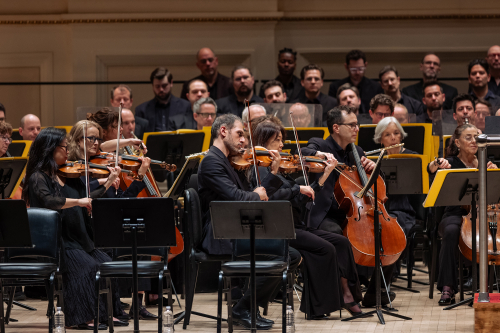
The players of the ASO immediately lured me in with the opera’s long prelude, which starts very delicately; gentle wind themes emerge, and shimmering strings and mellow brass fall pleasingly on the ear. An ethereal violin solo from concert-master Cyrus Beroukhim (photo above by Matt Dine) signals his ongoing importance as the score unfolds. Broad, sweeping music transforms into a lyrical, pastoral segment before a burst of animation introduces the singers.
Tenor John Matthew Myers launched his thrilling evening of singing with passionate lyricism. Mr. Myers has taken on such arduous roles as Bacchus (at La Fenice) and the Emperor in FRAU OHNE SCHATTEN (at San Francisco Opera) whilst covering demanding parts like Peter Grimes, Walther von Stoltzing, and Herman in PIQUE-DAME at The Met. As the evening progressed, a voice in my head kept screaming: “This is our next Lohengrin!” Tonight, Mr. Myers scored a triumph at Carnegie Hall, winning a most enthusiastic ovation at the end.
As GUNTRAM‘s opening scene continues, we hear from one of my favorite mezzos, Katherine Goeldner (a delicious Carmen at NYC Opera) and tenor Bernard Holcomb as an Old Couple. Katherine is strikingly lovely to watch and hear, and when others were singing, she seemed engaged in the unfolding story. We also meet bass-baritone Nate Mattingly, stepping in for an ailing colleague in the role of Friedhold…we will hear more from Mr. Mattingly in the opera’s final act. As the opera moves onward, men from the chorus will come forward in small ensemble roles, always effective in voice and personality.
Mr. Myers now has a Lohengrin-like narrative wherein his dynamic range, the beauty and power of his voice, and his expressive gifts are all impressively on display: such an engaging singer.
Another group of singers now appear: Angela Meade as Freihild – in a blindingly bright golden gown – with Alexander Birch Elliott as her husband, Duke Robert, Rodell Rosel as the court jester, and the always marvelous basso Kevin Short as the Old Duke.
As the opera continues, it becomes evident that Maestro Botstein sometimes lets the orchestra play too loudly, causing the singers to have to over-sing. Ms. Meade’s voice always penetrates, and if her high notes were a bit screamy at first, she soon settled in to some of the best singing I have ever heard from her. Meanwhile, reminders of FRAU OHNE SCHATTEN and ROSENKAVALIER keep cropping up in the score.
Mr. Myers continues to amaze and delight us with his ardent, exciting vocalism, which also has a poetic air to it. There’s an all-hands-on-deck passage where everyone sings at once, but it’s brief. Then Kevin Short pours out his burnished tone, the jester has a silly moment, and a trio for Mssrs. Myers, Birch Elliott, and Short makes for some big singing. The chorus gives Act I a grand finish.
The principals leave the stage for a brief break, and then Act II (set at the Duke’s court) commences in a joyful, dance-like mood. Harp, chorus, and a male quartet of choristers have a scene, with interjections from Mr. Rosel. Ms. Meade and Mr. Short are joined by Mr. Myers, whose singing continues to amaze us. Maestro Botstein, seated and with his back to the audience, still occasionally allows orchestral volume swamp the singers, with who he has no eye contact.

Mr. Myers (above with the Maestro; photo by Matt Dine) now gives us some of the finest singing of the evening; his beautiful lied opens with harp accompaniment; this is a big sing, a flow of melody…truly outstandingly sung. Then the music turns stormy; Duke Robert meets his end (we could have wished for more vocal opportunities for the excellent Alexander Birch Elliott before his character’s demise). Kevin Short as the Old Duke now has a splendid passage before the stage is left to Ms. Meade.
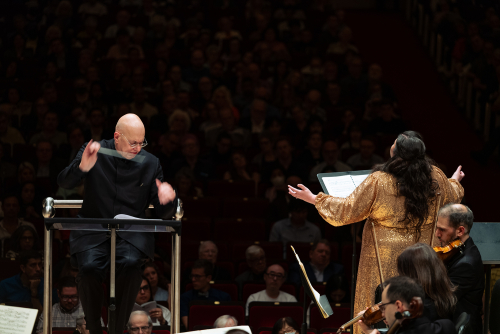
The soprano (above with the Maestro, photo by Matt Dine) delivers some of the best singing I’ve ever heard from her in her sad song, introduced by a somber clarinet theme. In the music, premonitions of Strauss’s FRAU and ELEKTRA yet to come can be detected. Ms. Meade proves herself a persuasive Straussian: she might make an excellent Dyer’s Wife.
Following a blessedly brief intermission, Act III opens with austere brass chords. A tone poem emerges, with the chorus chanting in Latin. Guntram and Freihild are alone onstage; the music becomes tempestuous, and the tenor sings of his anguish whilst the soprano continues in true Strauss mode. Mr. Myers’ voice is so perfect for this music. Ms. Meade sings with increasing urgency, the orchestra playing grandly, the string basses digging in as both singers give it their all.
Now Freihold, in the person of Nate Mattingly, arrives to chastise Guntram for the murder of Duke Robert. Mr. Mattingly sings handsomely. The conductor gets brass-happy but both Mssrs. Mattingly and Myers are unfazed, singing impressively.
Beautiful cello playing and shimmering violins now sound as Guntram faces his fate with resolve: he will withdraw from the world and live out his days as a penitent hermit. Mr. Myers really connects to his listeners here, his vocal generosity is ever-fascinating in its power and sheer beauty.
Amidst the hearty applause that greeted the bowing singers at the end, the tenor was lauded with special enthusiasm, deservedly so. I had hoped to congratulate him in person at the stage door, and to see Ms. Goeldner and Mr. Short again. But after a long wait, only the amiable basso had emerged.
(Performance photo by Matt Dine, courtesy of Pascal Nadon; click on each image to enlarge)
~ Oberon
 Oberon's Glade