(Bringing this 2024 article forward from Oberon’s Grove; this was my first time hearing this incredible ensemble.)

Above: the musicians of the Israeli Chamber Project at the end of their Merkin Hall concert; from left to right: Kobi Malkin, Carmit Zori, Guy Ben-Ziony, Assaff Weisman, Michal Korman, tenor Karim Sulayman, Sivan Magen, and Tibi Cziger. Photo by Judy Kuan.
~ Click on each image to enlarge.
~ Author: Oberon
Friday April 12th, 2024 – This evening’s concert by the Israeli Chamber Project at Merkin Hall was one of the most engaging and moving performances I’ve ever had the pleasure of attending. I’m not sure I can do justice to it in words; it was an emotional and spiritual experience that is practically indescribable.
The program featured classic works by Schumann, Debussy, and Barber, mixed with contemporary pieces by Naji Hakim and Zohar Sharon, and a thrilling world premiere from Gity Razaz. All of it was played (and sung) to perfection by the ensemble’s world-class musicians, and the distinctive voice of tenor Karim Sulayman. It was a desire to experience Mr. Sulayman’s singing live that initially drew me to attend the concert, after having heard him on some clips on YouTube (one of the finest here). His singing tonight was revelatory, as was everything about the program.

Above, playing the Schumann: Carmit Zori, Kobi Malkin, Guy Ben-Ziony, Michal Korman, and Tibi Cziger; photo by Judy Kuan
Music by Robert Schumann – Three Fantasy Pieces, Op. 73 (arranged by J. Keren for clarinet and string quartet) – opened the evening. Clarinetist Tibi Cziger’s plush tone mingled delightfully with the blend of the string players: Camit Zori and Kobi Malkin (violins), Guy Ben-Ziony (viola), and Michal Korman (cello). The immediacy of sound in this intimate hall made me feel like I was onstage, seated among the players.
The melodic flow of the Zart und mit Ausdruck, the light, waltzy Lebhaft, leicht (with its exhilarating rising scales), and the jubilant Rasch und mit Feuer provided one delight after another, with Mr. Cziger’s clarinet at the center of it all.

Above: composer Gity Razaz
A change in the order of the program now brought us the world premiere of Flowing Down the Widening Rings of Being by Gity Razaz. This is a staggeringly beautiful piece of music: the texts, drawn from Rilke and Rumi, were sung with compelling ardor and grace by Mr. Sulayman, and the blending of the players’ individual timbres creating an incandescent sound-world. I was often reminded of Britten, but this music has a deeper spirituality…and a dizzying feeling of rapture.
There are five songs, and for every line – even every word – of the texts, Ms. Razaz has found perfect colours for her instrumentation; aligned with this is the Sulayman voice, which is poetry itself. One of the key elements of the music is the harp, played by Sivan Magen; his melismas had an other-worldly feel. Mr. Cziger’s clarinet and deft expressiveness of Assaff Weisman at the Steinway were woven into the string textures to create gorgeously kaleidoscopic sonic resonances.
Mr. Sulayman cast his spell of enchantment in the opening song, Limits of Longing. The English translation of the Rilke poem has the striking passage, “Let everything happen to you: beauty and terror…”
Two Rumi settings – The Tree of Awe and Dance – are next. In the first, the incredible mixes of the instrumental sounds underlined Mr. Sulayman’s poignant words: “What hurts you blesses you”…”Darkness is your candle.” Dance has a great sense of urgency: it’s done as an agitato, with jagged sounds and a rambling piano part. There is a weirdly wonderful declamatory finish; the overall effect is one of palpable beauty.
In Rilke’s Endless Song, Mr. Sulayman suffuses each word and note with colours from his expansive palette. The orchestration is so…alive!…with the harp and clarinet constantly luring the ear. The singer/poet asks: “…am I a falcon, a storm, or an endless song?” with melting tenderness.
A Community of the Spirit (Rumi) brings the song cycle to a fabulous finish. Here we can savour the deep purple tones of Ms. Korman’s cello, whilst Mr. Sulayman tells us, at the end: “Live in silence. Flow down and down in always widening rings of being”; the tenor’s benediction lingers in a high, floated passage.
During the interval, I sought out composer Gity Razaz (above), and finally found her, with the help of one of her friends. I had so many things to say to her, but of course when the moment came I could only tell her how wonderfully she writes for the voice – a gift not shared by many contemporary composers. She was very kind, and signed my program:


Above: composer Zohar Sharon
Zohar Sharon’s The Ice Palace maintained the high level of both the writing and the playing which has made the evening fascinating so far. Mr. Cziger has brought his clarinet and bass clarinet, saxophone to the stage, and some of the players have singing bowls with them; Mr. Magen’s harp is still in place. We are ready for more magic.

Above, tenor Karim Sulayman singing Zohar Sharon’s Ice Palace with Mssrs. Malkin, Ben-Ziony, and Weisman, Ms. Korman, and Mssrs. Magen and Cziger; photo by Judy Kuan
Ice Palace is in five movements, opening with a Prelude of cool, shivering strings. Then comes Slow Freezing Drops, which is especially fine: the harp and strings in chilly harmonies, the clarinet and high-pitched violin duetting. Along the way, the song bowls hum or chime, lending a sense of reverence and mystery. Mr. Weisman brings a mood of Chopin to the Nocturne, with its rippling piano figurations sounding over shimmering textures. Swirling note patterns from the Magen harp align with clarinet and piano in Sparkling Flashes in the Mirror. At last we are Inside The Ice Palace, summoned by chimes and the rumblings of the bass clarinet. The harp and the sighing violins are heard; suddenly, there is a shocking chord. The music becomes eerie and – in the end – somber, with the bass clarinet lingering in the depths.
Back in my seat after the interval, I was annoyed by the texting of a girl seated in the front row across the aisle; my spirits sank. I’m sure the musicians noticed her, but luckily they ignored her…and so, eventually, did I.
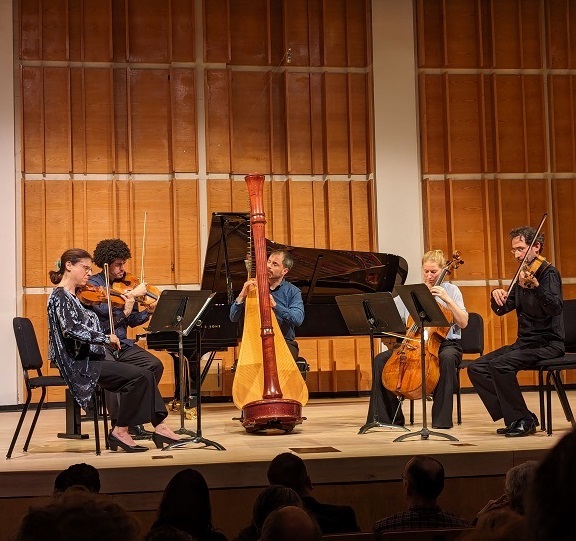
Above, playing the Debussy: Carmit Zori, Kobi Malkin, Sivan Magen, Michal Korman, and Guy Ben-Ziony; photo by Judy Kuan
Claude Debussy’s Sacred and Profane Dances for harp and string quartet is a piece I’d never heard before; Sivan Magen’s deftly lyrical playing of the exotic harp motifs emerged from the unison opening passage. The music is dreamy, then ecstatic, and finally lush in a cinematic way. Swirls of harp notes tempt the ear; it’s simply intoxicating music. But…why do I keep hearing phrases from TURANDOT here? My first thought was that Debussy had borrowed from Puccini, but, after a date-check, I realized it must have been vice- versa.
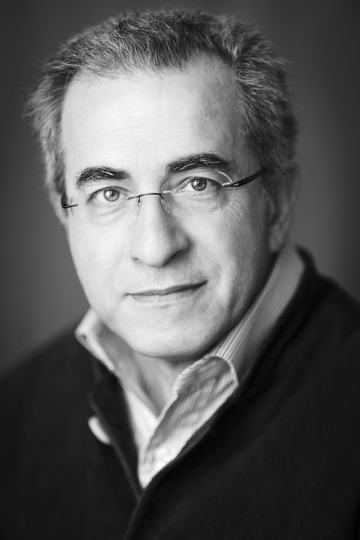
Above: composer Naji Hakim, photo by Aleksey-Vylegzhanin
Mr. Sulayman now re-appeared for The Dove by Naji Hakim. Drawn from biblical texts, the song opens with a high violin passage; the music is quite cheerful at first. Then agitated strings underscore the voice, and the music becomes more emphatic…and finally, almost exuberant. Again, the Sulayman voice cast its spell; his ravishing final note hung on the air, like a blessing of peace.

Above: tenor Karim Sulayman
Samuel Barber’s Knoxville: Summer of 1915, played tonight in an arrangement by Y. Shapiro, has been sung by tenors before: Russell Thomas has sung it in recital to striking effect. The Sulayman voice is very different from that of Mr. Thomas, and this evening the James Agee text sounded youthful, almost boyish.
The musical arrangement, with strings, clarinet, and piano, works beautifully in this setting. The clarity of Mr. Sulayman’s diction, and the radiant purity of his voice, were ideally matched with Mr. Cziger’s warm-toned clarinet, whilst the piano and strings were so artfully employed that I didn’t miss the orchestra at all.

Above: tenor Karim Sulayman singing the Barber, with Kobi Malkin, Carmit Zori, Assaff Weisman, Guy Ben-Ziony, Michal Korman, and Tibi Cziger; photo by Judy Kuan
Two passages especially intrigued me this evening: the uncanny expressiveness of Mr. Sulayman’s voice at the passage which begins “Now is the night one blue dew…” and the blessèd assurance of Mr. Cziger in the clarinet solo preceding “On the rough wet grass…”
And then there were the sweet head-tones which Mr. Sulayman produced for the final lines of the poem…and Mr. Cziger’s poignant response.
I see, reading over what I have written, that I have not really conveyed how luminous – and how precious – this evening felt to me. To all the artists and composers involved, my humble thanks.
~ Oberon
{Special thanks to Avi @ the ICP for sending me the performance photos by Judy Kuan}
April 14, 2024
 Oberon's Glade