(This review of an exciting TRISTAN & ISOLDE at The Met in 2008 first appeared on Oberon’s Grove. I’ve copied and pasted it for the Glade.)
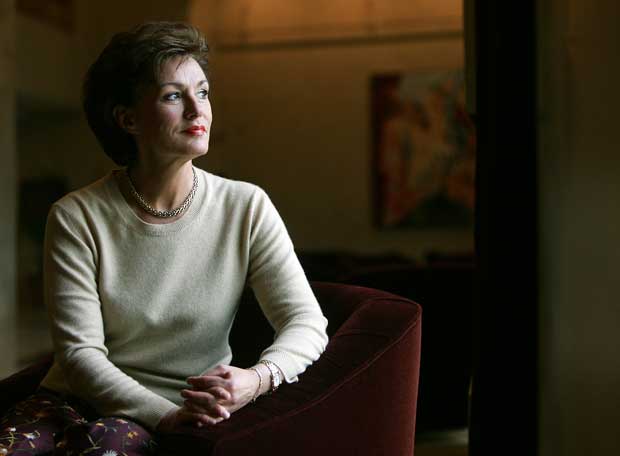
Friday December 12, 2008 – Waltraud Meier’s announced appearance as Isolde in the Met’s TRISTAN UND ISOLDE (replacing Katarina Dalayman) prompted Dmitry and me to get standing room spots and attend another performance of the Wagner opera which I had greatly enjoyed earlier this month.
Waltraud Meier is a pushed-up mezzo-soprano who has been singing some of the most arduous roles in the repertoire for many seasons, and singing them unsparingly. The heavy wear-and-tear on what is basically a lyric voice has left her with a somewhat shallow sound, a lower register that does not always ‘speak’ (for such a dramatically attuned singer, she avoids chest voice), an unpredictable top, and a non-existant high-C. All of this tells against her in making a viable Isolde, added to which in this event was her arrival the night before from Munich and her stepping into a production unfamiliar to her. By rights, it could have been a disaster. By sorcery, she transformed it into a thrilling reading of the role that was sometimes compromised vocally but never emotionally.
Over the years, singers like Leonie Rysanek, Dame Gwyneth Jones and Hildegard Behrens have turned vocal flaws and unwieldiness into assets by virtue of their sheer passionate commitment to what they are singing. That’s sort of what Waltraud Meier did tonight though on a somewhat more intimate scale than those three ladies. Because Meier really was an intimate Isolde.
Meier’s Isolde seemed so vulnerable, a victim of circumstance. With her faithful Brangaene towering over her, Meier seemed almost child-like as she raged against her fate and against the man who had taken everything from her and who was now bearing her off to an unwanted marriage. Meier’s steely, focused tone has a somewhat nasal quality which in lesser hands might become annoying; by her verbal acuity she turns it to an asset of remarkable expressiveness. No, she could not sustain the spear-like top notes of the Narrative & Curse; and in the exciting music preceding the Liebesnacht, the high-Cs simply failed to materialize. Ordinarily such vocal lapses would be cause for despair or even derision but so ardent is Meier’s approach to the music and so poetic her reading of most of the role that to worry about such things as a botched top note seemed the height of triviality.
Meier seduced and bewitched me with her hauntingly ravaged timbre. In a few passages, Meier unleashed some striking fire-power, letting the voice blaze out into the theatre. But mostly she drew us in to Isolde’s suffering and humiliation, and later to the passion that overtook her after drinking the potion. In the Liebesnacht, Meier and Peter Seiffert scaled their singing and expression to the tender intimacy of a lieder recital. In the Liebestod, the passing errant note was swept aside by the dreamlike quality of Meier’s singing – she had passed into another world where nothing mattered but her love for Tristan.
Peter Seiffert’s Tristan was a fine match for Meier’s Isolde. Having had a reportedly disastrous night at the season premiere, Seiffert then withdrew from two performances in favor of the excellent Gary Lehman. Returning, Seiffert showed an essentially lyric voice that has been weathered by long usage but which remains beautiful and expressive enough to create a believable Tristan. The tone has a steady beat but also the power and stamina to get through the long scene in Act III convincingly. He and Ms. Meier were rightfully hailed by the house at their bows.

Vocal honors for the evening went to the Korean basso Kwangchul Youn who sang King Marke with voluminous, darkish tone and a deep sense of the anguish of a man betrayed by his most trusted friend. As Youn poured out his mellow sound in wave after wave of generous lyricism, Marke’s monolog – which can sometimes seem over-long – could have gone on and on.
Gerd Grochowski’s stalwart Kurwenal and Matthew Plenk’s beauty of sound as the Sailor added greatly to the evening’s success, and Stephen Gaertner’s Melot showed his vocal and dramatic powers which the Met should be using far more often and in far more prominent assignments. Michelle de Young’s Brangaene again left me wondering…
Daniel Barenboim and the Met orchestra gave Wagner’s score a thrillingly sensuous reading.
December 13, 2008
 Oberon's Glade