(I couldn’t let my article about this lovely concert get lost in the move from Grove to Glade.)

Above: Angela Hewitt, photo by Nicholas V. Hall
~ Author: Oberon
Tuesday June 17th, 2025 – The renowned pianist Angela Hewitt joined the players of the Orchestra of St. Luke’s at Zankel Hall this evening as the orchestra’s Bach Festival 2025 continued with a program of masterworks by Bach and Mozart.
The concert felt like a ray of light and hope in an ever-darkening world. The full-house crowd at Zankel Hall were amazingly attentive, and a pin-drop silence filled the space as Ms. Hewitt and the OSL players captivated us with their artistry.
The pianist, who I was hearing live for the first time, looked fetching in a black-on-white frock. Her stage presence is as lyrical as her playing, and when she turned to the musicians to conduct from piano bench, her gestures had the elegance of a ballerina’s port de bras.
And what a piano she had at her finger tips! The sleek Fazioli was parked on the stage like a regal Rolls-Royce, and the sound was rich and resonant. Every nuance of Ms. Hewitt’s playing hung marvelously on the air.
J. S. Bach’s keyboard Concerto in G-Minor was an adaptation of a violin concerto in A-minor, thought to have been written during Bach’s period as music director in Cöthen (1717-23).
The work is the very model of an Italian baroque concerto, with its classic layout of fast-slow-fast movements. Bach treats this formula so graciously: by dove-tailing the soloist’s material with that of the ensemble, the music feels integrated and unified, with the musical motifs passed effortlessly between soloist and strings.
The opening Allegro has a lively start: the blend of keyboard and strings so cordial, Ms. Hewitt’s perfect articulation graced with delightful subtleties. And here I must immediately mention the magic of John Feeney’s benevolent bass-playing; as always with this artist, the music is built upon his sure, steady, and velvety tone.
In the ensuing Andante, which opens with stately chords, Ms. Hewitt played with such feeling, her lower range meshing with the Feeney bass to splendid effect. The music veers between passionate and reflective: these mood swings are relished by the players. An exquisite trill was Ms. Hewitt’s finishing touch as the movement reached its conclusion. The finale, a Gigue, sets forth in minor mode, with animated, infectious rhythms. Here Ms. Hewitt charmed us with some sweet touches of rubato, and flourishes of impeccable fiorature.
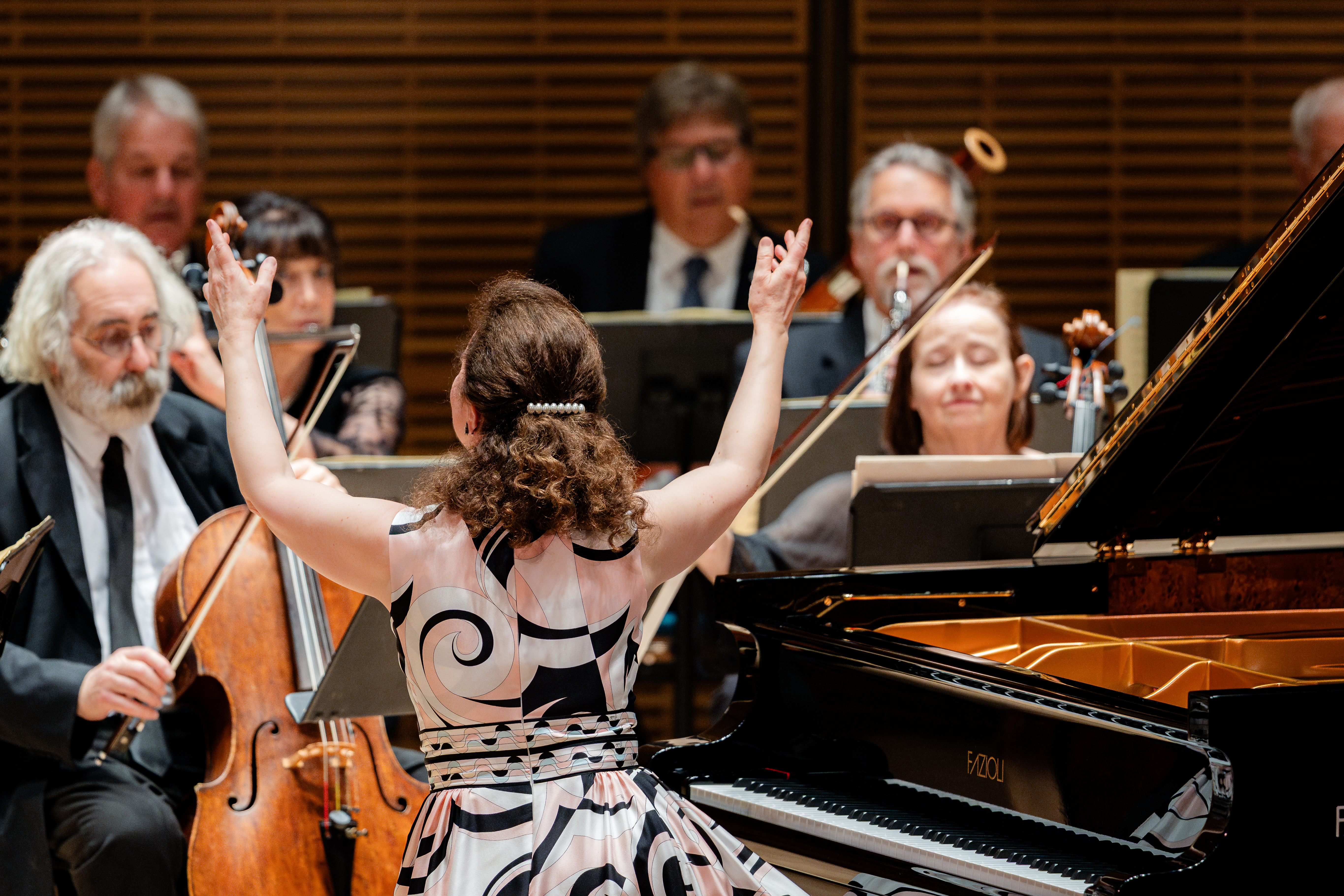
Above: the pianist as conductor, photo by Nicholas V. Hall
Mozart’s Piano Concerto No. 17 in G-major, K. 453, brought forth the OSL’s talented wind players; from my vantage point, they were mostly hidden by the piano, but they certainly made their impressive mark with their playing.
The Allegro‘s charming start is laced with pauses. Each wind voice is heard from in turn. Sprightly playing from Ms. Hewitt entwines with the ensemble, and brief solo piano passages are etched into the mix. The bassoon has some special moments, and a sly echo effect is part of the fun. The wind voices are supported by rippling keyboard figurations before Ms. Hewitt has a jewel-like cadenza. Throughout, I simply loved watching when the pianist turned to conduct.
In the Andante, prayer-like lyricism and fine harmonies among the ensemble transport us. A piano solo is laced with punctuating wind chords. Music that moves between serenity and melancholy made beautiful contact with my soul. A splendid cadenza took Ms. Hewiit from the depths to the heights of the piano’s range, polished off with a heavenly trill.
Wit and grace alternate in the concerto’s Allegretto finale, which commences with a light and airy dance. Ms. Hewitt’s playing is fast and florid, and the winds have their opportunities to shine. The music turns wistful, and then string shivers and horn calls lead us to the end.
Following the interval, we heard Mozart’s Quintet for Piano and Winds in E-flat major, K. 452, wherein Ms. Hewitt was joined that magician of the clarinet, Jon Manasse, and Stephen Taylor (oboe), Marc Goldberg (bassoon), and Stewart Rose (horn).
The first movement commences with chords; seriousness prevails here. The extended slow introduction presents solos from each of the wind players, interlaced with piano passages. This Largo develops into an Allegro moderato: graceful yet curiously hinting at darkness. Jon Manasse’s playing is marvelous and subtle.
The Larghetto highlights the finely-blended wind mix; each musician has his/her say, each playing their finest. Mozart’s operatic ensembles are brought to mind in this well-structured movement.
The concluding Rondo begins almost hesitantly, but soon begins its joyful dance. The music is charming, and so very well-played; I especially relished a very long trill from Mr. Manasse. Mozart thought highly of this quintet: “The best thing I have ever written,” is how he described it to his father Leopold, a few days after its premiere on April 1, 1784, at Vienna’s Burgtheater.
Back to Bach for the program’s finale: his keyboard Concerto in D-Minor, BWV 1052, has a Vivaldian air about it. After a unison start, the opening Allegro features restless piano phrases over simmering strings. John Feeney’s bass is a major force here, whilst Ms. Hewitt displays her vast dynamic range at the Fazioli…her brief, cascading cadenza is especially radiant. A return to the unison theme closes the movement as it began.
The ensuing Adagio again starts with a unison passage, rather mournful. Ms. Hewitt takes up a sad, melodically simple song which leads to an uplifting passage, only to subside into a shadowy mood. The unison theme recurs, the music doleful.
From its swift and sure start, the concluding Allegro sweeps us onward. Dotty notes from the keyboard give way to rippling passage-work, Ms. Hewitt’s playing so very gracious and assured. John Feeney’s bass shepherds the music on to its glorious end.
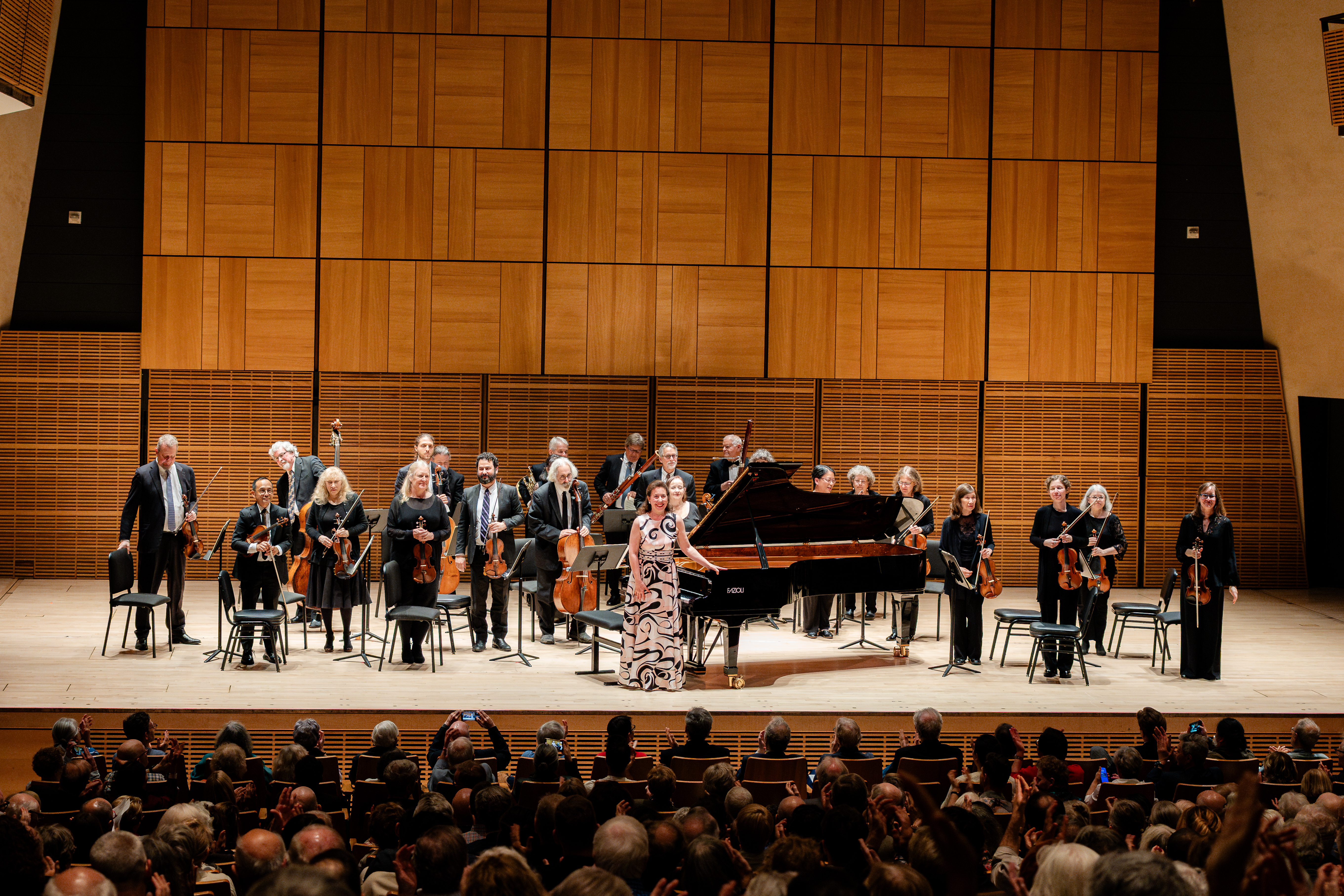
As the last note faded into silence, the spell-bound audience erupted with heartfelt applause and shouts of brava! for the beloved Ms. Hewitt and the musicians of the OSL. (Photo above by Nichols V. Hall). Called back for a second bow, the pianist announced an encore: the classic Largo from Bach’s F-minor concerto. Her haunting, sublime playing was underscored by the gentle heartbeat of Mr. Feeney’s bass, bringing the evening to a heavenly conclusion.
(Performance photos by Nicholas V. Hall, courtesy of Emily Walsh at 21C Media Group. Click on each image to enlarge.)
~ Oberon
 Oberon's Glade