
Above: Walter Morse Rummel
[Note: I am re-reading this fascinating book about a distant relative of mine who was an acclaimed concert pianist, the god-son of Mathilde Wesendonck, a student of Hans von Bülow, a friend of Debussy, and a lover of Isadora Duncan. The book has become even more intriguing for me since discovering another quite obscure – but delightful – connection within my extended family.]
Here is my original article:
It took me several readings of Isadora Duncan’s biography over the years before it sank in that pianist Walter Morse Rummel and I are distantly related. Walter Morse Rummel’s mother, Cornelia, was the daughter of Samuel F B Morse, inventor of the telegraph. My mother, Nancy Morse Gardner, also descends from Samuel F B Morse, and she sustained the connection by giving my brother Jeffrey the middle name Morse.

One aspect of Walter Morse Rummel’s life that particularly intrigues me is his rather obscure but fascinating connection to Richard Wagner: for Rummel’s god-mother was Mathilde Wesendonck (above, click on image to enlarge), from whose poetry Wagner drew for his gorgeous Wesendonck Lieder. Details of the life of Mathilde Wesendonck were not widely known, but that situation has now been at least somewhat remedied by the appearance of this book. The exact nature of the relationship between Wagner and Mathilde – whether it was sexual or merely spiritual – is unclear, but their mutual interest was the proximate cause of Wagner’s separation from his first wife.
But, back to the matter at hand: currently I am reading Prince of Virtuosos, a biography of Walter Morse Rummel by Charles Timbrell.
Walter Rummel was born in Germany in 1887. His father was the then-well-known British pianist Franz Rummel, and his mother – as noted previously – was American. Walter studied piano first in Washington, DC, and thereafter in Berlin where he trained with Leopold Godowsky. Walter Rummel held American citizenship, although his career was entirely in Europe.
By 1908, Walter Rummel was in Paris, where he belonged to Debussy’s inner circle. As a pianist, Rummel toured the countries of Europe, becoming well known for his cycles of ‘one-composer’ recitals which he repeated at many venues across the continent. He was especially admired for his Chopin and Liszt interpretations, though critics were divided sharply over his artistry. As a friend of Debussy, Rummel premiered ten of the composer’s piano works. He performed as soloist under the baton of many famed conductors, including Felix Weingartner and Reynaldo Hahn. Renowned as a pianist of immense creative power, Rummel specialized in the music of J S Bach; he transcribed several cantatas by Bach, as well as many pieces by Bach’s forerunners.
Charles Timbrell’s book is thoroughly and lovingly researched, especially in its detailing of Walter Rummel’s career as a major star in the pianistic firmament of his day: what he played – and where – is painstakingly cataloged. Against this factual background we read reviews of Rummel’s performances that veer from lauds worthy of a god to stark dismissiveness. It’s seems clear that Rummel was an erratic performer, which accounts for the wide range of critical reactions; audiences, however, tended to idolize him.

Above: Antoine Bourdelle’s fanciful depiction of Walter Rummel and Isadora Duncan; click on the image to enlarge
Rummel’s affair with Isadora Duncan began in 1919 when he signed on as musical director and accompanist for her frequent tours. Their collaboration resulted in some of Duncan’s best work, but when the pianist became enamoured of one of the Isadorables, Anna (Denzler) Duncan, things became very rocky between Walter and Isadora, and they went their separate ways.
Walter had a reputation as a womanizer, and one young lady seems to have committed suicide when she found her passion for the pianist was unrequited. In 1932, following two failed marriages, Walter Rummel married Francesca Erik, a Russian poetess who claimed to be a daughter of the last tsar. Francesca subsequently became the mistress of King Leopold of the Belgians; their liaison lasted five years during which time she remained married to Rummel, returning to him as the first winds of impending war began sweeping across Europe.
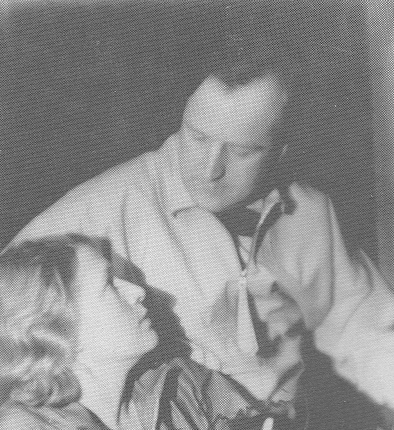
Above: Walter and Francesca Erik Rummel
Rummel’s unfortunate lapses of judgement in the late 1930’s and early 1940’s, when he performed in Germany and in Nazi-occupied France during the war, did serious damage to his career. He even filed for German citizenship, giving up his American citizenship. In 1944, venturing to Austria with Francesca, their papers were confiscated and he became a man without a country.
He thereafter had considerable difficulty explaining to Allied officials that he was apolitical and had performed during the war years wherever he was invited because music was his life. Eventually, he resumed his career but he was already experiencing the onset of spinal cancer from which he eventually died in 1953. Francesca, suffering from Parkinsons disease, went insane but lived on until 1976, dying in Montreux at the age of eighty.
One story recounted in the Timbrell biography which I found particularly moving was of Rummel’s encounter with Bernard Gavoty, critic of Le Figaro, who, in 1949, had given the pianist a severe review for what turned out to be his last concert with orchestra. Gavoty wrote years later that he had received a phone call from Rummel following the publishing of the review; Rummel asked the writer to meet him.
When they met in a small cafe, Gavoty was shocked by the appearance of the once-handsome pianist. Rummel began by saying, “Your review hurt me because it was correct, and it hit me at a time in my career and in my life when I have reason to doubt both. At certain moments, nothing is more unbearable than the truth.”
Gavoty felt uneasy, but said nothing. Rummel went on: “I once was an artist, of that I am sure. You were hearing me for the first time, weren’t you?” Gavoty nodded. “What a pity you hadn’t heard me earlier. I’m sure you would have liked my sound, which pleased Debussy…yes, it’s too bad…it’s too late.” Rummel then signed to the waiter and paid for Gavoty’s cup of tea, which the writer had not touched. He shook Gavoty’s hand and slowly walked away.
“The memory of my article burned my eyes…” Gavoty wrote, “…and I remained there in a stupor, prey to a vague discomfort, and understanding – a little late – that, between a cruel duty and an inadmissable compliance, there are cases when one should prefer silence.”
Walter Morse Rummel’s mystical recording of the Liszt transcription of Wagner’s Liebestod seems to me an ideal summation of my distant but curiously thrilling connection to him, and to Isadora. It is also – reportedly – the last piece of music he ever played: for Francesca, just before his final hospitalization. Listen to it here.
 Oberon's Glade