(A 2008 article about a new production of PETER GRIMES at the Met; Anthony Dean Griffey, a longtime friend of mine, enjoyed a special triumph.)
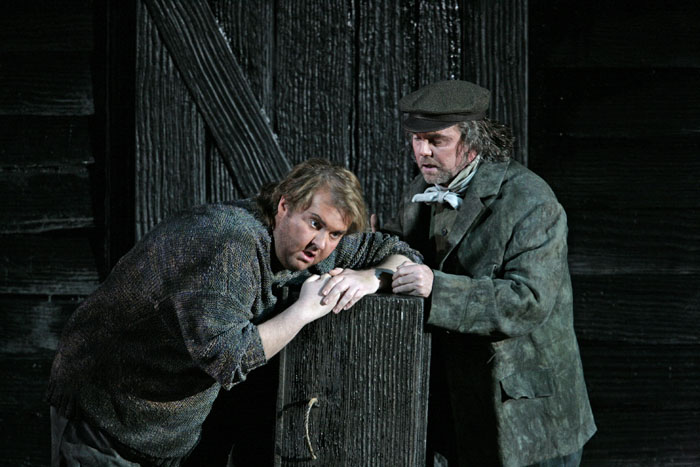
Above: Anthony Dean-Griffey as Grimes and Anthony Michaels-Moore as Balstrode; a MET Opera photo.
Monday March 3, 2008 – The Met’s new production of PETER GRIMES is a very uneven affair; I found myself tonight alternating between feeling keenly drawn into it and then being slightly bored. I thought it was musically more satisfying than visually; the orchestra played very well and the chorus excelled.
I’m not sure if the new production will gain many new admirers for the opera; GRIMES has never been ‘popular’ at the Met and it seems to get revived there more out of a sense of obligation than because of audience demand. Last night the house showed many empty seats on each level at the start and became emptier after each intermission. The unit set, based on the fishermen’s huts in this photo from Hastings, England, is meant to show us the claustrophobic atmosphere of the unpleasant community known as The Borough. The walls isolate and close in on Grimes as the community becomes more and more fearful and enraged. The upright, up-tight citizens, clad in black (the women all seem to be widows) have chosen Grimes as their focus of hatred because he is different. The drunkenness, drug addiction, prostitution and hypocrisy of several of the other townsfolk are simply overlooked because the drunks, addicts and prostitutes are ‘normal’ and Grimes isn’t.
Dramatically the new production is largely a stand-and-sing affair. The chorus just lines up in rows and belts out the music (very nicely!) while the characters stand or sit in front without creating any real tension or showing the dynamics of the relationships. The dark wooden wall which fills the stage is pierced by doors on various levels which open and close distractingly to let characters comment from above. The quartet for Ellen, Auntie and the Nieces which usually shows a nice cross-class female unity here finds each woman standing alone in a doorway and singing to the audience. The scene of the populace gathering in the inn during the violent storm was pretty effective thanks to the lighting which allowed light (and wind) to flash in whenever the door was opened.
A visual weakness from my point of view was that the sea is never seen; the whole story and the music with its thrilling orchestral interludes revolve around the sea – the source of livelihood for the townspeople…and Peter’s ultimate grave. Each act began with blue spotlights shining on the wall; Dmitry said, “There’s your sea!” The production does end with a visual coup as the walls move away exposing the stark white drop and the chorus, all in black but no longer in character, intone the final “To those who pass the Borough…” as a sort of benediction on themselves. The outcast has been cast out; light shines on the community; life goes on.
Is Grimes a murderer? A child molester? Has he really committed any crime or is he simply an unlucky, unloved fellow with rough manners and an inability to express himself? I’ve always thought that Grimes is an innocent victim of happenstance. But in this production Grimes does rough up the apprentice and the boy is clearly terrified of him; in other interpretations I have seen their relationship handled differently – Peter’s brusque treatment simply a way to help toughen the boy for the work to be done – an awkward way of reaching out – and even subtle signs of tenderness between them: that they might have gotten on well eventually and made a success of their work if the villagers had just left them alone. In the current staging, Peter loses something of our sympathy when he seems on the verge of strangling the boy.
The Met has put on a strong cast including Patricia Racette as Ellen Orford, Anthony Dean Griffey as Grimes and Anthony Michaels-Moore as Balstrode. Racette’s vibrato is getting to the point where it’s almost an impediment even though she can usually control it; a few phrases had an unpleasant edge but she managed to offset this with her sympathetic phrasing and use of dynamics.
Tony Griffey’s voice is more lyrical in scope than that of Jon Vickers or Philip Langridge. Once or twice, Tony seemed a bit pressed vocally, but then he would deliver something absolutely stunning in its expressive beauty. His eerie head-voice in the trance-like phrases of “Now the Great Bear and the Pleiades” and his haunting rendering of the final mad scene were splendid. His big, lumbering presence and his facial expressions – which indicated that he was not totally in touch with his surroundings – were assets in his characterization. The evening was a great personal success for him, and so well-merited.
Anthony Michaels-Moore was a magnificent Balstrode with his vocal warmth, unerring sense of dynamics and nuance and the clarity of his diction scoring in every phrase.
The last time I saw GRIMES, in the Met’s prior production, the character roles which make or break the opera were reduced to comically over-played caricatures. It seemed that the stage directors simply left the performers to their own devices, and the opera was seriously weakened. The people of the Borough are eccentric but they are not funny. In the present production we have a powerful group of singing actors, each of them making a vivid mark. Teddy Tahu Rhodes elevated the role of Ned Keene to star status. Rhodes, known for doffing his shirt – and more – in many productions, turns out to be much more than a singing PLAYGIRL centerfold. This guy has a grand-scale voice, rivetingly clear diction, and fantastic stage presence.
The inimitable Felicity Palmer was a fearsome busybody as the laudanum-addicted Mrs. Sedley and she sang with crusty authority. Greg Fedderly was a superb Bob Boles, his voice sailing out into the house with assurance and nailing the words – a potential Grimes himself? Dean Peterson not only sang powerfully as Hobson but played the ominous drumbeats with flair. Jill Grove reveled in the low-lying phrases of Auntie and her two pretty nieces – gowned in the only colours the production affords – were well played and voiced by Leah Partridge and Erin Morley. John Del Carlo’s big old licentious Mr. Swallow was grandly sung and Bernard Fitch’s pointed vocalism was another masterful contribution from this excellent character tenor. Logan William Erickson’s very natural acting as the Apprentice was moving; but why did his scream on falling down the cliff turn into a long whistle?
My friend Dmitry seemed displeased with Donald Runnicles on the podium; my only slight complaint was that a sense of the ethereal that can make certain high-lying phrases in the strings seem transporting was not quite there, and that at times Runnicles pushed the lyric voices of his cast a bit too hard. But the playing was superb, and the conductor won enthusiastic cheers from the house each time he entered the pit and also at the end.
~ Oberon
 Oberon's Glade


