Above, Ben Bliss as Tamino with MET Orchestra flautist Chelsea Knox; a MET Opera photo
Click on images to enlarge.
(This production, which I had kind of been dreading, turned out to be fascinating.)
Saturday April 12th, 2025 matinee – I have been looking forward to this afternoon’s performance of the McBurney Zauberflöte at The Met ever since I saw parts of it back in 2023. I had not expected to be so taken with the production, and I was glad today to have an opportunity see all of it, and to hear some fine singing. I will admit that, in the second act, a sense of longuers sometimes crept over me, possibly a result of not sleeping well in the past few nights. I was rather surprised to see so many empty seats in the House today.
Evan Rogister, who has previously conducted the Taymor Zauberflöte and Fire Shut Up In My Bones at The Met, was on the podium. His pacing and control over orchestral volume were mostly spot on, but he did not really illuminate the score, as Nathalie Stutzmann had done when the production premiered. The overture seemed brass-heavy at times. Favorite parts in the score, such as the “Bei Männern” duet and the Chorus of the Priests – which are cut in the Taymor English-language production – are right where they are meant to be, and seemed especially welcome this afternoon. The Taymor also cuts a lot of the spoken dialogue, which today felt overly long.
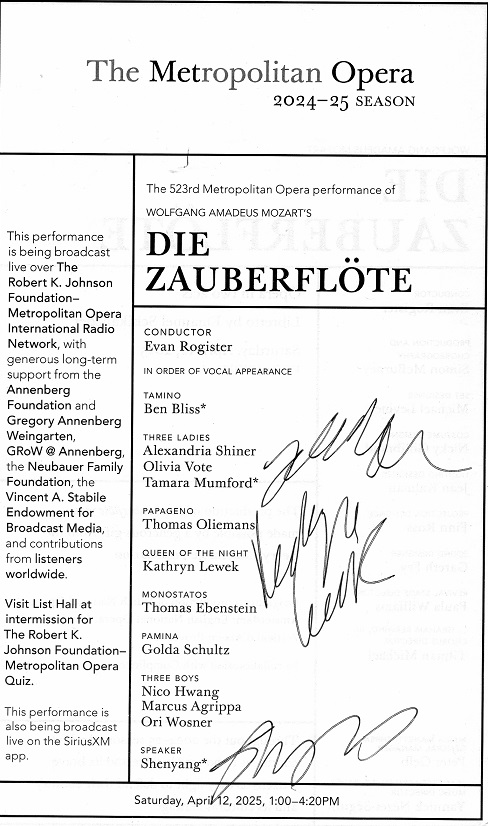
There were several hold-overs from the 2023 cast, including Thomas Oliemans as Papageno, Kathryn Lewek as the Queen of the Night, Stephen Milling as Sarastro, Alexandra Shiner, Olivia Vote, and Tamara Mumford as the Three Ladies, and Richard Bernstein and Errin Dwayne Brooks doubling as Guards and Priests. New this season are the Pamina and Tamino (Golda Schultz and Ben Bliss), with Shenyang as the Speaker, Thomas Ebenstein as Monastatos, and Magdalena Kuzma as Papagena. The Three Genii today were Nico Hwang, Marcus Agrippa, and Ori Wosner.
On opposite sides of the stage, Foley artist Ruth Sullivan produced sound effects from her booth whilst Blake Haberman showed us the writing on the wall with his amusing drawings and titles. In this production, the singers have lots of very physical acting to do, whilst still managing to deliver some very appealing singing.

Ben Bliss (above), an outstanding Tamino, made his frantic entrance being pursued by serpents; he is saved by the (excellent) trio of Ladies – Alexandra Shiner, Olivia Vote, and the delicious Tamara Mumford – who then proceed to gang-rape him while he’s passed out. The Ladies are a well-balanced trio vocally, though I admit it was mostly on Ms. Mumford whose singing I focused upon. Ben Bliss revives, but spends the remainder of the scene in his underwear, meanwhile giving us a gorgeous ‘portrait’ aria.

Above, a man with his ladder: Thomas Oliemans as Papageno in a MET Opera photo
Meanwhile, Papageno – in the person of Thomas Oliemans – has made his entrance, toting a step ladder that he will lug around throughout much of the evening. His opening aria, hilariously staged, was interrupted for some theatrical by-play, only to resume with his flock of paper birds swarming about; even members of the orchestra participated here.
Now the Queen of the Night, Kathryn Lewek, appears: a disheveled queen, down on her luck and living with her minions in squalor. Decrepit and care-worn, she relies on a cane and her wheelchair to navigate the stage. Ms. Lewek delivered a spectacular recit & aria, “O zittre nicht“, the andante hauntingly phrased with shimmering piano notes etched in, and then bursting into the bravura ‘cabaletta‘, rising up to a sustained top-F.
A melodious quintet (Mlles. Shiner, Vote, and Mumford with Mssrs; Bliss and Oliemans) sends the men on their quest to rescue the Queen’s daughter, Pamina. We first meet the princess (lyrically sung by Golda Schultz) as she attempts to escape captivity, pursued by men with flashlights. Her guardian, Monastatos (played by Thomas Ebenstein, an excellent singer and actor) encounters Papageno, and they have a comic duet. The bird-catcher now meets Pamina, and they join in the sublime duet “Bei Männern” – sadly omitted in the English language/Taymor production.
The Genii, as guides, now appear: they are boys but appear elderly, limping about with canes. Tamino stands before a wall of huge books where his attempts to enter Sarastro’s temple are thwarted by cries of “zurück!!” from within.

Shenyang, as the Speaker (above, in a MET Opera photo), emerges from Sarastro’s domain, and my favorite scene in the opera commences. Shenyang, with his mellifluous bass-baritone timbre and finely-inflected diction, is a tall and noble onstage presence, always carrying a book with him. He tells Tamino what must happen in order for him to gain entry to Sarastro’s realm. Between his verbal subtlety and his powerful voice, Shenyang brings the character – often a cipher in other productions – vividly to life. As the opera moves forward, the Speaker has much speaking to do…long passages in which we can savor Shenyang’s expressive German diction. In later scenes, the towering bass-baritone carries with him an oil lamp with an open flame.
Left alone before the forbidden temple, Ben Bliss sings with ravishing clarity of Tamino’s pain at being thwarted in his quest. The words of the Speaker have turned Tamino’s world upside down: is Sarastro really evil? In this pensive mood, he turns to the magic flute for solace. Chelsea Knox, the Met’s luminous flautist, joins Ben onstage. The birds flock around them, enchanted by the sounds. Ben, such a persuasive singer, introduces a mini-cadenza whilst Ms. Knox’s fluting casts a spell.
Pamina and Papageno, attempting escape, rush in, pursued by Monastatos. The slave and his flunkies are enchanted by Papageno’s music box, played by Katelan Trần Terrell from the edge of the stage. The slaves break into a dance, with a contemporary accent tossed in.
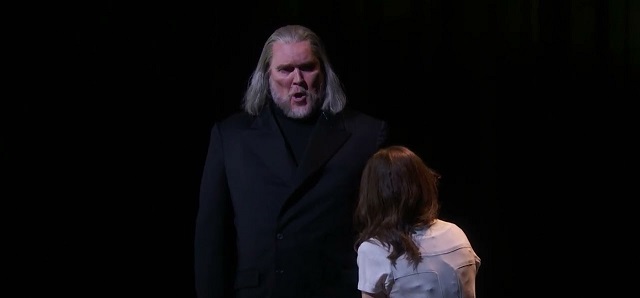
Above, Stephen Milling as Sarastro; a MET Opera photo
Sarastro, in the towering person of the marvelous Danish basso Stephen Milling, now marches down the Met aisle with his acolytes and ascends to the stage to question Pamina. Golda Schultz offers an honest defense, bravely sung. Sarastro, with the Speaker ever near him, sets the rousing Act I finale on its way.
During the interval, the stage has been set with rows of chairs; here Sarastro’s loyal followers gather. Mr. Milling, standing at the orchestra railing, addresses them before taking the stage. A large conference table rises from the floor; Sarastro addresses the faithful using a microphone while the orchestra plays. Shenyang then speaks further, before Mr. Milling delivers one of Mozart’s greatest arias, “O Isis and Osiris” with a reverential tone which becomes even grander in the melody’s repeat.

Above, Ben Bliss as Tamino and Gilda Schultz as Pamina, with Stephen Milling as Sarastro looming in the background; a MET Opera photo
Pamina and Tamino are told of the trials they must endure; Mr. Milling joins Golda and Ben in a trio. Shenyang has lots of speaking to do.
The stage clears; Monastastos limps on, having been tortured for lying. Finding Pamina slumbering also, Mr. Ebenstein sings incisively of his plan to have her. But just as he is about to pounce, the Queen of the Night wheels in, banishes the wily slave, and orders her daughter to kill Sarastro. Kathryn Lewek commences the brilliant “Der Hölle Rache“, which is practically soprano’s theme song. The soprano gives us all the fiorature and top Fs with brilliance, then delivers the knockout punch with her sustained and powerful vow of vengeance, crushing Pamina’s feeble resistance with a top note of searing intensity. The audience erupted with applause and cheers.

Above: Kathryn Lewek as the Queen of the Night; a MET Opera photo
Sarastro’s anger with Monastatos causes the slave to become deranged; he will go over to the Queen of Night’s side. Mr. Milling then treats us to more beautiful bass singing with “In diesen heil’gen Hallen“; the opening verse perfect, the second even more so.
Shenyang greets Mssrs. Bliss and Oliemans as they prepare for their test. After the Speaker leaves, the men ignore a vow of silence, burstng briefly into “New York, New York!” The Genii arrive to sing an admonishing trio…

…and then Ms. Schultz (above, in a MET Opera photo) arrives but is grief-stricken by Tamino’s silence. Her plaintive aria, perhaps taken a bit to fast for maximum effect, was touchingly sung.
Mozart’s incredibly beautiful Chorus of the Priests – another omission in the Taymor/English version – was lovingly voiced. Tamino almost chickens out as he is led off for the tests of fire and water. Papageno/Oliemans stays behind for a long and chatty scene as he prepares his glass harmonica, amiably pissing in one to bring it to proper pitch. “Ein Mädchen oder Weibchen” is then delivered with many witty touches.
The bird-catcher now meets Papagena, played by Magdalena Kuzma, but their destined union is delayed. The Genii appear to console and encourage the despondent Pamina. Ms. Schultz will join her prince for the trials of fire and water, which are depicted by projections of a massive blaze (firemen arrive!) and later by the lovers floating in a pool.
Papageno’s suicide attempt is halted by the Genii, who tell the birdcather to put his magic music box to use again. It works!…and after their charming ‘Pa-pa-pa-pa‘ duet, the merry couple rush blithely up the Met aisle.
The Queen, her Ladies, and Monastatos are thwarted, and – as Sam Gamgee once said – “All’s well as ends better!” Sarastro heals the Queen and she joins in the opera’s joyous finale.
At a time when hatred runs rampant in the world, it was so meaningful today to experience this Mozart masterpiece wherein love triumphs.
~~~~~~~~~~~~~~~~~~~~~~~~~~~~~~~~~~~~~~~~~~~~~~~~~~~~~~~~~~~~~~~~~~~~~~~~~~~~~~~
After a rousing ovation, I went to the stage door to say hello to Tamara Mumford and Shenyang, both of whom I had met back in their days as MET Young Artists. They both look happy and healthy, and it was so nice to see them again after so many years. I also talked to Kathryn Lewek, a petite and friendly woman; when I asked if she would would sing Donizetti’s Lucia for us someday, her eyes lit up: “I would love to!!” (She does have Met engagements coming up in roles other than Mozart’s star-flaming queen, which she has sung here 80 times!)
 Oberon's Glade