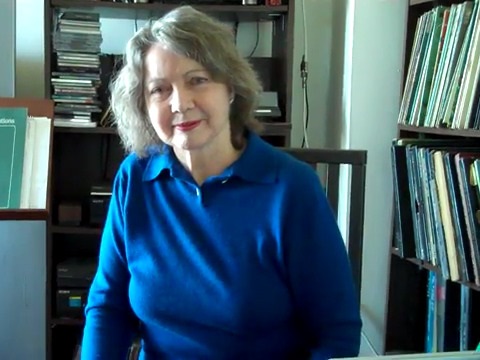
Above: composer Ellen Taaffe Zwilich
(The last few days of importing articles from Oberon’s Grove onto Oberon’s Glade are here. I especially wanted to keep this story of meeting composer Ellen Taaffe Zwilich.)
Click on each image in this article to enlarge.
~ Author: Oberon
Sunday March 2nd, 2025 – Chamber Music Society of Lincoln Center gave us an evening of music for strings – and only strings – at Alice Tully Hall. Nine superb musicians joined together for the program, bringing us works dating back to the early 19th century thru the dawn of the 21st century.
A 1984 Carnegie Hall commission, Ellen Taaffe Zwilich’s Double Quartet for Strings, opened the concert. This was my second experience with a Zwilich score this Winter: in late December, the NY String Orchestra offered her Prologue and Variations at Carnegie Hall. Read about it here.
The two quartets involved in the Zwilich piece were peopled by wonderful artists: Francisco Fullana, Julian Rhee (a violinist new to me), Paul Neubauer, and Dmitri Atapine formed one quartet, and Ani Kavafian, Kristin Lee, James Thompson (playing viola), and Mihai Marica made up the other.
A note is struck by all to open the Allegro moderato, and it is sustained by the violins. A strong unison passage follows. The violins from the two quartets exchange phrases to a vibrant, insistent beat. Cello animation sets up vivid, searing music; the celli sing on high and Mr. Thompson sounds wonderful in a viola passage. Ms. Lee plays on, to the prevailing accents, and Mr. Fullana commences some bright plucking. The movement fades to silence.
Msrs. Fullana and Rhee harmonize to open the Lento; Ms. Kavafian joins, and the violas and cellos have their say. Mr. Fullana makes a stunning impression, playing over cello chords. Dense harmonies, and a terrific blend of timbres, make the music so alive. There is a pause, and then a repeated note sounds as rich cello phrases are joined by the others, one by one. Mssrs. Fullana and Rhee shine here, but it is Ms. Lee, on a sustained note, who has the final moment.
The Allegro vivo springs up suddenly; there is wonderful energy in this music. Cellos trill, and dynamic variety lures the ear. Mssrs. Fullana and Rhee sustain a note while Ms. Kavafian shimmers on high; violas and cellos add sonic texture. Then there’s a preparation and launch of fresh ideas; more trills, and Mr. Fullana playing passionately in alt. With a long, sustained note, the music vanishes into thin air.
For the concluding Adagio, an ethereal mood emerges, with the four violins sustaining on high while violists Neubauer and Thompson join in a duet, later transformed to a quartet when cellists Atapine and Marica join. Ms. Kavafian plays in the upper range over somber harmonies and sustained tones. A cello duet leads to a unison passage for the four violins. Lower notes sound, and the work reaches its poignant finish.
The composer was warmly greeted as she stood in her box for a bow; meanwhile, she had sent a rose to each of the musicians onstage. What a lovely moment!
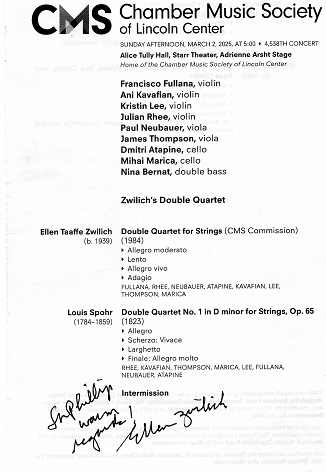
While waiting for the concert to start, I had noticed Ms. Zwilich’s presence; I decided I would go up and meet her during the interval. She was very kind and signed my program. While I was there, a friend of hers asked her what she had thought of tonight’s performance of her Double Quartet. “Well, they knocked it out of the ballpark!” was her reply. I couldn’t agree more.
We reach back to 1823 for Louis Spohr’s Double Quartet No. 1 in D minor for Strings, Op. 65. For this, two distinct quartets appeared rather than having all eight musicians in a semi-circle. Stage left, one quartet was led by Ms. Lee with Mssrs. Fulllana, Neubauer, and Atapine, while – stage right – the other was expertly led by Mr. Rhee, with Ms. Kavafian and Mssrs. Thompson and Marica. Since the latter quartet were directly in my line of sight, I tended to pay more attention to them.
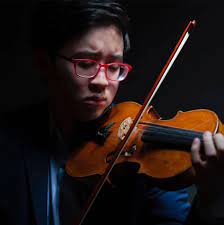
In the opening Allegro, Mr. Rhee (above) made an excellent impression, with a magical dynamic range and persuasive phrasing. Mihai Marica, always a favorite of mine, was most impressive this evening, as was Mr. Thompson, who made the most of a beautiful viola theme, taken up soon after by Mr. Marica. Blending perfectly with their colleagues in the stage-left quartet, they turned the Allegro into a most appealing experience.
The Scherzo has a lively start, and Mr. Rhee continues to delight here; across the stage, Kristin Lee sometimes echoed Mr. Rhee’s phrases. A gallant beat is established as Mssrs. Rhee, Thompson, and Marica have solos, whilst Ms. Kavafian makes the most of every opportunity. In a sort of da capo, Rhee and Marica communicate to fine effect. The music drifts away.
Rhee leads off the Largetto, and Marica plays gorgeously here; sometimes he and his counter-part, Mr. Atapine, join forces. Meanwhile Ms. Lee and her group have a reprise of their own. Everyone’s playing very well indeed.
A scurrying feeling and amiable harmonies set the concluding Allegro molto on its way. Lively exchanges of themes mean everyone gets a chance to shine. The movement has a bustling feeling, with some brief detours along the way. It’s music that’s melodious…and full of delights.

Above, playing the Spohr: Julian Rhee, Ani Kavafian, Mihai Marica, James Thompson, Paul Neubauer, Dmitri Atapine, Fracisco Fullana, Kristin Lee; photo by Tristan Cook:
Max Bruch’s 1920 Octet for Strings brought the four violinists (Ms. Kavafian taking the lead), and two violists together, with Mr. Marica. But rather than a second cellist, Nina Bernat joined the ensemble with her double bass; this brought fresh colours into the mix.
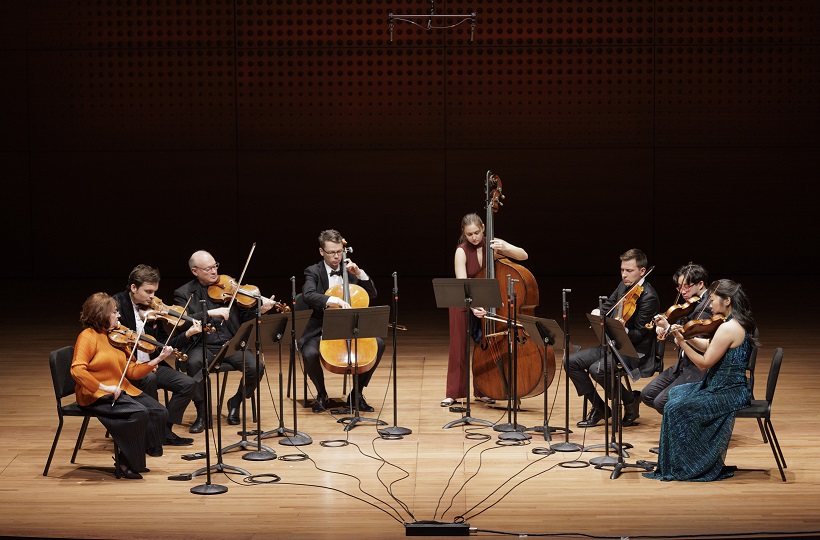
Playing the Bruch: Ani Kavafian, Francisco Fullana, Paul Neubauer, Mihai Maruca, Nina Bernat, James Thompson, Julian Rhee, Kristin Lee; photo by Tristan Cook
Bruch’s Octet is in three movements, opening with an Allegro moderato. Paul Neubauer’s sublime theme is taken up sweetly by Ms. Kavafian. Ms. Bernat’s playing is perfect, Mssrs. Fullana and Marica are splendid, and Kristin Lee, and Mssrs. Rhee and Thompson maintain their high level. There is a big unison passage, then tremelos support Ms. Kafavian’s lyricism….so very appealing. The movement has a grand finish.
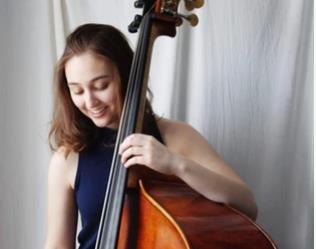
Above: Nina Bernat
The only work on the program for more than eight musicians was Olli Mustonen’s Nonet II which adds a bass player to the mix of four violins, two violas, and two cellos. Nina Bernat, a singular bassist, was again very impressive.
The Nonet lists four movements, but I could only discern three; perhaps I missed a transition thanks to the disruptive chatterboxes seated in front in me. At any rate, the music has an itchy start; the cellos and bass add depth whilst the violins slash away. A trudging beat takes over; the music builds excitingly, with repeated chords leading to a sudden stop.
The Adagio was especially fascinating: a 4-note motif repeats endlessly throughout the movement, but, with varying instrumentations and shifting harmonies, it becomes spellbinding. There is a key change, and a rise of emotion…really gorgeous colours emerge.
The concluding movement has the feel of a Mendelssohn scherzo: light-filled and lovely. Brisk bass figurations from Ms. Bernat and a vivid agitato from Mr. Fullana sustain our interest. Intensity rises until the music meets with a sudden halt.
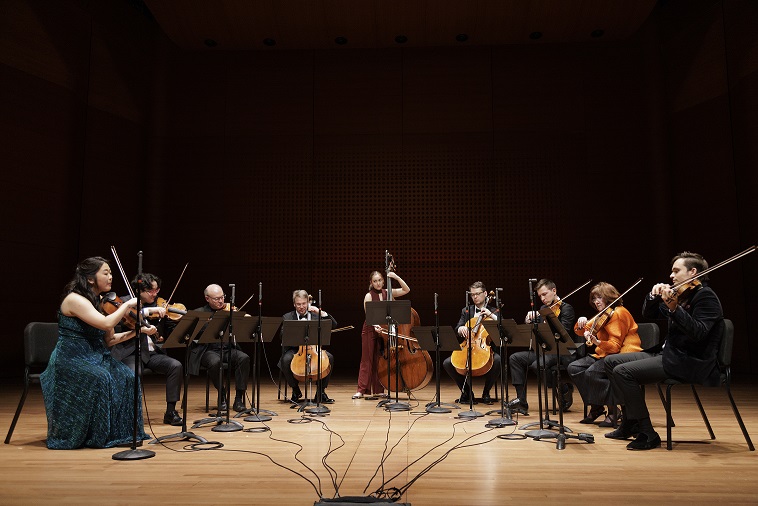
Above, playing the Mustonen: Lee, Rhee, Neubauer, Atapine, Bernat, Marica, Thompson, Kavafian, and Fullana; photo by Tristan Cook.
My thanks to Beverly Greenfield of Kirschbaum Associates for sending the performance photos by Tristan Cook.
 Oberon's Glade