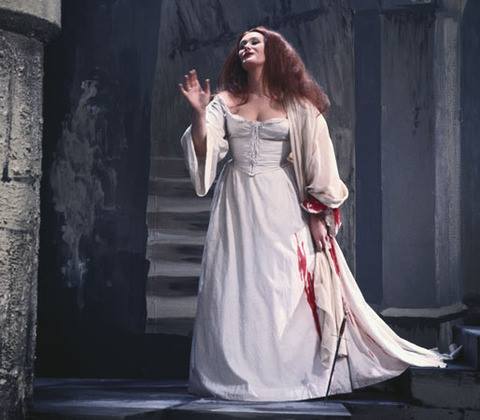
Above: Dame Joan Sutherland as Lucia di Lammermoor; click on the image to enlarge
(In the final days of access to my original blog, Oberon’s Grove, I’m trying to rescue some articles that were left behind in the mass transfer. I wrote this in 2017.)
~ Author: Oberon
I fell in love with opera on January 12th, 1959. I know the exact date because the television program that so captured my imagination was released – many years later – on video. It was a Bell Telephone Hour presentation of Renata Tebaldi singing excerpts from Puccini’s MADAMA BUTTERFLY.
That half-hour mesmerized me: who was this woman in a kimono singing in a language I could not understand? Why was her voice so big and rich? Why were these melodies reaching a depth of feeling in me that I’d never realized existed? Why did she kill herself? To a small, unhappy 11-year-old boy living in a tiny town, this experience opened a portal for me: a gateway into another world where I could be safe, wrapped in music and poetry of uncanny beauty.
What I didn’t know at the time was that an operatic event took place in London within a month of my Tebaldi-revelation: an Australian soprano named Joan Sutherland, who had been singing Mozart and Wagner for a few years, had a stunning triumph in Donizetti’s LUCIA DI LAMMERMOOR at The Royal Opera House, Covent Garden, on February 17th, 1959. Sutherland’s break-thru performance would colour my earliest years as an opera-lover.
After that first televised Tebaldi experience, it took a while for me to construct my own operatic world. At that point, I was sadly unaware of the Texaco-Metropolitan Opera Saturday matinee broadcasts; had I known of them, I could have heard some wonderful performances between Spring 1959 and December 1961. Instead, I had to settle for few-and-far-between tidbits on television: any opera singing on the Ed Sullivan Show, the Voice of Firestone, and the Bell Telephone Hour became unmissable opportunities for me.
My parents kindly bought me a two-LP set of RCA Victor artists singing Verdi and Puccini arias. It is not an exaggeration to say I wore the records out with constant playing. The singers were Albanese, Milanov, Peters, Bjoerling, Peerce, Merrill, Warren, and Tozzi. Thus I cut my operatic teeth.
Then, on Friday December 8th, 1961, I chanced to see a small notice in the Syracuse newspaper that the Texaco-Metropolitan Opera Saturday matinee broadcast season would begin the following day, and would continue for twenty consecutive Saturdays. What??? I was of course the only person in my household to care.
The broadcast was to be LUCIA DI LAMMERMOOR featuring Joan Sutherland, who had just a few days earlier made her Met debut. I tuned in a full hour before the broadcast was to start. Radio reception was spotty, but then suddenly the voice of Milton Cross was heard. Oh, my god, someone is actually talking about opera! I was on cloud nine. Milton Cross told us about Sutherland – her leap to fame at Covent Garden and her fresh triumph at The Met. The phrase “high E-flat” was bandied about. I ran to the piano and struck the note and sang it – an easy reach for my pre-pubescent boy soprano.
Then Milton Cross told the story of the opera’s first act: I was thrilled – thrilled, I tell you! – to hear him speak of a forbidden love, of a ghost in a well, of a secret meeting, and a desperate parting. It was everything!
The opera finally started, and I was riveted to the old ivory-coloured box radio. Unfortunately my grandmother, who lived with us, had been sick to her stomach all morning and now she was feeling worse. I could hear her moaning and groaning, but I ignored her and clung to the music I was hearing. Such romance and passion! Sutherland had become my idol, and Richard Tucker as Edgardo sang thrillingly.
My mother suddenly announced that we must take my grandmother to the hospital, about ten miles away. I threw my own mad scene, saying I had to stay at the radio until the opera ended. My mother wouldn’t hear of it. I think my hatred of my grandmother started that afternoon. No exaggeration.
At any rate, the Saturday matinee Met broadcasts became my lifeline: nothing could interfere with my Saturday afternoons. I got my parents to buy me a reel-to reel-tape deck and I went back over and over the broadcasts of each succeeding week. I joined the Metropolitan Opera Guild, and devoured each issue of Opera News ravenously. I began to dream of going to The Met, and – in 1963 – my parents took me. I was able to see eight performances at the Old Met, accompanied by my parents or an older family friend. At last, in the late Summer of 1966, having graduated from high-school, I made my first solo trip to New York City and was on the ticket line for the opening weeks of the New Met.
But…back to LUCIA:
When Sutherland returned to the role of Lucia at The Met in 1982, she had a colossal success. I was at the performance that was telecast (!), and the atmosphere in the House was electric. Dame Joan’s Mad Scene literally stopped the show.
Here’s the soprano in Lucia’s final moments:
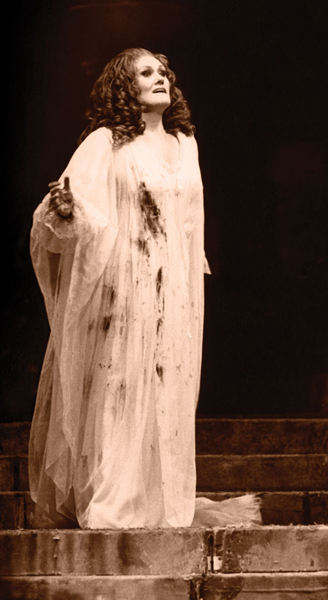
Above: Sutherland as Lucia at the Met, 1982.
In the years that followed Sutherland’s first Lucias, there were a number of sopranos who made wonderful and vastly different impressions in the role: Roberta Peters, Renata Scotto, Beverly Sills, Patricia Brooks, Patricia Wise, Rita Shane, Gianna Rolandi, June Anderson, Edita Gruberova, and Mariella Devia.
Flash forward nearly 60 years from Sutherland’s first London Lucia, and the reverberations of La Stupenda’s Bride of Lammermoor are still hovering in the operatic air: my beloved friend and lyric-coloratura extraordinaire Lisette Oropesa recently took on the role of Donizetti’s hapless mad-woman on the same stage where Sutherland had triumphed in 1959.
The bloody nightgown is still an iconic symbol of Lucia’s tragic destiny, but of course the Royal Opera production’s director could not resist tampering with the story to try to make it more…whatever…and thus the blood is now the result of a miscarriage, because of course Lucia was pregnant. Odd that Donizetti hadn’t picked up on that.
Be that as it may, Lisette enjoyed an enormous London success with her Lucias: rave reviews, and standing ovations.
~ Oberon
 Oberon's Glade
