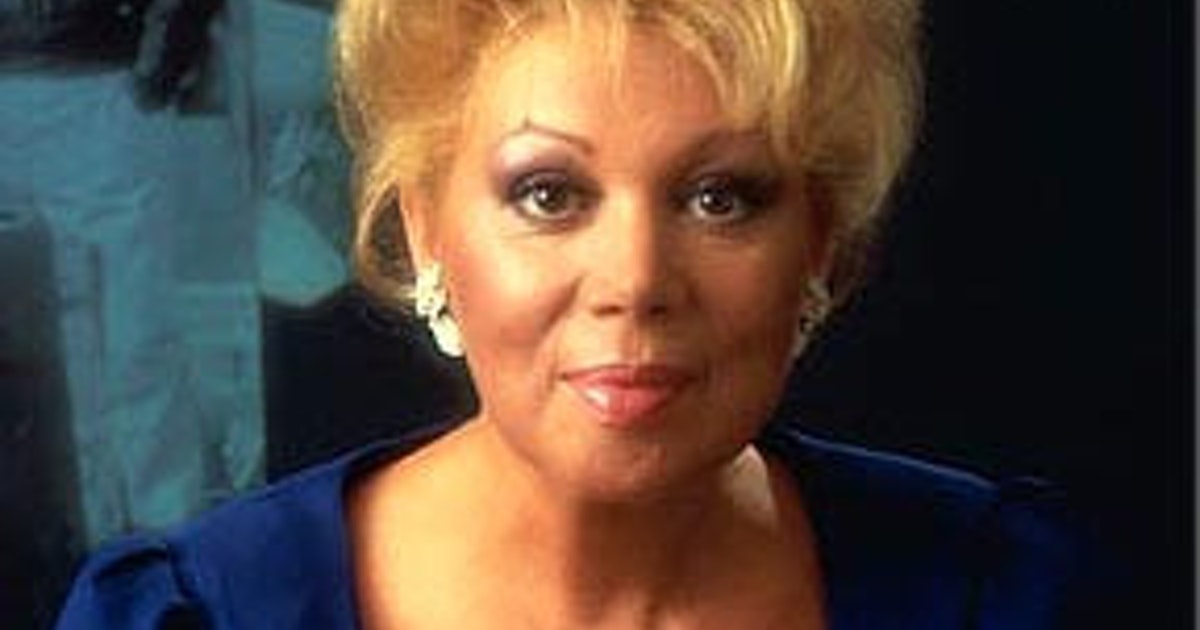
Above: Mirella Freni
(Only two days remain for me to locate articles from Oberon’s Grove that did not come thru in the big transfer to Oberon’s Glade. I’m doing my best to locate stories that were especially important to me at the time of writing…such as this one.)
One of the greatest musical experiences of my life took place at Tanglewood on July 11th, 1981: a performance of the Verdi REQUIEM by the Boston Symphony Orchestra conducted by Seiji Ozawa, with soloists Mirella Freni, Shirley Verrett, Ermanno Mauro, and Nicolai Ghiaurov.
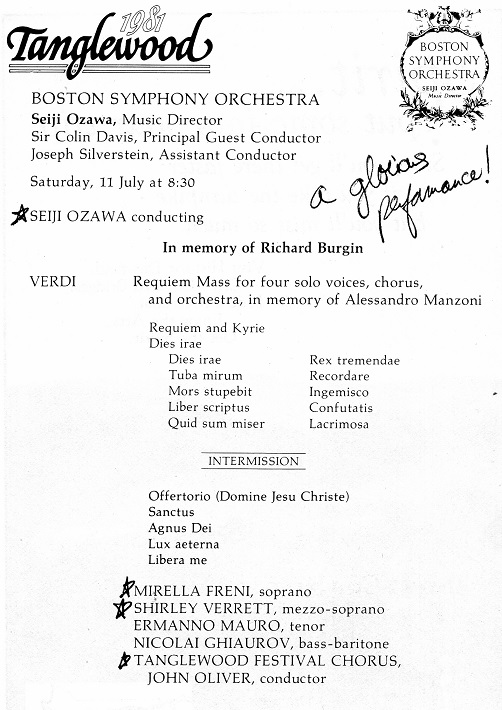
Here’s what I wrote in my opera diary the day after the performance:
“A spectacular night at Tanglewood – one of the most thrilling performances of anything I have ever attended. Everything clicked: even the weather was perfect. Orchestra, chorus, and soloists all threw themselves into the music with passion, making this dramatic and beautiful score come to vibrant life.
The day was magnificent, wandering about the lawns with me dear friend Richard. We met up with Andrew and Father Rick, who had driven over from Boston. They’d brought a picnic (this, following a great lunch at Miss Ruby’s). As the bright sky began to fade to evening and the huge crowd moved into the Shed, a great sense of excitement welled up.
Mirella Freni led the soloists on; and then, as the first whispered notes of the music stole through theatre, a palpable hush settled over the crowd, which remained transfixed until the final note faded away and an an enormous ovation was unleashed.
Seiji Ozawa gave a masterful rendering of the score; there were no attempts to make the REQUIEM anything but what it is: a sacred opera. With his luminous orchestra and splendidly fervent chorus responding in the most astute and passionate way to the Maestro’s every command, Ozawa summoned forth all the blood and thunder – and the spine-tingling subtleties – that make this work such a treasure. With the chorus and orchestra providing a glorious tapestry of sound, the four wonderful vocal soloists poured forth their heavenly melodies with true splendour.
Basso Nicolai Ghiaurov ‘s voice may have lost a bit of its plush over the years, but his is still very much a voice to be reckoned with. His upper notes were a bit effortful in places; set against his authority and deep commitment, it didn’t matter much. Time and again he brought the bass line to the fore. A most impressive performance!
Ermanno Mauro sang in a straight-forward manner for the most part; his full-throated, warmly Italianate sound was always a pleasure. When Ozawa was able to coax the tenor into a more refined phrase or note, the result was lovely. Mauro’s singing was less “precious” than we sometimes hear in this music, and was well in keeping with Ozawa’s largely extroverted feel for the music. Not only in his solos but also in his blendings with his colleagues, the tenor made an excellent impression.
Shirley Verrett gave a spell-binding interpretation of the mezzo role, which combined flawless vocalism with the trademark Verrett flame. From the moment this gorgeous woman opened her mouth, she seized upon the imagination, bringing forth her ringing top notes, rich and smouldering chest voice, and her great gift for dynamic control; and underneath every phrase, the fire was burning. Watching her sing is as thrilling as hearing the sound she produces: the intensity and passion of this woman is thrilling beyond words.
Verrett’s “Liber scriptus” was glorious, and her duets with Mirella Freni were extraordinary musical experiences. She launched the “Lux aeterna” with special warmth and beauty of tone, and – like Ghiaurov – she was able to highlight her musical lines in the ensembles. Shirley Verrett remains one of the most exciting singers of our time. Watching and listening to her tonight, with everything in gear and the fire at the blazing point, it’s hard to imagine anything more thrilling. Bravissima!!
It had been twelve years since I last heard Mirella Freni live, and as she led the soloists out this evening, I simply fell in love with her. Time has been more than kind to her, not only vocally but physically: what a tremendously appealing woman she is – so utterly feminine, and having a simple air of dignity that is captivating.
Freni has ventured far from her Susannas and Juliets, and the voice has held up superbly – now a plusher sound, and with a more intense delivery than in her younger days. She gave a performance of great assurance, tonal enchantment, commitment, and poignancy. With the pearly tone, the expressive use of chest notes without pressure, and the urgency of diction and expression at moments of drama, she rendered the music with true authority. And over all she shed her luminous personal beauty.
Freni showed that she can beam in on those uncanny high piani, demonstrating awesome control. She brought all her gifts to bear in her singing of great “Libera me“, culminating on a suspended B-flat of celestial radiance. The soprano’s passion in the final glorious passages as she soared over the chorus and orchestra was something to hear…and to see. And then, the final hushed plea: “Libera me…” brought the work to a touching close.
Now commenced an ovation of epic proportions. Symphony audiences can be rather staid in showing their appreciation after a concert, but here we had a genuine ‘operatic’ response. Freni, now beaming like an angel on Easter Sunday, led the soloists out; Verrett, more austere but breath-takingly beautiful, stood beside the soprano as fervent cries of brava! rang out. The contrasting physical appeal of Freni and Verrett was fascinating to behold, and I would give anything to have a photo of the two of them during these emotionally super-charged moments. The singers and Maestro were called out repeatedly, the chorus and orchestra reaping deafening roars of cheers whenever they rose to bow.
With the stage filled with such remarkable musicians, the audience seemed reluctant to let them go. What a gift, to create such sheer beauty…it gave me the chills. An evening I’ll never forget!”
 Oberon's Glade