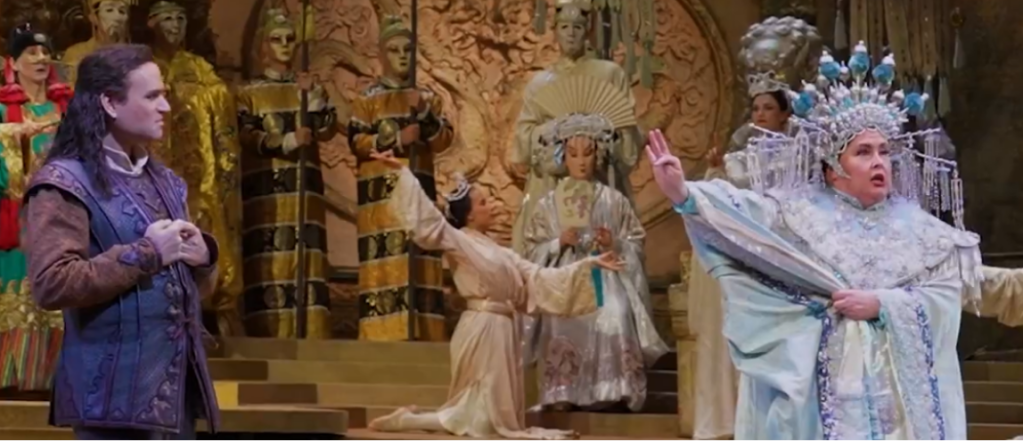
Saturday September 27th matinee – Kicking off my 2025-2026 season with one of my favorite operas: TURANDOT. The Met’s Franco Zeffirelli production – which premiered in 1987 – has paid for itself many times over, and inevitably plays to large audiences, no matter who is in the cast.

This season, two popular Met personalities – Angela Meade and Michael Fabiano (above) – were singing Turandot and Calaf for the first time in the House. South African soprano Masabane Cecilia Rangwanasha – the 2021 winner of the Song Prize at the Cardiff Singer of the World Competition – had made her Met debut earlier in the week at the season prima as Liu, and Ukraine-born basso de luxe Vitalij Kowaljow, anchored the cast with his superb Timur.
Off-setting this very promising cast was the conductor, Carlo Rizzi, who followed the current Met trend of fast-and -loud playing from the pit. This produced a surface excitement, but caused the singers to resort to forcing at several key moments.
Vocally, the opera got off to a great start with bass-baritone Le Bu giving a grand rendering of the Mandarin’s opening pronouncements. This singer is so impressive, and there are so many roles I’d love to hear him sing at The Met. The Mandarin has more to sing in Act II, but this is a voice ready for bigger things.

(I’ve admired Le Bu every time I have heard him. Today, I got to meet him and get his autograph.)
In quick succession, we hear Ms. Rangwanasha, Mr. Fabiano, and Mr. Kowaljow: all in fine voice. The soprano gets a gift from Puccini very early on: the famed, floated B-flat on “Perché un dì, nella Reggia, mi hai sorriso!” which was magically sustained.
The chorus has much to do in this act, and “O taciturna” was finely sung, with lovely roulades from the clarinet. Mr. Fabiano brought forth tender softness with his “O meraviglia“upon beholding Turandot for the first time. The trio of ministers – baritone Hansung Yoo, and tenors Tony Stevenson, and Rodell Rosel – now set out to deter Calaf from attempting Turandot’s riddle game.
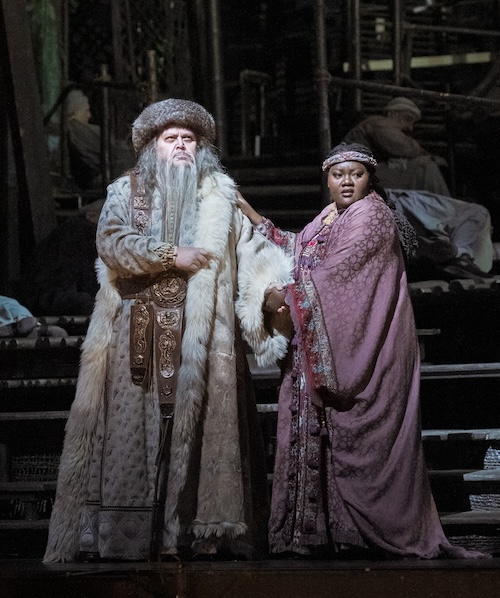
Above: Vitalji Kowaljov and Masabene Cecilia Rangwanasha as Timur and Liu; a Ken Howard/MET Opera photo
Mr. Kowaljov pleaded movingly with his son, and Ms. Rangwanasha sang a gorgeous “Signore, ascolta“, her tone so appealing, her hushed, sustained B-flat at the end delectable. In response, Mr. Fabiano sings marvelously in “Non piangere, Liu“, though the conductor would later press the tenor as the act moves to its finish. There was hearty applause as the curtain came down, but it had stopped before the bow lights came on; nonetheless, the singers came out…and were warmly cheered. I love the old tradition of watching the bows against the great gold curtain…a tradition that has all but died.
The interminable intermission seemed longer than ever today.
Then the scene of the three ministers was especially delightful today: a highlight of the show, really. How wonderful to find another distinguished baritone, Hansung Yoo, today. His “Ho una casa nel Honan” was so beautifully sung, with fine phrasing and dynamic nuance. Rizzi’s orchestra was again encroaching on the voices here and there, but the baritone and his tenor colleagues (Mssrs. Stevenson and Rodell) really made the scene thoroughly enjoyable.
We move to the grand hall of the imperial palace; after Le Bu’s impressive reprise of his announcement, Thomas Capobiano makes a voicey Emperor…his exchange with Mr. Fabiano was handsomely sung by both. And now, Ms. Meade takes center stage for “In questa reggia” where her vibrant tone – mixing in subtleties and dips into chest voice along the way, plus blazing tops – made a vivid impression, though again Rizzi was a detriment at times.
There was not enough tension in the Riddle Scene, but both soprano and tenor sang very well. Clarinet interjections during the second riddle were superbly etched in. Ms. Meade’s third riddle was chesty and word-conscious, lots of satiny tone…though spoilt by a cell-phone going off. The tenor was tested by the high-C at “..ardente d’amore!” but he held on. Moments later, Mr. Fabiano gave some of his most ravishing singing of the evening with “Il mio nome non sai...”
During the interval, two young ladies – one from Spain and one from Munich – stopped by for a chat, their melodious speaking voices were so charming. Then a Japanese gentleman with snow-white hair came to my desk and asked me if I thought the orchestra was too loud. Yes, sir! That problem is my pet Met peeve nowadays.
Puccini, the master-composer who always turns purely orchestral passages into sonic wonders, gives us the atmospheric prelude to the third act. Mr. Fabiano began “Nessun dorma” perfectly, but the conductor then allowed the orchestra to compete with rather than support the singer. Fab made a noble effort, with his lyrical tapering of tone at “…la luce splendira…” truly gorgeous. The aria’s thrilling conclusion won the tenor a big ovation, but it took a lot of will power to achieve.
Hangsun Yoo had more memorable passages as he tries to plead with Calaf to “take the money” and run. The baritone’s “Straniero, tu non sai...” and then his “Principessa divina...” (to mollify Turandot) were outstandingly sung.
In preparing to face torture, Ms. Rangwanasha as Liu displayed a rich lower range at “…ma chiudetemi la bocca...”; moments later, she was spinning some heavenly high phrases as she addressed Turandot directly. In Liu’s final sacrifice – with her strikingly sung “Tu che di gel sei cinta...” – the soprano sealed her triumph.
Cruelly told by Ping that Liu has died, Vitalij Kowaljow’s initial powerful outburst turns to a poignant lament, so tenderly sung. Bravo, Vitalij!
The brass are already going at it as Mr. Fabiano blasts Ms. Meade’s Turandot for her heartlessness. They exchange powerful phrases and then, with great crushing chords, Calaf kisses the princess. The music calms, Ms. Meade singing so beautifully in “Del primo piano” (with lovely support from the orchestra) before blazing away for a bit before telling Calaf to leave with the mystery of his name intact. The tenor’s cry of “Io son Calaf!” was nearly covered by the trumpets. For a moment, the singers compete with high, urgent phrases, and then depart for the throne room.
There, standing before her father, Turandot says she has learned the stranger’s name: “It is love!“.
One of the great delights of opera-going is discovering a “new” voice. Today I was hearing the Korean baritone Hansung Yoo for the first time. This is a singer whose vocal gifts immediately made a deep impression on me. On returning home, I went in search of him on YouTube and found this beautiful rendering of Strauss’s “Allerseelen“. For me, this is a voice that comes from the heart.
~ Oberon
 Oberon's Glade