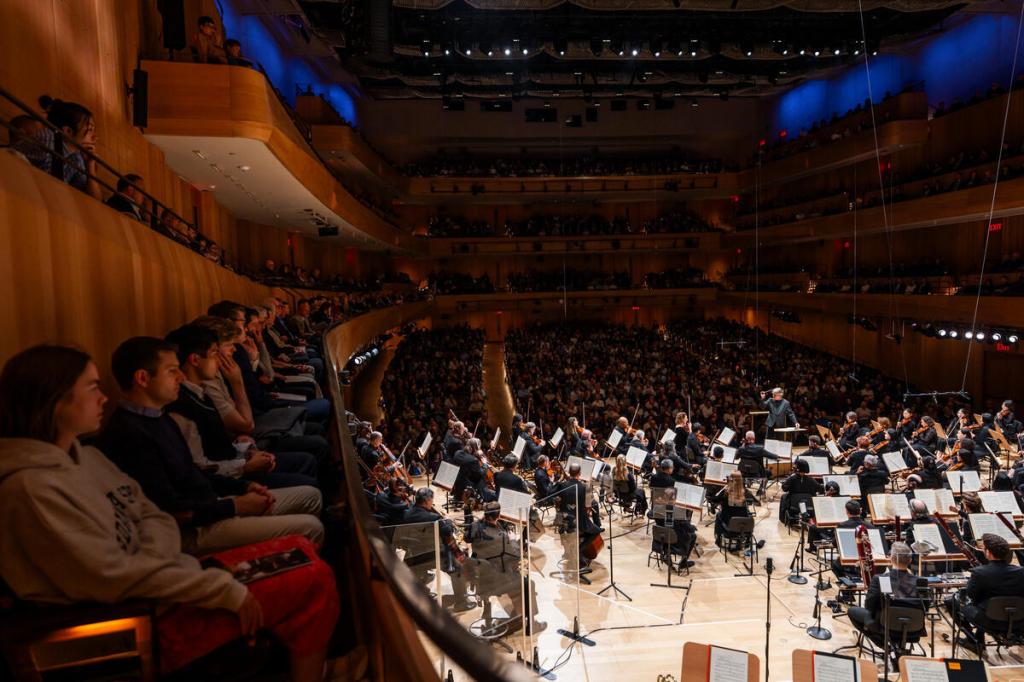
~ Author: Mark Anthony Martinez II; performance photos by Chris Lee
Saturday October 4th, 2025 – The New York Philharmonic had a fascinating program of Boulez and Debussy pieces for this all-French concert. It was a beautiful early Fall night, and I was coming with two friends to see the show. I looked at the program before the concert and realized that I had only heard La Mer, and all of the other pieces were totally new to me.
I love French music for its unique tonal world. The impressionists like Debussy, in particular, encapsulate that flowy, ethereal quality that is the sonic equivalent of paintings by Monet and the other visual impressionists.
It was an almost perfect early Autumn evening, still warm but not hot. When entering David Geffen Hall, there was a buzz from all of the people already there. We came close to the start of the concert, so we quickly went to our seats.
Esa-Pekka Salonen was guest conducting the New York Philharmonic, and I was excited to see his handling of the orchestra. He had just recently finished a tenure as the principal conductor of the San Francisco Symphony.
The lights dimmed, and then a single spotlight shone on the piano in the back of the orchestra. I thought this was odd and was a bit perplexed as to what was going to happen. I was also confused by the placement of the piano. I thought, if the piano was so important as to warrant a spotlight, then it should surely be placed closer to center stage. The lit-up piano played the first Boulez piece, Notation IV, Rhythmique (for solo piano). It was certainly a more modern-sounding piece (even though it was written in 1945). Boulez was a composer in the twelve-tone school of composition. The most famous of those composers was Schoenberg, and you could definitely hear some echoes of Schoenberg in Boulez.

Above: Maestro Salonen with Pierre-Laurent Aimard at the piano; photo by Chris Lee
After the piano had finished, the spotlight disappeared, and the orchestra erupted into the full orchestral version of the same piece. It was a fascinating treat to see truly a fragment, or dare I say, a notation, become fully realized as an orchestral piece. Boulez wrote the orchestral version of his Notations starting in 1978, with revisions going up until 1987. The orchestral version definitely sounded more complete and somehow more full of menace. The orchestral version, in particular, sounded like something that would be in an early black-and-white film or perhaps a modern horror movie.
And full of more surprises, the orchestra seamlessly moved into Debussy’s Gigues from Images for Orchestra. There was no applause break; the musicians simply charged on into a completely different tonal world. What was so interesting was how traditional the Debussy felt in comparison to the Boulez, which is particularly funny because Debussy truly was very avant-garde when his music first came out.
Gigue (which is a type of dance) had a lovely lilting quality, very reminiscent of Rimsky-Korsakov’s Scheherazade in parts. I loved the orchestra’s handling of the piece as it swayed and danced its way to completion.
Even though Boulez and Debussy’s pieces were written decades apart, in some ways, I could hear the connection between the two pieces back to back. The Debussy had some moments that came out of nowhere, that sounded almost jarring. It was almost as if Boulez took those jarring moments and made an entire piece out of them.
The orchestra masterfully played the pieces, even though they were so different in nature. Salonen was certainly a very dramatic conductor, with big swooping gestures and cutoffs. As a musician, I think I might have a difficult time following, but the Phil were perfect in how they executed the music.
The next set of pieces was once again kicked off by solo piano, with the spotlight shining on it. The piece Notation VII, Hiératique was far more contemplative and minimal than the first piece. When it got to the orchestral version, instead of a wall of sound, the music was much more subtle at first. The strings jumped in at times with violent fervor, then went back to the calmer nature. As the piece progressed, the more maniacal-sounding sforzandos took over, and the piece became more and more sinister. This one, in particular, reminded me a great deal of The Rite of Spring by Stravinsky in some ways.
The piece ended and directly led into Rondes de printemps by Debussy. What was striking was how similar the beginning of the Debussy sounded to the just-finished Boulez. The pieces were exquisitely paired, sort of like wine and chocolate (though the Boulez felt more like taking a shot than drinking wine). The Debussy reminded me a bit of his Afternoon of a Faun. It had a pastoral sense to it as the music romped around.
After the springtime ushered in by Debussy faded away, the final piece of the first half of the concert commenced stridently. The piece, Notation II, Très vif (which means “very lively”), really went all out with the entire orchestra. Everyone was playing in what sounded sort of like a train almost coming off its tracks. Then the piece ended as abruptly as it started.
Everyone took well-deserved bows, and when Salonen came back, he made a cute gesture to the percussion section, as if he were playing percussion himself, and they stood up and took bows.
The intermission felt short, perhaps because the weather outside was so nice as I went onto the balcony with my friends. When we came back, a piano was set center stage for another piece I had never heard before. The latter half of the concert was Debussy only. The piece that started the second half was Fantaisie for Piano and Orchestra.
The pianist, Pierre-Laurent Aimard, wore a full black outfit and walked up to the piano, shook Salonen’s hand, then sat down at his instrument.
This piece was the closest thing to a concerto that Debussy wrote. It was very much a showpiece, in line with a lot of similar concertos written in that era. It sounded a lot like Rachmaninoff’s piano concertos in some regards, but the entire piece sounded very much like Debussy.
It was interesting to hear Debussy writing for a virtuoso performer because I feel like his music (though difficult to play) was normally never intended to be showy like that of some of his other contemporaries.
The music was truly some of the most sublime I’d heard in a while. I used to be a pianist myself, so it is always great to hear some fantastic piano playing. The Fantaisie was very playful and again reminded me of his other orchestral pieces like his Faun. The first movement had the piano gliding up and down the keyboard, fluttering along almost. The piano’s light touch actually reminded me a lot of Saint-Saëns’s piano concertos, the effortless scales and arpeggios that made the piano almost sound like a harp. The two composers were said to have hated each other in real life, so I’m not sure if Debussy willingly took influence or if it was something just in the French musical world at the time.
The music was gorgeous but did have one downside. Debussy really lives in his own soundscape in a sense, and he never really leaves it. Unlike more traditional concertos where there is a stark contrast between movements, or even within movements, the Debussy all sounded like the same world, in a sense.
The piece ended in a flurry of notes from the piano and a rounding fanfare of brass rather beautifully. Aimard took three curtain calls, and some people in the audience expected to hear an encore, but he just left the stage afterward.

Above: conductor and pianist take a bow; photo by Chris Lee
The concert’s selling point was now ready to unfold, and the orchestra readied itself to play La Mer. The symphonic suite, for being so beloved now, was not well received when it first premiered. The piece was broken down into three movements: From Dawn till Noon on the Sea, The Play of the Waves, and Dialogue of the Wind and the Sea.
The piece opened with what sounded like a rising sun over a gently moving sea. Debussy really is a master of tone painting because every second of the piece conveyed how the sea moves and evolves throughout the day.
Part of the reason why people attribute La Mer’s initial lukewarm reception was because it was not played well. As such, one reason why it was possible to hear all the rippling of the waves is because the New York Philharmonic and Salonen brought out the beauty Debussy dreamed up.
The second movement picked up the pace, not so much in tempo, but in terms of what was happening in the music. There was a lot going on, and Salonen conducted the different complex changes in rhythm with great fervor. I was trying to figure out what the time signature was, but it looked complicated nonetheless.
The last movement of the piece settled down a bit compared to the second movement. The music had a more conversational tone as it slowly built up to the climax. Toward the end of the piece, you could hear the cascading water crashing as the orchestra finished with its final grand eruption.
~ Mark Anthony Martinez II
(Performance photos by Chris Lee, courtesy of the NY Philharmonic)
 Oberon's Glade