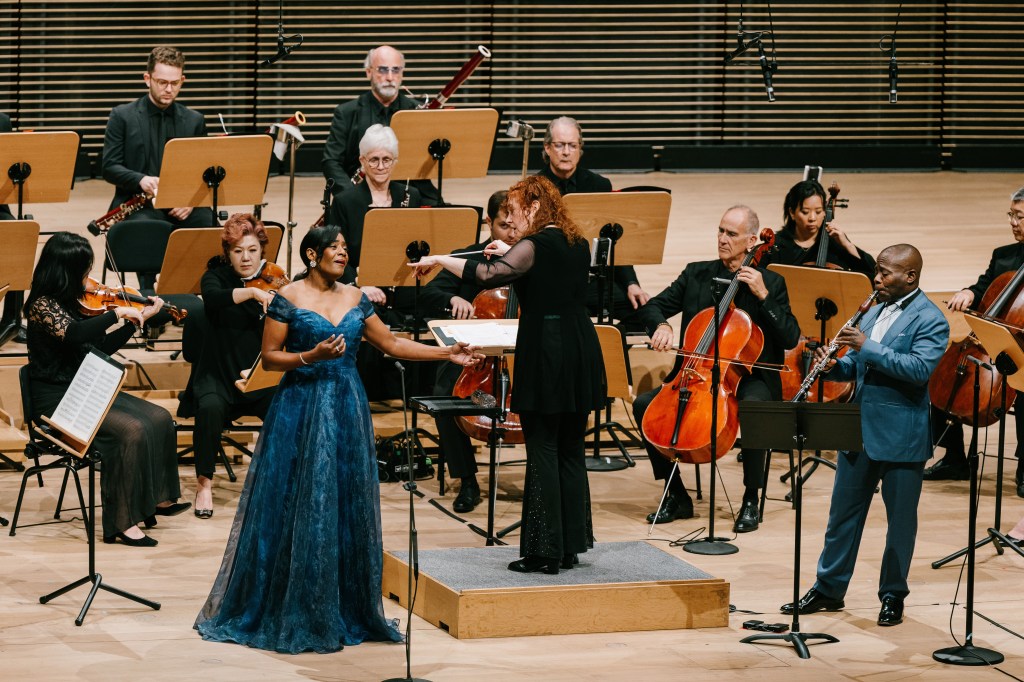
Above: Jeannette Sorrell on the podium, with the evening’s soloists Sonya Headlam and Anthony McGill. Photo by Fadi Kheir.
~ Author: Lane Raffaldini Rubin
Thursday October 16th, 2025 – This week the New York Philharmonic took a detour from its regular programming of large-scale Romantic and Modernist works to present a selection of eighteenth-century music.
Jeannette Sorrell led the Philharmonic in works of Wolfgang Amadeus Mozart and the perennially under-programmed Joseph Bologne, Chevalier de Saint-Georges. Bologne has often been referred to as “the Black Mozart”, a term now thankfully retired. In fact, given the historical circumstances, one must wonder whether Mozart was really the “white Bologne”.
Bologne, eleven years Mozart’s senior, was brought as a boy from the French colony of Guadeloupe to Paris, where he dazzled the élite and became a sort of living legend. None other than the would-be American president John Adams reported hearing King Louis XVI describe Bologne as “the most accomplished Man in Europe in Riding, Shooting, Fencing, dancing, [and] Music.” As a musician Bologne was specifically known as a virtuoso violinist, an innovative composer of concertos for that instrument, and a skilled director of instrumental ensembles and opera companies across Paris.
But entrenched racism kept Bologne from accomplishing all that he was capable of. When Marie Antoinette advocated for Bologne’s appointment as director of the Paris Opéra, leading ladies in the company claimed that they could not take direction from a man such as Bologne.
In certain ways, Mozart followed the path laid by Bologne to become a European musical sensation, favorite of royals and socialites alike. Sorrell, leader of the Cleveland-based baroque ensemble Apollo’s Fire, assembled a program that featured examples of Bologne’s writing for violin and opera and was bookended by one of Mozart’s earliest works and one of his most mature late works.
The program opened with the three-part overture to Mozart’s opera La finta semplice, written in 1768 at the encouragement of Emperor Joseph II when Mozart was all of twelve years old. One can’t help but wonder how much help Wolfgang received from his father Leopold in the composition of his earliest works, but Wolfgang’s nascent style does shine through. This is particularly true in the rhythmic motor and curved figuration of phrases passed between high and low strings. The Italianate third section of the overture features a snappy language that breaks from the conservatism of the first two sections. Sorrell and the Philharmonic, with an appropriately sized string ensemble, played this music with elasticity, transparency, and continuous directionality of phrasing.
Soprano Sonya Headlam, a frequent collaborator of Sorrell’s, joined the Philharmonic in the recitative Enfin une foule importune and aria Amour, devient moi propice from Bologne’s 1780 opera L’Amant anonyme. After hearing the youthful Mozart, Bologne’s music was striking in its stormy palette of timbres. The accompanied recitative was actively orchestrated and full of alluring minor-key rumblings, bringing to mind the seria style of Gluck. The orchestra had much more interesting music than the soprano, unfortunately, whose material unfolded unremarkably above this accompaniment.
Anthony McGill, the Philharmonic’s principal clarinet, joined the orchestra as the soloist in Bologne’s Violin Concerto No. 2 in an arrangement for clarinet by Derek Bermel. McGill approached the concerto’s lyrical solo passages with characteristically sweet, placid tone. He assuredly tossed off many of the fast movements’ bravura passages that feature what were string crossings in the original version for violin. A cadenza that comes relatively early in the movement was hushed and pastoral, presaging the beautiful long melodic lines of the second movement. Sorrell kept the Philharmonic very well balanced through brilliant and lyrical passages alike. By the end of the third movement, McGill’s playing and Bermel’s arrangement convinced me that this concerto was perfectly suited for the clarinet.
(A point of personal privilege: on the same evening that McGill played Bermel’s version of Bologne’s concerto, the South Dakota Symphony Orchestra, my old ensemble, and the Lakota group The Creekside Singers were performing a piece it had commissioned from Bermel and Emmanuel Black Bear.)
McGill and Headlam joined forces in the scena Parto, parto, ma tu ben mio from Mozart’s opera La clemenza di Tito. Headlam’s full-throated instrument came in striking contrast to McGill’s vibrato-less clear voice. In moments of musical dialogue between the soprano and clarinet Headlam noticeably sweetened up her sound, which was most beautiful in the lower tessitura of the vast pitch range required of her in this music.
Mozart’s Symphony No. 40, which rounded out the program, served as an ideal avatar for some of the evening’s big questions: Why bring a baroque bandleader—an outsider to the symphony circuit—to conduct the Philharmonic? Can an ensemble like the Philharmonic engage in the traditions of historically informed performance?
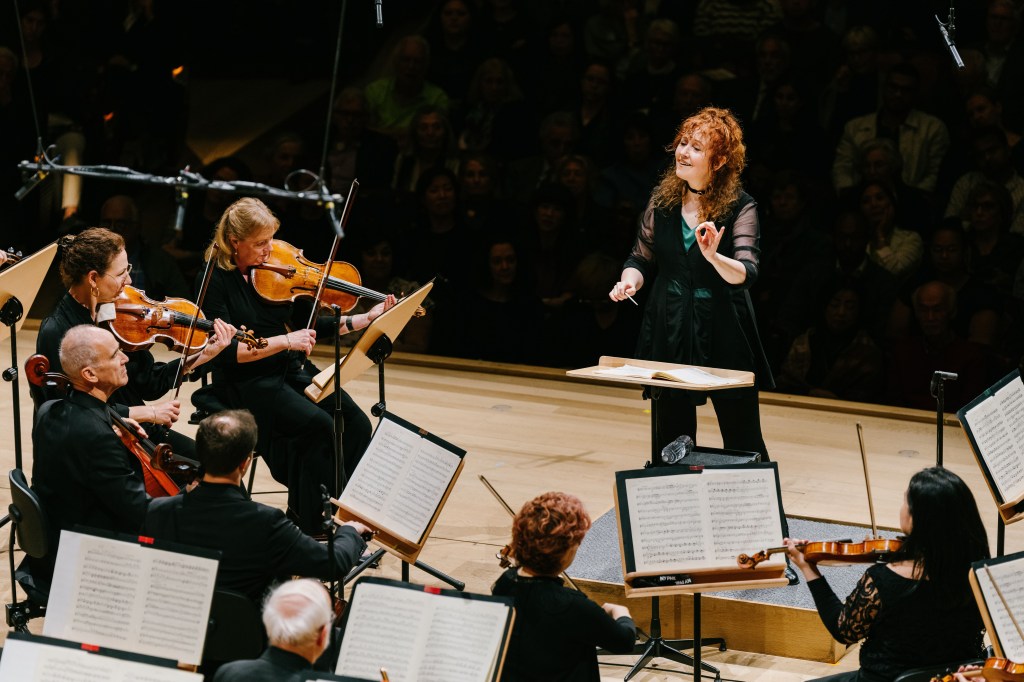
Above: Jeannette Sorrell; photo by Fadi Kheir
Sorrell’s reading of the first movement infused electricity into each melodic figure, with perfectly tapered phrases and an abundance of character in the bass lines. Elegant appoggiaturas are tossed between the violins and winds in the second movement, taken tonight with a lovely quick tempo. And the fourth movement, played with restraint, continues this dedication to the shapes of phrases, even as they speed quickly by.
Sorrell may be more of a bandleader than a symphonic conductor, but there wasn’t a moment all evening that she did not have firm control of the ensemble’s tempo, shape, or timbre. She shepherded the group in what could only be considered sensible techniques of historical performance (minimal vibrato, decaying long bow strokes, transparency of sound, fleet tempos), without veering either into a mannered, academic treatment in one direction or an over-styled, exaggerated spiciness in the other.
This is what the New York Philharmonic should sound like playing Mozart, or Bologne, or any music from before 1800.
~ Lane Raffaldini Rubin
Performance photos by Fadi Kheir, courtesy of the New York Philharmonic.
 Oberon's Glade