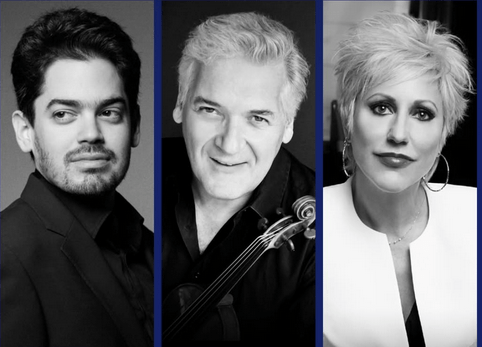
Above: Lahav Shani, Pinchas Zukerman, and Amanda Forsyth
Friday October 17th, 2025 – Guest artists (and married duo) Pinchas Zukerman and Amanda Forsyth joined musicians from the Israeli Philharmonic Chamber Ensemble at Zankel Hall tonight for a concert which featured two of my favorite chamber works – the Mendelssohn Piano Trio #1 and the Shostakovich Piano Quintet. Each half of the program commenced with music by Paul Ben-Haim.
Lahav Shani, director of the Israeli Philharmonic, was the pianist of the evening…and what a pianist! His playing throughout the evening was nothing short of spectacular.
The concert commenced with Ben-Haim’s Berceuse Sfaradite. As he walked out onto the Zankel Hall stage, Mr. Zukerman was greeted with prolonged, affectionate applause. This beloved artist, now 77 (my age exactly!) played the Ben-Haim Berceuse (a transcription of a vocal song) so sweetly and tenderly, gorgeously accompanied by Mr. Shani. As the music faded sublimely into its ethereal finish, the audience burst into vibrant, sustained applause – and wouldn’t stop until Mr. Z came out for a bow.
Mendelssohn’s Piano Trio No. 1 was the work that first drew me into the world of chamber music. Decades ago, whilst living in Hartford, I’d tuned in early for a Metropolitan Opera Saturday radio broadcast. The local station played the Mendelssohn as a ‘prelude’ to the Met performance. For some reason, I flipped on my cassette recorder and taped the trio. I was captivated by the music; I hadn’t even jotted down the names of the musicians, but I played the tape often in the ensuing years; I still have it…though it no longer plays.
Tonight was only my second hearing of the 1st trio played live: nowadays it seems that it’s the 2nd piano trio of Mendelsohn that is most often heard in concerts. For me, the first trio far outshines the second with its flow of melody, enticing harmonies, and persuasive mood swings; it is music so familiar and so evocative for me.
The opening movement introduces us to Ms. Forsyth’s rich cello tone; she sets forth the signature main theme of the Molto allegro agitato, a melody I find heart-rendingly beautiful: it strikes right to the soul. Harmonies develop, and there’s a brief, pensive interlude with piano passages. This is followed by a rising passion, as swirling piano motifs lead to the movement’s end.
Mr. Shani’s playing of the introduction to the Andante con moto was so appealing; the strings join but the piano continues to be prominent, sometimes veering into minor mode. A sense of urgency rises…and falls. Mr. Zukeman plays a lovely theme, underpinned by cello staccati. Then, a gently rocking cello rhythm carries us to a quiet end.
Mendelssohn, master of the scherzo, gives us a sprightly one here. Mr. Shani’s playing dazzles, and Mr. Zukerman’s timbre and technique are is irresistible. The trio’s final allegro is full of swings from major to minor and back again. Plucked notes from the cello develop into a plush duet for the two string voices. The piano urges things along, and there’s a slight lull before the build-up to the final passages. The three artists were enthusiastically cheered for their beautiful rendering of this musical treasure. Part of me wanted to leave then, and carry this sweet memory with me. But another piece I love, by Shostakovich, loomed before us.
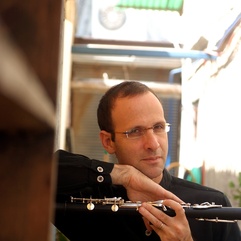
But first, another Ben-Haim work: clarinetist de luxe Ron Selka (above) and Maestro Shani offered a truly engaging performance of Ben-Haim’s Songs without Words for Clarinet and Piano. Like the opening Ben-Haim piece, these songs were first vocalises. The opening Arioso found Mr. Selka taking the long phrases in stride with his amazing breath control and spine-tingling tone. The ensuing Ballad mimics the insistent babbling of a story-teller, whilst the concluding Sephardic Melody is drawn from a traditional folk song. Mssrs. Selka and Shani served up this music to perfection.
Mr. Shani then displayed his abundant technique and deep-felt artistry when he joined the Toscanini Quartet (violinists Yevgenia Pikovsky and Asaf Maoz, violist Dmitri Ratush, and cellist Felix Nemirovsky) for the evening’s closing work: a magnificent rendering of the Shostakovich Piano Quintet.
Composed in 1940 – between the Sixth and Seventh Symphonies – the quintet was an immediate success. It won the then-controversial composer the Stalin Prize in the same year, and was thereafter played frequently by Soviet quartets, often with Shostakovich himself at the piano.
The basic structure of this truly amazing work is as follows:
I. Prelude: Lento: A piano-led prelude that previews the work’s highly emotional tone.
II. Fugue: Adagio: A grand, complex fugue, which builds in tension before fading out.
III. Scherzo: Allegretto: A somewhat frantic movement that contrasts with the more formal opening movements.
IV. Intermezzo: Lento: A lyrical movement that provides a feeling of calm before the finale.
V. Finale: Allegretto: The final movement is upbeat and features various distinctive themes; the ending is whimsical, with the piano having the final say.
As the musicians took their places, I had to decide whether to continue taking notes or to sit back and savour this monumental work without the distraction of trying to find words to describe what is essentially beyond description. So I put my pen away…
A momentary string issue with Ms. Pikovsky’s violin caused a slight disruption, but even this could not deter me from my concentration. How fascinating is every note of this score (and most especially its monumental Adagio) and how marvelous was the Toscanini Quartet’s playing of it. Of course, Mr. Shani at the Steinway was at the epicenter of this musical masterpiece: truly an artist of the finest quality. Slight audience distractions could not detract from my deep enjoyment on this glorious music, so perfectly played by this impeccable quintet.
A hearty ovation broke out the moment the last note of the Shostakovich sounded. An encore was demanded, but I couldn’t catch Mr. Shani’s announcement of what the piece was. Appropriately, it brought together the Toscaninis, the pianist, and Mr. Selka’s mellow-toned clarinet for a breezy, romantic piece into which lovely melodies were woven
Thus, an evening which could make us feel – if only for a couple of hours – that all’s well with the world.
~ Oberon
 Oberon's Glade