
Above: Maestro Pichon and the Orchestra of St. Luke’s; photo by Fadi Kheir
Author: Lane Raffaldini Rubin
Thursday November 6th, 2025 – As the OSL strings played the soft opening chords of the Geistlicher Marsch from Beethoven’s König Stephan, members of the Clarion Choir marched toward the stage in slow motion from the wings and the rear of the hall. The enveloping, uncanny feeling of this assembly was heightened when Alex Rosen, in his booming profound bass, recited passages from Walt Whitman’s “Song of Myself”:
Do I contradict myself?
Very well then I contradict myself,
(I am large, I contain multitudes.)
The audience, who came to hear Beethoven’s Symphony No. 9, were confronted head-on (in English) by Beethoven’s and Whitman’s inner questioning: How does the self relate to the collective? How might my ego find its place in the world? These questions remain as vital today as they were for Beethoven’s revolutionary-enlightenment deism and Whitman’s rugged American individualism.
In Whitman’s multitudes we hear a prefiguration of Beethoven’s (andSchiller’s) Millionen (“millions”). But if Millionen merely suggests sheer number, then multitudes shows us the integration of the self and the collective: the multitudes within each of us, the multitudes in which we are each just one voice.
The evening’s program, played without breaks or applause, wove together the march from Beethoven’s König Stephan incidental music, Friedrich Silcher’s Persischer Nachtgesang based on the Allegretto from Beethoven’s Symphony No. 7, selections of Beethoven’s incidental music from the play Leonore Prohaska, and his Symphony No. 9.
Overlaid on an orchestral excerpt from Leonore Prohaska were excerpts from Maya Angelou’s “The Caged Bird”:
The caged bird sings
with a fearful trill
of things unknown
but longed for still
and his tune is heard
on the distant hill
for the caged bird
sings of freedom.
Angelou’s lines do not map as neatly onto Beethoven’s music and philosophy as Whitman’s do, but they evoke a similar struggle of an individual toward a lofty goal, whether it be joy, freedom, or confraternity. And they invoke music—singing, in particular—as a vehicle for this struggle. Leonore Prohaska, a play about a real war orphan who enlisted to defend Prussian freedom against Napoleonic despotism, was a fitting substrate for the recitation of Angelou’s poem of freedom, read in an impressive Scottish brogue by mezzo-soprano Beth Taylor.
This is how Pichon chose to preface Beethoven’s Symphony No. 9: by preemptively reframing our notion of what Schiller’s and Beethoven’s Ode to Joy is really about. By constructing a ground above which Beethoven’s finale might nobly soar.
When Pichon moved seamlessly into the Symphony’s first movement, I came to a new understanding, steeped in all this prefatory music and language, of this sometimes vacuous movement. My understanding came from another near-contemporary of Beethoven, Søren Kierkegaard, who said that “anxiety is the dizziness of freedom.” As the singers resumed their slow-motion procession onto the stage, the Orchestra launched crisply into the first movement’s buzzing and abstract terrain. This music bursts at the seams but never seems to go anywhere. It is not until the Scherzo begins that we find an outlet for this pent-up energy. Pichon and the Orchestra brought out this intensity but could have lent more contrast to the first movement’s few peaks and valleys.
The alternating Scherzo and Trio sections of the second movement illustrate the dual nature of Beethoven’s cosmology. On the one hand, the Scherzo music is a Newtonian clockwork, an ideal machine of intricate contrapuntal parts. The Trio music, on the other hand, takes us outside on one of Beethoven’s sylvan walks. This movement presents both of Beethoven’s paradigms of nature in miniature: one concerning its logical internal structure, the other its sublime, unpredictable, earthly manifestations. The Orchestra occasionally sacrificed clarity for the sake of Beethoven’s fast tempos. The woodwinds and horns struggled to keep up, while the strings grew muddy in more difficult passages.
The third movement inhabits the sublime realm of B-flat major. The violins take up a prayer-like melody (reminiscent of the ascending theme from the slow movement of the Pathétique piano sonata) that gets reworked into ever-more florid variations—as a religious follower might search for more and more effusive ways to profess devotion. The first violins effortlessly tossed off the fast runs of these variations and the clarinet solo near the middle of the movement was an oasis of transparent simplicity. Amidst these high points, the prominent horn solo was disappointingly labored and out of tune.
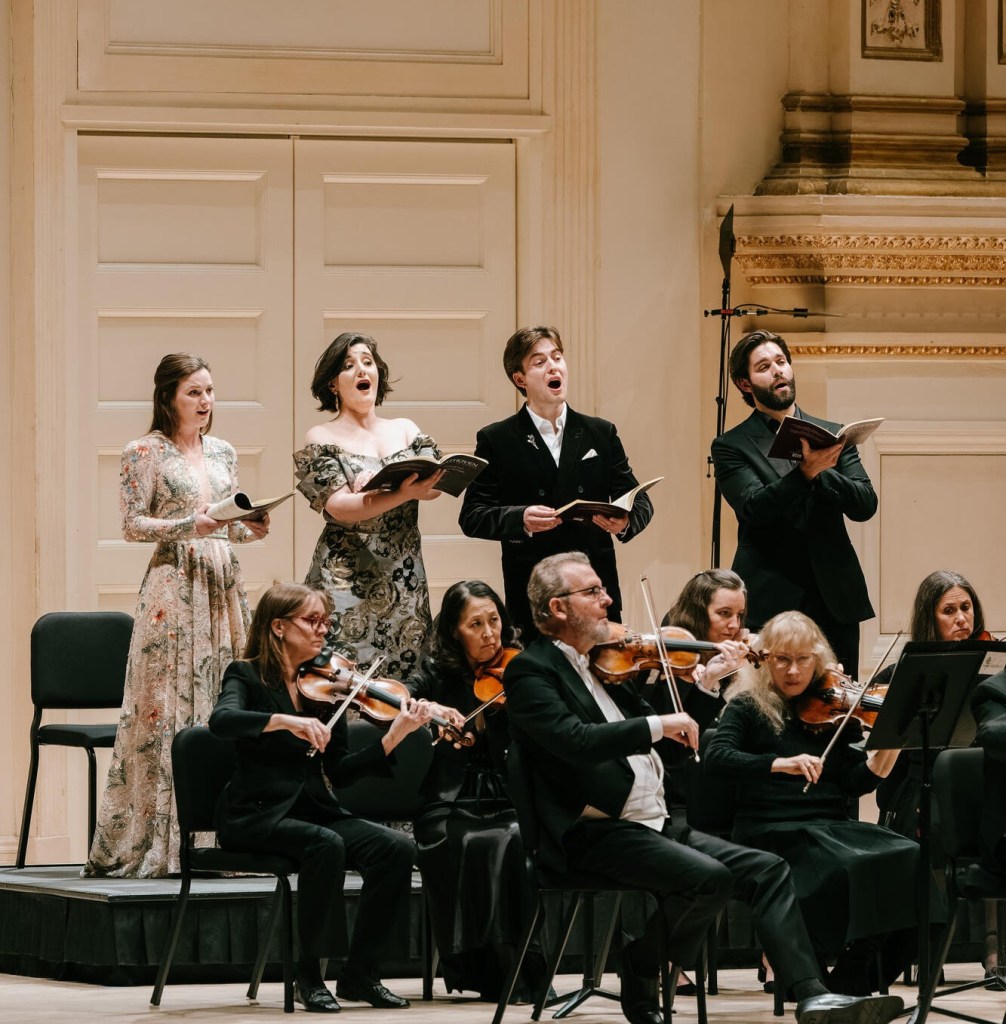
Above, the evening’s vocal soloists: Liv Redpath, Beth Taylor, Laurence Kilsby, and Alex Risen. Photo by Fadi Kheir.
The fourth movement, an entire symphony unto itself, begins by mixing music from each prior movement with cacophonous fanfare and a recitative-style prefiguring in the low strings of the statement later enunciated by the baritone. The low strings were unfortunately ponderous and clumsy, while the themes from the earlier movements all sounded even better in their recapitulations than they did in context. Pichon took an extended pause before the first full statement of the Ode to Joy theme, a shame because it detached this music from the lines that constructed it.
When Alex Rosen stood to deliver “O Freunde, nicht diese Töne! (Oh friends, not these sounds!)”—a moment that never fails to produce frisson—he seemed to embody Whitman, shaking the score in his hands and elbowing his sound into every corner of Beethoven’s line. The chorus and soloists worked through variations on the Ode to gloriously full-throated effect, arriving at a massive and harmonically remote chord. When the fog of that chord clears, Beethoven pieces together a Turkish military march and tops it off with a tenor solo (Froh, wie seine Sonnen fliegen), sung with brassy heroism by Laurence Kilsby.
By this point Beethoven has abandoned the traditional form of the symphony (to say nothing of his use of choral forces and cantata-like text) in favor of the narrative journey of Schiller’s poem. At one moment a chorale suits the narrative best, in others a chant-like recitative, in another an interlude of fugal variations in the strings.
All this music in the service of Beethoven’s existential goal—a brotherhood of man, “Seid umschlungen, Millionen! (Be embraced, ye millions!)”—tonight, however, understood to mean not only confraternity but also freedom and the enactment of oneself.
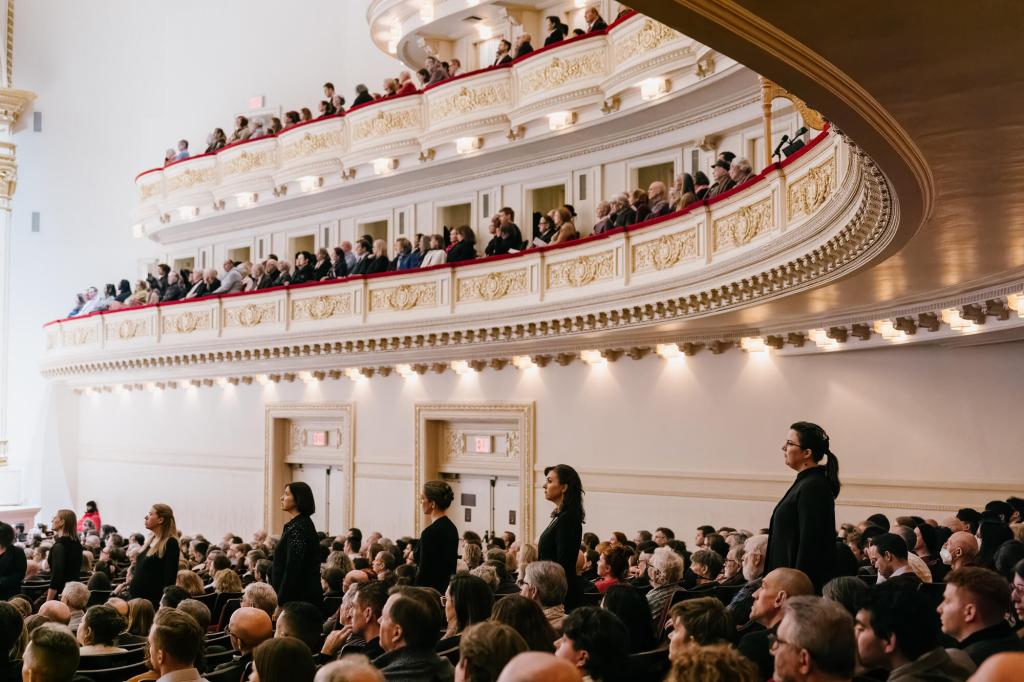
At the coda, some members of the audience stood (photo above by Fadi Kheir), scores in hand, and joined in singing the final verses. It was a gesture that borders on pandering and gimmickry, but it showed the ever-expanding potential for the idea of a universal brotherhood. The Orchestra’s playing did not always rise to meet this lofty aim, but Pichon’s program may have finally given the Symphony No. 9 a full-enough arc to warrant so norm-shattering and monumental a finale as the one that Beethoven gave us.
~ Lane Raffaldini Rubin
Performance photos by Fadi Kheir, courtesy of Carnegie Hall
 Oberon's Glade