~ Author: Oberon
Saturday November 8th, 2025 matinee – LA BOHEME has been with me for a long time. The Act I arias of Rodolfo and Mimi, plus their love duet, were on the first operatic recording I ever owned: a two LP set of arias and duets from operas by Verdi and Puccini that my parents gave me in 1960. The singers were Victoria de los Angeles and Jussi Björling. I later brought the full opera with the same singers, conducted by Sir Thomas Beecham. When LPs became passé, I bought the same complete recording on CDs. It remains the only complete BOHEME in my CD collection, and the voices of de los Angeles and Björling still seem so perfectly suited to the music.
My first hearing of a complete BOHEME live was on a Met broadcast in 1962 with Lucine Amara and Barry Morell. I finally saw the opera onstage for the first time at New York City Opera in 1966 with Anne Elgar and Michele Molese. My first live Met Opera performance of BOHEME took place (in concert form) in Central Park in 1967 with Anna Moffo and Sándor Kónya. And at last, in 1968, I saw Teresa Stratas and Gianni Raimondi singing BOHEME at The Met.
This afternoon, up at my score desk and waiting for the Met matinee to start, these memories flashed thru my mind. Curiously, in the last 60 years, I’ve seen BOHEME less frequently than one might expect. My repertoire has expanded greatly, and my passion is more with Wagner and Strauss than with Puccini and Verdi. Even so, Puccini’s Bohemian rhapsody can still smack me right in the heart, as today’s performance proved.
This matinee of BOHEME was being transmitted live to movie theatres all over the world; for some reason, the show started 15 minutes late. By the time Mimi made her entrance, it was freezing up in the score desk area, and during both of the interminable intermissions, I thought of leaving. But the singers and the orchestra’s playing kept me there as if by force.
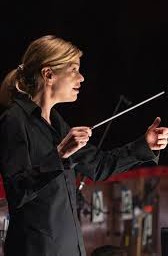
Above: Keri-Lynn Wilson
I frequently complain about Met conductors who rush thru operas and carelessly drown out the voices along the way. I feared as much today, since I was experiencing Keri-Lynn Wilson (aka Mrs. Gelb) for the first time; but she proved me wrong, giving us one of the best and most thoughtfully conceived BOHEMEs I’ve ever heard. Curiously, at the stage door after the show, one fan was whining about her covering of the voices…well, yes: for a few moments she did do that. But compared to the onslaughts of noise some of the Met’s favoured maestros deliver, she was refreshingly supportive of the voices.
Curtain up, and the huge sound of Lucas Meachem’s mavelous baritone immediately seizes our attention. The likewise voicey tenor of Freddie De Tommaso soon chimed in, and a few minutes later, basso Jongmin Park and baritone Sean Michael Plumb rounded out this impressive quartet of Bohemians. Mr. Meachem baited the Met’s go-to Benoit, Donald Maxwell, and after a dismissive, stentorian “Via di qua!” (“Get out of here!”) the roomates were headed out to Cafe Momus. Throughout all of this, Maestro Wilson kept everything lively but under control.

Above, landlord and tenants: Donald Maxwell as Benoit surrounded by the four Bohemians: Sean Michael Plumb, Freddie De Tommaso, Lucas Meachem, and Jongmin Park. Photo by Karen Almond.

Mimi – Juliana Grigoryan (above)- has a ‘big lyric’ voice that sounds so pleasing in the House; she and Mr. De Tommaso will carry us thru their much-beloved arias with engrossing phrasing and melodious detail. The conductor supports the voices perfectly. Mr. De Tommaso’s “Che gelida manina” is generously sung, and Ms. Grigoryan’s way with words makes a touching impression: her “Viva sola, solletta…” beautifully sustained, her “Ma quando vien lo sgelo” gorgeously savourable. The conductor is so attentive to the poetry of the music. As the introductory phrase of the love duet sounds, the voices of the offstage Bohemians chiding Rodolfo seemed more humorous than ever. Soprano and tenor pour forth a flood of sound before their charming banter about whether to leave for Momus or stay in the intimate garret is truly engaging. The soprano’s top-C was not quite perfect, but the tenor harmonized in a most pleasing finale to the act.
After the long pause of re-setting the stage, Maestro Wilson gives the Momus scene a dynamic start; I am loving everything the conductor is doing with this score. In the ensuing conversational phrases among the characters, Mr. Park’s voice stands out. Mr. De Tommaso sings thrillingly in his brief introduction of Mimi to his friends. The jolly “Parpignol” chorus seems fresh in Maestro Keri’s approach to it: the magic’s in the details, such as Mimi’s delight in her new bonnet, and the candid commentary from the Bohemian pals.
Heidi Stober’s Musetta sounds annoying at first, but that’s often the case with this high-strung character, The soprano commences the waltz with enticing intimacy of phrase, becoming more expansive before a big-bang of a high-B at the end. She nails the tops in the ensuing ensemble…Marcello/Meachem leads the waltz-reprise with boundless power…another Stober top-B polishes things off, whilst her besotted beau confides: “Sirena…!“
Maestro Keri (I’m loving her by now!) paints a sonic picture with the opening of Act III…there is delicacy here, as well as a boding of things to come. The harp enchants, and Keri brings out the sound of the clinking wine glasses from inside the tavern – I’d never previously understood what that passage was depicting. Ms. Stober’s nice reprise of the waltz motif brings an end to this little ‘prologue’ to the drama to come…a prologue to which the thoughtful conductor has brought a sense of importance.
Ms. Grigoryan and Mr. Meachem make their duet an essential part of the unfolding drama: she perfectly communicating the desperation of Mimi’s plight, and he a consoling angel. The following exchange of De Tommaso and Meachem is riveting, the tenor powerful at “Invan, invan nascondo…” before the mounting anxiety of “Una terrbile tosse…”
Ms. Grigoryan’s aria of farewell is heart-rendingly expressive; soprano and conductor capture every nuance here, moving me deeply with their sustained, poignant finish. In the ensuing quartet, each character’s emotions are expressed. But the audience’s laughter at the Met Titles’ translation of the Musetta/Marcello exchange blots out Mimi’s infinitely tender “Sempre tua per la vita…”.
Maestro Keri gives us a brisk and loud introduction to Act IV. Mr. DeTommaso opens his nostalgic duet with Mr. Meachem so beautifully; the baritone takes a long, powerful top note at “…una bocca procace“. The duet’s final phrases are superbly sung, and ideally supported by the orchestra.
Sean Michael Plumb stands out in the ensuing scene of the partying Bohemians, making his every note and word count. Musetta’s sudden appearance with the dying Mimi brings all joy to a standstill. The voices of Mimi and Rodolfo briefly unite in a vocal outpouring. Mimi greets her friends by name; sadness abounds. She reminds Macello how good a person Musetta is; the situation brings these two back to the reality of their mutual love.
Jongmin Park’s “Vecchia zimara” – a vocal highlight of the afternoon – was so deeply felt, his timbre and sustained line infinitely touching.
Mimi and Rodolfo are left alone; Ms. Grigoryan’s “Sono andati?” is achingly expressive. Mr. De Tommaso is so ardent in his despair…every moment of his singing comes from the heart. The delicacy of the soprano discovering the bonnet that was Rodolfo’s first love token wipes me out. After Mimi’s hushed final words – such magically spun pianissimi from Ms. Grigoryan – the audience gently applauded…something I’d never experienced before.
And then, suddenly, the opera became a palpable reminder of all my faults and shortcomings as a lover and a friend over the years. There’s no way of undoing what’s been done, and no opportunity to express remorse, or even to apologize: we simply carry these burdens to our graves.
~ Oberon
 Oberon's Glade