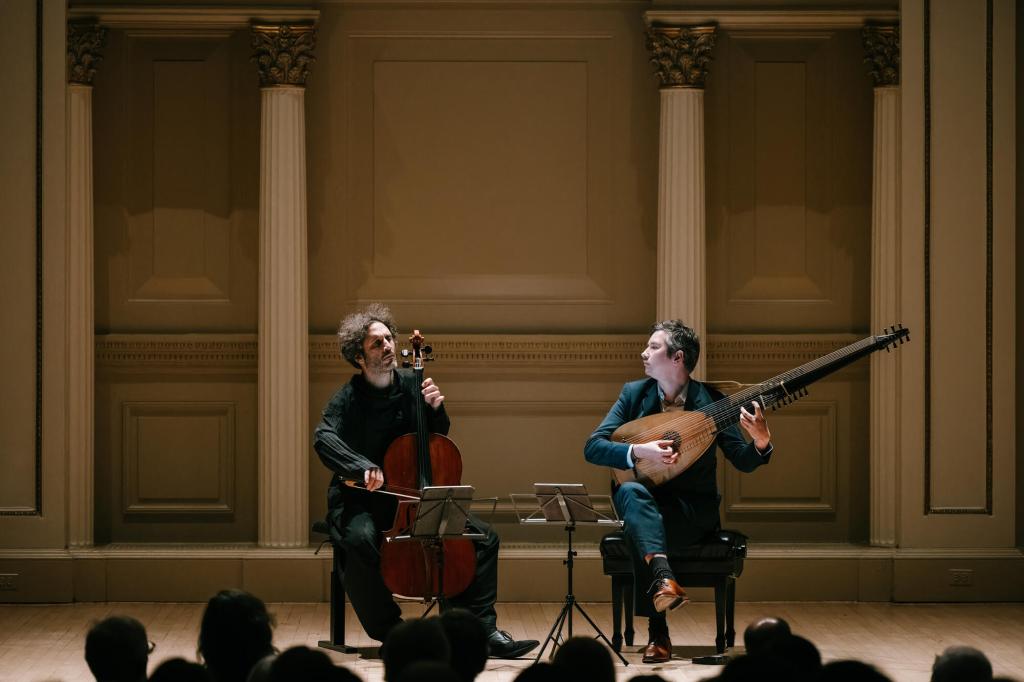
Above: Nicolas Altstaedt and Thomas Dunford; photo by Fadi Kheir
Author: Lane Raffaldini Rubin
Tuesday November 18th and Thursday November 20th, 2025 – This week, Carnegie Hall presented two very distinct baroque programs. The first, on Tuesday, featured cellist Nicholas Altstaedt and lutenist Thomas Dunford in Weill Hall and the second, on Thursday, featured the ensemble L’Arpeggiata in Zankel Hall. Both performances were led by lutenists (Christina Pluhar in the case of L’Arpeggiata) and acted like jam sessions, to differing degrees, where improvisation linked major components of the programs together.
Altstaedt and Dunford presented a loose program centered on Marin Marais and J.S. Bach which also included Arvo Pärt’s Spiegel im Spiegel, winning them inclusion in Carnegie’s ongoing celebratory Pärt series. L’Arpeggiata’s program, titled “Wonder Women” after their 2024 album, was muddied by last-minute changes necessitated by the withdrawal of one of the featured vocalists due to illness. Intending to feature only works by women composers and traditional songs about women, the evening did include several works by men—and all of this was played by the almost exclusively male ensemble.
Tuesday’s program began with Marais’s breezy La rêveuse. Although Marais and Antoine Forqueray (whose music we also heard) played and composed for the viola da gamba (for no less prestigious patrons than the royal court of Versailles), Altstaedt performed these works on the violoncello. The two instruments resemble one another but differ in ways that result in distinct technical abilities and challenges. The viola da gamba’s six strings are tuned at smaller intervals than the cello’s four strings and the former features a much flatter, fretted fingerboard, which makes it well suited to playing chords and using the bow to cross the strings back and forth.
Altstaedt’s playing often hindered the fluidity of Marais’s more melodic pieces as well as some of the rollicking passagework of selections like Forqueray’s La Leclair. Altstaedt, who is not strictly a performer of early music, was not at ease in the gamba music on the program. He became an altogether different musician when he played Bach’s Cello Suite No. 5, however, giving us highly disciplined bowing technique, characterful dance rhythms, and a series of strikingly hushed fast passages.
But Dunford was the evident leader and star of the evening. One got the clear sense that this was his program and Altstaedt was along for the ride. Dunford, who always brings charisma and congeniality to the stage, plays the theorbo with such comfort that the instrument seems merely an extension of his body. Between most pieces on the program, Dunford riffed improvisatory interludes and, at one point, even threw in his transcription of Erik Satie’s Gnossienne No. 1 as a treat. Most notable was his arrangement of Bach’s famed Cello Suite No. 1, which he treated with ripe sweetness, occasional vibrato, and gorgeously froggy tone in the lower register. Dunford’s arrangement made the piece a natural fit for the theorbo, despite its differences from the instrument for which Bach wrote the piece.
Dunford’s transcription of Spiegel im Spiegel suited Pärt’s music just as well, not dressing Pärt in baroque clothing but demonstrating the outside-of-time nature of Pärt’s tintinnabuli compositions. The cello floats above harp-like arpeggios and low drones in the theorbo. The two voices add up to a gorgeously simple lullaby and an exercise in patient listening. This Spiegel im Spiegel is in a way the opposite of Marais’s Couplets de folies (which wrapped up the first half of the program), a set of variations based on the extremely popular Spanish “folia” melody and chord progression which piles on more and more intricacy, technical bravura, and sheer sound as it barrels to its conclusion. Spiegel im Spiegel begins near silence and remains there, giving us only what is necessary to sustain beautiful music.
On Thursday L’Arpeggiata presented a robust setlist of music taken from folk sources, rustic popular traditions, and aristocratic women composers. I call it a setlist because L’Arpeggiata approaches music-making much the way jazz musicians do, with emphasis on improvisation, riffing, sharing solos, expressing feeling over refinement, and not taking oneself too seriously.
The players and singers brought pure joy to the music. Doron Sherwin, on the traditional cornetto, leaned into moments of tone bending and hammed up the melodic lines of a traditional Italian canzona that may as well have been composed by Nino Rota. Tobias Steinberger reveled in extended tambourine solos that entranced the audience. As the evening progressed, the vocalists loosened up and infused their singing with dance steps and intricate series of narrative hand gestures. The male alto Vincenzo Capezzuto’s take on Lo guarracino, a Neapolitan comedic song that tells the story of a small fish in love with a sardine and, according to Pluhar, describes “fish wars” and includes “a hundred verses of fish names in Neapolitan” was funny and impressive. Capezzuto sang with confidence and never stumbled.
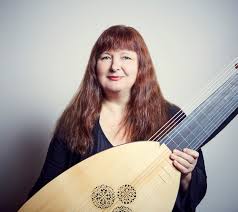
Christina Pluhar (above) has a much more understated stage presence than Dunford but took a moment to shine in Giovanni Girolamo Kapsberger’s “Toccata arpeggiata” from the first book of the Intavolatura di chitarrone (this piece is the source of the ensemble’s name). Kapsberger is the most interesting composer for the theorbo and Pluhar brought out a striking sense of mystery in his music.
The Chilean-Swedish mezzo-soprano Luciana Mancini was a standout, singing with a sultry and viscous tone in very low tessitura and almost exclusively in Spanish. In the traditional Mexican song La bruja, which closed the program, Mancini began with a witchy laugh and offered a gorgeously haunting, gravelly recounting of a sorceress and her conquests and tribulations.
The academic stil moderno songs of Barbara Strozzi and Francesca Caccini—themselves fascinating figures in the man’s world of baroque Florence and Venice—were peppered in as well and offered some beautifully dramatic vocal writing. But the program’s Neapolitan tavern songs and Mexican ballads offered a rare and captivating glimpse into the roots of many idioms that we can still recognize in today’s popular music from around the world.
~ Lane Raffaldini Rubin
 Oberon's Glade